


Generate Accurate Bug Reports With an AI Bug Description Agent
Why repeat the same manual steps every time a test fails? Use an intelligent smart bug description agent to create automated bug descriptions that reflect observed outcomes and supporting evidence. No need to rewrite bug reports from scattered logs and screenshots.


Where Bug Reporting Breaks Down in Modern QA
Failure context is scattered across logs, screenshots, and test steps
Reports vary in quality depending on who writes them
Important details are missed or rewritten inconsistently
Engineering teams spend time clarifying issues instead of fixing them
How the AI Bug Description Agent Interprets Failure Evidence
Test steps and execution sequence
Runtime logs and error traces
Screenshots and visual evidence
Environment, role, and data-state context
Automated Bug Description From Logs and Screenshots
Get concise summaries of what failed, stepwise reproduction context, clear distinction between expected and actual behavior, relevant error messages surfaced from logs, and visual references tied to failure points. This AI agent for automated bug reporting produces descriptions grounded in evidence.
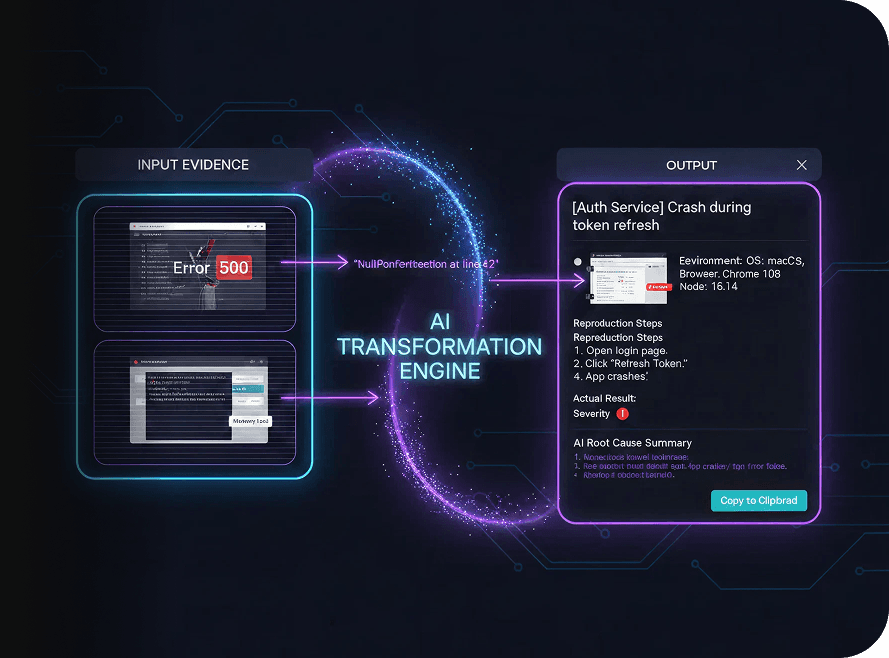

AI Bug Summarization Focused on Communication, Not Diagnosis
The Bug Description Agent does not determine root cause, classify severity or priority, auto-resolve issues, or change test logic or app behavior. It assists you by improving signal quality, but your engineering and QA teams retain full control of investigation, prioritization, and fixes.
Request Free TrialFrequently Asked Questions (FAQs)
What does an AI Bug Description Agent do?

An AI Bug Description Agent converts failure evidence into structured bug reports. It uses AI bug analysis from logs, screenshots, and test steps to create readable summaries that reflect what occurred during a failure.
What does an AI Bug Description Agent do?
An AI Bug Description Agent converts failure evidence into structured bug reports. It uses AI bug analysis from logs, screenshots, and test steps to create readable summaries that reflect what occurred during a failure.
Does automated bug description replace human-written reports?
No. Automated bug description reduces manual effort and improves consistency, but you remain responsible for reviewing and approving each report before it is shared or tracked.
Does automated bug description replace human-written reports?
No. Automated bug description reduces manual effort and improves consistency, but you remain responsible for reviewing and approving each report before it is shared or tracked.
What inputs are used for bug description generation?
Bug description from logs and screenshots is combined with test steps, environment context, and observed outcomes. These inputs allow the agent to produce accurate, evidence-backed summaries.
What inputs are used for bug description generation?
Bug description from logs and screenshots is combined with test steps, environment context, and observed outcomes. These inputs allow the agent to produce accurate, evidence-backed summaries.
Can this AI-based bug description agent work with existing issue trackers?
Yes. The agent generates bug descriptions that can be submitted to existing issue tracking systems, allowing teams to continue using their current workflows.
Can this AI-based bug description agent work with existing issue trackers?
Yes. The agent generates bug descriptions that can be submitted to existing issue tracking systems, allowing teams to continue using their current workflows.