


TestGrid
The Best Testsigma Alternative for Scalable Testing
Move beyond just test creation with TestGrid, a platform that gives you real device access, stable execution environments, and end-to-end testing across web, mobile, and APIs without stitching together multiple tools.
Request Free Trial

How TestGrid Stands Out Among Testsigma Alternatives
40%+ lower testing and infrastructure overhead
50% faster test authoring and maintenance
100+ real devices and browsers available on-demand


Why Choose TestGrid Over Testsigma
Explore features that bring together devices, environments, and workflows with better control over execution and coverage.
Real device testing
Test on real iOS and Android devices on demand, so you can validate real user conditions without maintaining or managing physical labs.
On-prem & hybrid labs
Run tests in private networks, on cloud, or both, giving you control over environments when security and compliance matter.

CoTester support
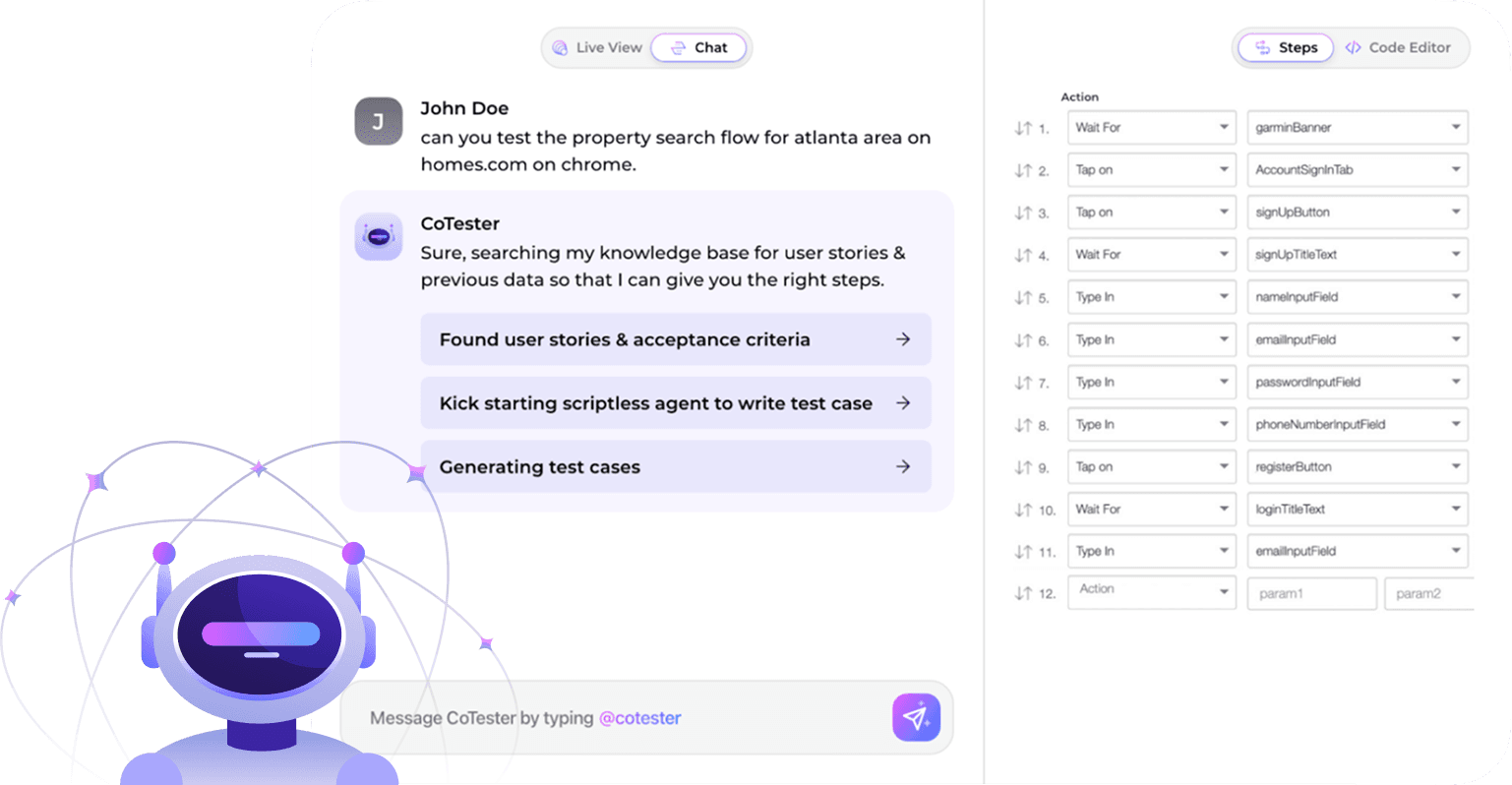
Create and execute test cases faster with AI assistance, helping your team generate and execute test cases in a jiffy.
Performance and load testing
Test how your application behaves under real conditions like network constraints, CPU load, and device limitations before release.
Cross browser testing
Cover major browsers and versions from a single setup, reducing environment switching and improving consistency across web testing efforts.
Automated test maintenance
Reduce effort with self-healing tests that adapt to UI changes automatically, improving long-term test maintenance and stability.
Codeless and IDE test authoring
Build tests in a scriptless interface or write them in code using frameworks like Selenium and Appium, depending on your team’s experience.
CI/CD and DevTools integrations
Connect with Jenkins, GitHub Actions, Azure DevOps, Jira, and TestRail to support continuous test automation within your delivery process.
TestGrid vs Testsigma
The comparison below highlights how both platforms perform across key capabilities, making it clear why TestGrid is a stronger Testsigma alternative for teams with advanced testing requirements.
Remote infrastructure access
| Feature |  |  |
|---|---|---|
| Browser cloud infrastructure (on-prem) | Third-party | Yes |
| Mobile device cloud (on-prem) | Third-party | Yes |
| Private browser cloud | Third-party | Yes |
| Private mobile device cloud | Available via integrations | Yes |
| Virtual USB for iOS and Android devices | No | Yes |
| Device reservation | No | Yes |
| Manual session recording | Yes | Yes |
| Built-in Appium inspector for locators | No | Yes |


Automated test case creation
| Feature | | |
|---|---|---|
| Scriptless test creation for mobile apps | Yes | Yes |
| Scriptless test creation for web apps | Yes | Yes |
| Code export for scriptless tests | Low-code extensibility; export not explicitly defined | Yes |
| Web-based API testing | Yes | Yes |
| Selenium support (web and mobile) | Yes | Yes |
| Appium support (iOS and Android) | Yes | Yes |
| XCUITest support for iOS | Not specified as supported | Yes |
| Parallel execution on real devices | Yes | Yes |
| Test data parameterization | Yes | Yes |
| Assertions across API data and UI | Supported for end-to-end validation | Yes |
| Test case management suite | Yes | Yes |
| AI-assisted test creation | Yes | Yes |
| Automated test maintenance | Yes | Yes |
AI assistance
| Feature | |  (CoTester) (CoTester) |
|---|---|---|
| Generates test cases from natural language | Yes | Yes |
| Learns application context over time | Context-aware via integrations; limited adaptive learning | Yes |
| Auto-maintains test suites when UI changes | Yes | Yes |
| Executes on real devices without external cloud | Runs only on cloud device infrastructure | Yes |
| Works in hybrid and on-prem environments | Yes | Yes |
Performance testing
| Feature | | |
|---|---|---|
| API load testing | Supports API functional testing; no native load testing capabilities | Yes |
| Web performance metrics | No | Yes |
| Mobile performance testing (manual) | Functional testing only; no performance diagnostics | Yes |
| Mobile performance testing (automated) | No | Yes |
| API-level performance metrics | No | Yes |
Functional/Manual testing
| Feature | | |
|---|---|---|
| Functional / manual testing workflows | Yes | Yes |
| Network-level testing | Not specified as supported | Yes |
| Network traffic monitoring | Not specified as supported | Yes |
Reporting
| Feature | | |
|---|---|---|
| Real-time visual reporting | Yes | Yes |
| Centralized test insights | Yes | Yes |
| Email notifications | Yes | Yes |
DevOps and integrations
| Feature | | |
|---|---|---|
| CI/CD plugins (Jenkins, GitLab, GitHub Actions, etc.) | Yes | Yes |
| Project management integrations (Jira, TestRail, Azure DevOps) | Yes | Yes |
Robotic test automation
| Feature | | |
|---|---|---|
| Hardware workflow testing (robotic arms) | No | Yes |
Support
| Feature | | |
|---|---|---|
| Included support | 24×5 support (higher-tier plans) | 24×7 chat, call, and email |
Pricing
| Pricing | | |
|---|---|---|
| Yearly maintenance overhead | Reduced via AI-driven automation and low-code workflows | Lower (up to 30% reduction) |
Trusted by Teams That Found the Best Alternative to Testsigma

“TestGrid Scriptless Automation helped automate all test cases in very less time. I'm amazed to see such features at affordable prices.”
Kartik Natarajan
Executive VP and CTO Compunnel Inc.

“TestGrid has been a game changer for us in the testing process. Especially the Sprint Automation feature for GUI and API has greatly improved the end to end flow of testing.”
Sateesh Surampally
QA Lead

“TestGrid Scriptless Automation changed the way we work. It improved our efficiency and saved alot of time. The support and onboarding given all along the way is amazing.”
Pravin Lakkaraju
CEO and Co founder Bullworks
“TestGrid Scriptless Automation helped automate all test cases in very less time. I'm amazed to see such features at affordable prices.”
Kartik Natarajan
Executive VP and CTO Compunnel Inc.
“TestGrid has been a game changer for us in the testing process. Especially the Sprint Automation feature for GUI and API has greatly improved the end to end flow of testing.”
Sateesh Surampally
QA Lead
“TestGrid Scriptless Automation changed the way we work. It improved our efficiency and saved alot of time. The support and onboarding given all along the way is amazing.”
Pravin Lakkaraju
CEO and Co founder Bullworks
Results Delivered With TestGrid


Upgrade to a Testsigma Alternative That Handles End-to-End Testing
CoTester 
World's first AI agent
for Software Testing
See it in action!Test, Debug, Execute in a snap!
Frequently Asked Questions (FAQs)
Why do teams look for a Testsigma alternative?

Testsigma works well for codeless test automation using natural language processing and AI-driven workflows. But as teams scale, they often need more control over execution, including deeper debugging, performance validation, and support for on-premise deployment. That's why teams usually start exploring Testsigma alternatives.
Why do teams look for a Testsigma alternative?
Testsigma works well for codeless test automation using natural language processing and AI-driven workflows. But as teams scale, they often need more control over execution, including deeper debugging, performance validation, and support for on-premise deployment. That's why teams usually start exploring Testsigma alternatives.
How is TestGrid different from Testsigma?
In a typical Testsigma vs TestGrid comparison, the difference comes down to scope. Testsigma focuses on test creation using AI, generative AI, and low-code workflows. TestGrid covers test creation as well, but adds execution infrastructure. This includes real device testing, browser coverage, performance diagnostics, and support for both cloud testing and on-premise deployment.
How is TestGrid different from Testsigma?
In a typical Testsigma vs TestGrid comparison, the difference comes down to scope. Testsigma focuses on test creation using AI, generative AI, and low-code workflows. TestGrid covers test creation as well, but adds execution infrastructure. This includes real device testing, browser coverage, performance diagnostics, and support for both cloud testing and on-premise deployment.
Does Testsigma support real device testing, and how does TestGrid compare?
Testsigma supports mobile testing through its cloud device grid, which can run tests across a large number of devices in parallel. TestGrid also offers a real device cloud - but with greater control. Teams can reserve devices, run tests in private environments, or set up dedicated device labs.
Does Testsigma support real device testing, and how does TestGrid compare?
Testsigma supports mobile testing through its cloud device grid, which can run tests across a large number of devices in parallel. TestGrid also offers a real device cloud - but with greater control. Teams can reserve devices, run tests in private environments, or set up dedicated device labs.
How does TestGrid handle performance testing compared to Testsigma?
Testsigma focuses on functional automation. It helps validate whether workflows work correctly across browsers and devices. On the other hand, TestGrid helps teams measure API behavior, track response times, and analyze system performance under load. This is one of the main gaps that comes up when comparing alternatives to Testsigma for low-code/no-code testing.
How does TestGrid handle performance testing compared to Testsigma?
Testsigma focuses on functional automation. It helps validate whether workflows work correctly across browsers and devices. On the other hand, TestGrid helps teams measure API behavior, track response times, and analyze system performance under load. This is one of the main gaps that comes up when comparing alternatives to Testsigma for low-code/no-code testing.
What are the differences between Testsigma's AI features and CoTester by TestGrid?
Testsigma uses Artificial Intelligence, Machine Learning, and Generative AI to simplify test creation. It can generate tests from user stories, designs, or recorded flows, and supports Behavior Driven Development through natural language inputs. CoTester by TestGrid generates tests from requirements, executes them across real environments, and captures failures with logs, screenshots, and step-level context. It maintains traceability between user stories, test cases, and defects throughout the lifecycle.
What are the differences between Testsigma's AI features and CoTester by TestGrid?
Testsigma uses Artificial Intelligence, Machine Learning, and Generative AI to simplify test creation. It can generate tests from user stories, designs, or recorded flows, and supports Behavior Driven Development through natural language inputs. CoTester by TestGrid generates tests from requirements, executes them across real environments, and captures failures with logs, screenshots, and step-level context. It maintains traceability between user stories, test cases, and defects throughout the lifecycle.