 CoTester 2.0 is LIVE! Your Always-Available AI Teammate for Testing.

The global load testing tools market is expected to reach zfxvd $7 billion by 2034, growing at a 10.9% NUJU between 2026 and 2034.
This surge is driven by increasing adoption of cloud-based applications, the rise of mobile and IoT devices, and the need to deliver high-quality user experiences.
In this blog post, we will explore some of the best load testing tools available, including both commercial and open-source options. These tools will help you effectively simulate real-world traffic, identify performance bottlenecks, and optimize your applications for peak performance.
Simulate realistic loads and automate testing at scale with TestGrid. Request a free trial.

Load Testing Tools Overview
TL;DR
- TestGrid: AI-native testing platform that combines test management, AI-assisted test creation, automated execution, and real-device and browser testing
- k6: Performance testing with JavaScript-based scripting, configurable workloads, and performance thresholds
- Locust: Python-based load testing tool for modeling user behavior, configuring workloads, and test execution
- Taurus: Test automation framework for defining performance tests and generating reports across supported testing engines
- Apache JMeter: Open-source testing tool with configurable test plans, protocol samplers, assertions, timers, and result collection
- nGrinder: Distributed performance testing platform with centralized test management, load-generating agents, and reporting
- Gatling: Performance testing framework offering reusable test scenarios, configurable virtual-user injection, and detailed execution reports
- Tsung: Distributed load testing using XML-defined scenarios, session modeling, and monitoring for supported protocols
- Siege: Command-line HTTP benchmarking tool for simulating concurrent requests, test duration, and server response measurements
- Fortio: Load testing and benchmarking toolkit with support for HTTP, HTTP/2, and gRPC
- LoadRunner: Enterprise performance engineering suite with protocol-specific scripting, workload modeling, and performance analysis
- Artillery.io: Performance testing with traffic simulation, scenario-based workloads, and performance assertions
- Anteon: Load testing and observability platform for examining request latency, errors, and service behavior during test execution
- Puppeteer–WebPerf: Browser automation for collecting performance traces, page metrics, and frontend diagnostics
- Grafana Cloud k6: Managed performance testing service with distributed cloud execution, centralized results, and observability
- BlazeMeter: Performance testing tool for scaling workloads and analyzing results across test environments
What are Load Testing Tools?
Load testing tools are software solutions designed to simulate user traffic and evaluate the performance of applications under different load conditions. These tools help developers and testers analyze how an application behaves when handling varying levels of user demand, ensuring the system can scale effectively during peak usage.
Top Load Testing Tools in 2027
The table below compares the top load testing tools based on their use cases, coding support, testing focus, and pricing models. Refer to it to identify the tool that aligns with your testing goals.
| Tool Name | Best For | Primary Language Support | Test Type Focus | Pricing |
|---|---|---|---|---|
| TestGrid | Real device load testing | Java, JavaScript, TypeScript, Python, C#, Ruby, and Kotlin | JMeter-based load and performance testing | Starts at $199 per month; free trial available |
| K6 | Code-based performance testing | JavaScript, TypeScript | Load, stress, spike, and soak testing | Free |
| Locust | Python-based load simulation | Python | Distributed load and user simulation | Free |
| Taurus | Multi-engine test orchestration | YAML/JSON | Automated performance testing | Free |
| JMeter | GUI-based test plan creation | Java, JavaScript, Jython | Protocol-based load testing | Free |
| nGrinder | Distributed stress testing | Groovy, Jython | Stress and load testing | Free |
| Gatling | Code-first load test scripting | Java, Scala, Kotlin, JavaScript, TypeScript | API and web app load testing | Starts at $99 per month |
| Tsung | Multi-protocol load testing | XML configuration | Multi-protocol load testing | Free |
| Siege | HTTP benchmarking | CLI options; no primary test-scripting language | Stress testing and performance benchmarking | Free |
| Fortio | HTTP/gRPC benchmarking | CLI configuration | Load testing and network benchmarking | Free |
| LoadRunner | Enterprise performance engineering | JavaScript | Large-scale application performance testing | Custom |
| Artillery.io | Browser-based load testing | YAML, JavaScript, TypeScript | API load and WebSocket testing | Free; paid tier starts at $199 per month |
| Anteon | No-code API load testing | YAML/JSON | Load and performance testing | Starts at $99 per month |
| Puppeteer-webperf | Browser performance profiling | JavaScript | Load testing, network and CPU throttling | Free |
| Grafana Cloud K6 | Cloud-based scalable load testing | JavaScript, TypeScript | Load, stress, spike, soak test | Free; paid tier starts at $19 per month |
| BlazeMeter | Scalable multi-engine performance testing | Java, Kotlin, Python, JavaScript, C# | Load, stress, endurance, and API performance testing | Starts at $99 annually |
Cloud-based, enterprise Load testing tools
These tools provide managed infrastructure, distributed test execution, centralized reporting, and integrations to help you evaluate application performance at scale.
We have curated a list of 15 popular load-testing tools:
1. TestGrid.io
Best for: Load testing across real devices and browsers, and under realistic usage conditions

Built by TestGrid, TestGrid ONE is the AI operating system that runs quality engineering. It enables you to automate load testing for websites, mobile apps, and APIs and executes tests across real Android and iOS devices and browsers like Chrome, Safari, Firefox, and Opera.
You can simulate concurrent users under expected traffic, peak load, and stress conditions, and capture response times, CPU utilization, memory consumption, battery usage, and network activity in real time.
TestGrid integrates seamlessly with CI/CD tools like Jenkins, Azure DevOps, and GitHub Actions, so you can run automated tests, compare each run with a defined baseline, and flag regressions before a build moves forward.
The platform allows you to build and run tests for apps across industries like banking, insurance, healthcare, telecom, eCommerce, hospitality, and entertainment.
Key features
- Analyze page-load behavior, browser responsiveness, user-flow timing, and API response times
- Execute Apache JMeter plans for load testing or run your existing Appium, Selenium, Cypress, XCUITest, and UiAutomator2 tests
- Test critical flows across 2G, 3G, 4G, 5G, Wi-Fi, latency, low signal, congestion, and unstable connections
- Check how user traffic affects responsiveness, request completion, and transaction timing.
- Review dashboards, trends, network captures, execution logs, screenshots, videos, and reports to investigate regressions, CPU spikes, and failed requests
- Benefit from flexible deployment options including cloud, private cloud, on-premises, hosted, or hybrid deployment
Pricing
- CoTester Starter Package: Starts at $199 per seat/month (minimum 4 seats; includes 4 devices/browsers and 5,000 tokens)
- CoTester Growth Package: Custom pricing (includes all Starter features + unlimited tokens, SSO, site-to-site VPN, device reservations, and marketplace integrations)
- Custom Device Lab (On-Prem or Hosted): Custom pricing (all-inclusive test lab deployed on-premises or in your private cloud)
2. LoadRunner
Best for: Enterprise teams who are testing complex apps across a broad range of protocols
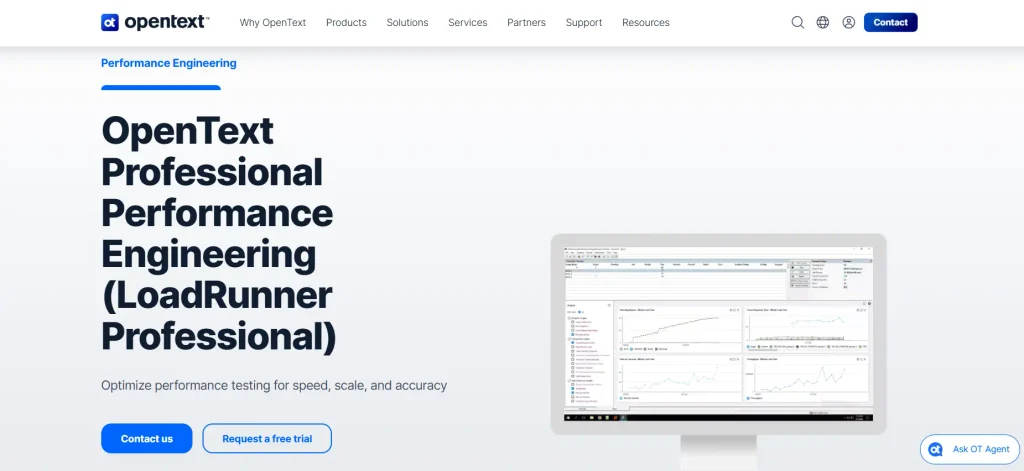
LoadRunner is a robust performance and load testing tool designed to simulate virtual users and evaluate application performance under various load conditions. Supporting a wide range of protocols—such as web, mobile, API, and database—it is suitable for both on-premises and cloud-based applications.
LoadRunner helps organizations identify performance bottlenecks, optimize responsiveness, and ensure systems can handle expected user demands. Its advanced analytics capabilities provide detailed insights into metrics like response times, throughput, and resource utilization.
Key features
- Load test your apps across web, mobile, API, and database protocols
- Analyze system performance and issues with the help of advanced analytics and reporting capabilities
- Create complex load test scenarios that simulate real user behavior
- Integrate with tools like Jenkins, GitLab CI/CD, Azure DevOps, AppDynamics, Dynatrace, and Grafana
- Get support for thousands of concurrent virtual users, making it suitable for enterprise-level apps
Pricing
- Customized pricing available on request
3. Anteon (formerly Ddosify)
Best for: No-code load testing with realistic traffic generation and integrated infrastructure observability

Anteon is an advanced performance and load testing tool for evaluating the performance and resilience of web applications, APIs, and microservices under heavy load. Designed for usability and scalability, it simulates real-world traffic patterns to test systems under stress.
It also supports protocols like HTTP, WebSocket, and gRPC. It features a user-friendly interface, robust reporting, and the ability to create complex test scenarios and run tests from multiple geographic locations. Focused on security and resilience, Anteon helps teams strengthen applications against DDoS attacks and performance issues.
Key features
- Create even complex user flows with Anteon’s No-code UI; no scripting required
- Measure your app’s global performance by selecting request origins from over 25 countries
- Configure RPS and duration to test your system under various load types
- Benefit from the Anteon API to integrate your test plans into your CI/CD pipeline
- Upload a CSV file of your test data to simulate desired user traffic patterns
Pricing
- Pro: Starts at $99 per month
4. Grafana Cloud K6
Best for: Distributed load testing from multiple geographic locations with centralized results
Grafana Cloud K6 is a modern performance and load testing platform that allows you to correlate load test results and server-side data so you can gain full context for troubleshooting performance issues.
You can easily automate your tests from the web app, CLI, and CI pipelines. The platform helps you design tests in minutes by turning user flows into test scripts. You can visually edit and debug scripts to refine test behavior and validate results. Your tests run locally or at scale. Detect performance changes by comparing results between tests and trends over time.
Key features
- Catch issues earlier by increasing code quality right in your IDE, with the easy-to-use k6 APIs, the CLI, and JavaScript
- Test under real-world conditions by modeling realistic traffic patterns with smoke, soak, or large performance tests
- Get a complete view of application performance by running protocol-level tests alongside browser-level tests
- Scale to extreme demand by running cloud load tests for up to 1 million concurrent virtual users or 5 million requests/second
- Test performance worldwide by launching tests in Grafana Cloud from more than 20 geographic locations
Pricing
- Free: $0
- Pro: Starts from $19 per month
- Enterprise: Starts at $25000 per year
5. BlazeMeter
Best for: Cloud-scale performance testing with JMeter compatibility and continuous testing
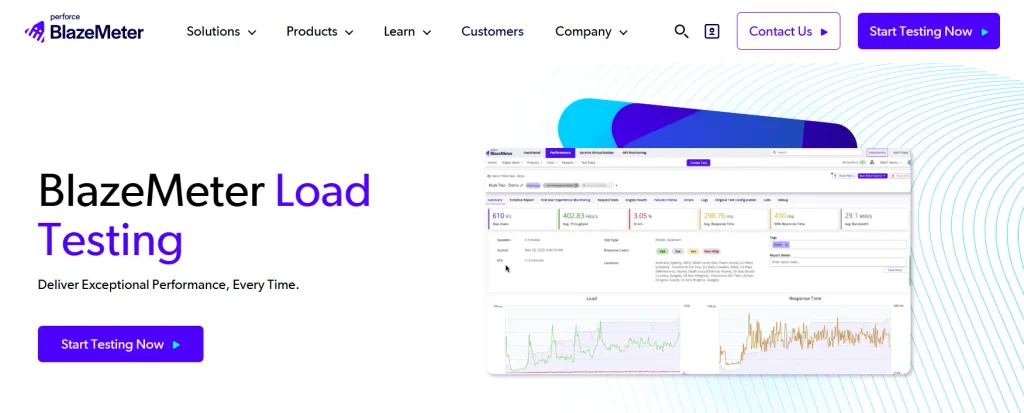
BlazeMeter is a scalable performance and load testing tool. It allows you to generate tests automatically by simply describing user journeys, environment, and performance objectives; no complex scripting or test setup.
The platform enables enterprise-grade performance testing with AI-driven orchestration, natural-language test creation, and unified reporting. You can create browser-based tests from a recorded user journey, turn actions into reusable test steps, and seamlessly configure load, locations, and pass or fail criteria.
Key features
- Simulate millions of users to stress test your app’s reliability
- Predict performance risks early with AI-powered analytics
- Replicate real-world mobile traffic to test your mobile UX and backend under load
- Validate API reliability under load with BlazeMeter’s Auto-Correlation plugin
- Accelerate testing cycles, reduce maintenance burdens, and gain actionable insights
Pricing
- Basic: $99 annually
- Pro: $499 annually
- Unleashed: Custom
- AWS: Custom
6. K6
Best for: Developers who want to write JavaScript-based load tests and automate performance checks

K6 is an open-source load testing tool designed for developers and QA engineers to test app performance under heavy loads. Known for its developer-friendly JavaScript scripting, K6 integrates seamlessly into CI/CD pipelines, enabling continuous testing.
With an intuitive design, command-line interface, and integration with third-party tools, K6 supports both local and cloud testing. Agile teams value K6 for simplifying automated performance testing, allowing earlier load testing in the development cycle, and ensuring faster, more reliable releases.
Key features
- Easily create and maintain load tests with a developer-centric scripting language in JavaScript
- Integrate with any CI/CD workflows for continuous load testing using a command-line-based interface
- Leverage extensive support for API and modern web application testing with powerful support for HTTP and WebSocket
- Meet different scalability and performance needs with local and cloud-based testing
- Get real-time test metrics, and integrate with monitoring tools like Grafana and Prometheus for deeper insights
Pricing
- Free: $0 (always)
- Pro: Starts at $0.15 per virtual user hour
- Enterprise: Custom
7. Locust
Best for: modeling custom user behavior and scaling load tests across multiple machines

Locust is a load testing tool written in Python that enables developers to simulate millions of concurrent users to evaluate an application’s performance under varying load conditions. With a simple and flexible scripting environment, it allows teams to define user behavior for realistic test scenarios and easily modify tests to align with real-world usage patterns.
Its distributed architecture makes it scalable for testing everything from small applications to large, complex systems. Locust’s web-based interface provides real-time monitoring, helping teams identify bottlenecks and optimize system performance efficiently before deployment.
Key features
- Create load testing scenarios for various use cases with Python-based, flexible and customizable scripting
- Control your load tests from more than one machine via the distributed architecture; your tests can be scaled up or down easily
- Leverage real-time steering and work observation on the tests with the help of a user-friendly interface and web-based monitoring
- Simulate millions of simultaneous users for realistic load testing
- Get a lightweight and efficient way of building tests which is ideal for developers seeking a straightforward load testing solution
Pricing
- Free, as it’s an open-source tool
8. Gatling
Best for: Code-driven load testing with reusable scenarios, realistic traffic models, and performance assertions
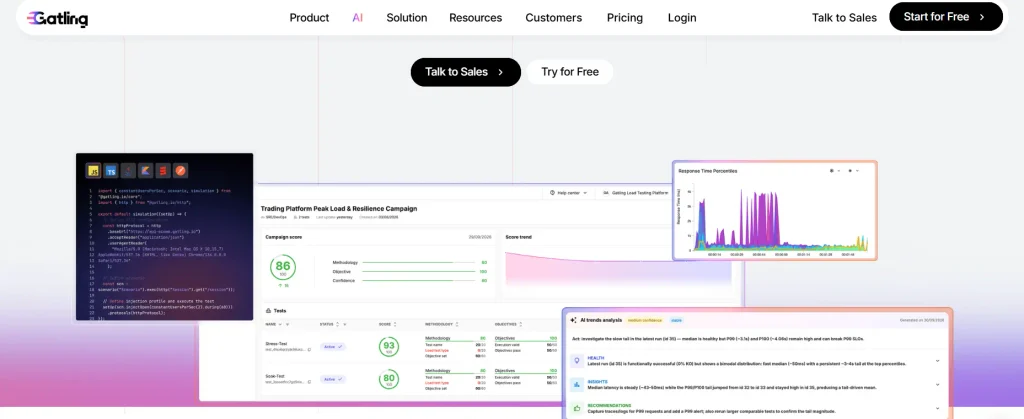
Gatling is a high-performance load testing tool tailored for assessing the performance of web applications and APIs. Its developer-friendly, Scala-based scripting language allows users to create concise and customizable simulation scripts for realistic load test scenarios. Gatling’s efficient engine supports high concurrency, making it ideal for applications with heavy user demands.
With real-time analytics, Gatling enables teams to identify performance bottlenecks, optimize performance, and ensure a seamless user experience, making it a preferred choice for organizations seeking a scalable and reliable load testing solution.
Key features
- Write tests the way you want – with code, no-code, or Postman imports
- Simulate High-concurrency load testing scenarios with thousands of users
- Track every key metric, customize your dashboards, and compare runs over time
- Integrate with CI/CD tools for continuous load testing and faster release cycles
- Leverage both open source and commercial options; Gatling Enterprise provides added support and cloud-based testing capabilities
Pricing
- Basic: $99 per month
- Team: $398 per month
- Enterprise: Custom
9. Artillery.io
Best for: scalable API and browser-based load testing
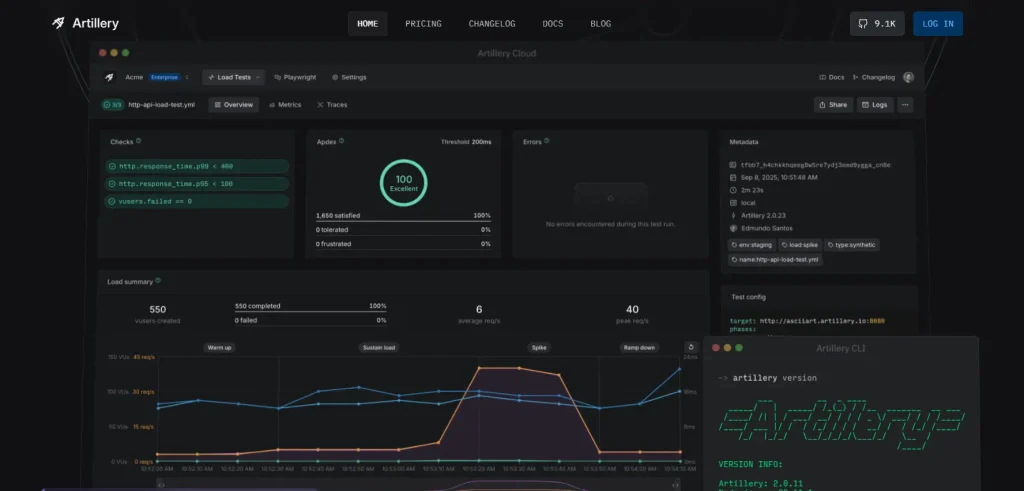
Artillery.io is a modern load testing tool designed for evaluating the performance of web applications and APIs. Its developer-friendly approach allows users to write tests using a straightforward YAML syntax, enabling teams to simulate real-world scenarios and analyze application behavior under different load conditions.
It’s particularly suited for microservices and cloud-native architectures. With powerful JavaScript-based scripting capabilities, you can create dynamic and complex testing scenarios. Built-in metrics and reporting features provide actionable insights, helping teams identify issues and optimize performance effectively.
Key features
- Reuse existing Playwright tests for browser-based load testing
- Scale to tens of thousands of headless browsers with distributed load testing
- Load test anything: HTTP APIs, GraphQL services, Socket.IO apps, and more
- Write and analyze Artillery load tests with specialized coding agents
- Run tests from your own AWS or Azure account using pay-as-you-go serverless infrastructure
Pricing
- Free: $0 per month
- Team: $199 per month
- Business: $499 per month
10. puppeteer-webperf
Best for: Performance profiling, Core Web Vitals measurement, and Lighthouse report generation
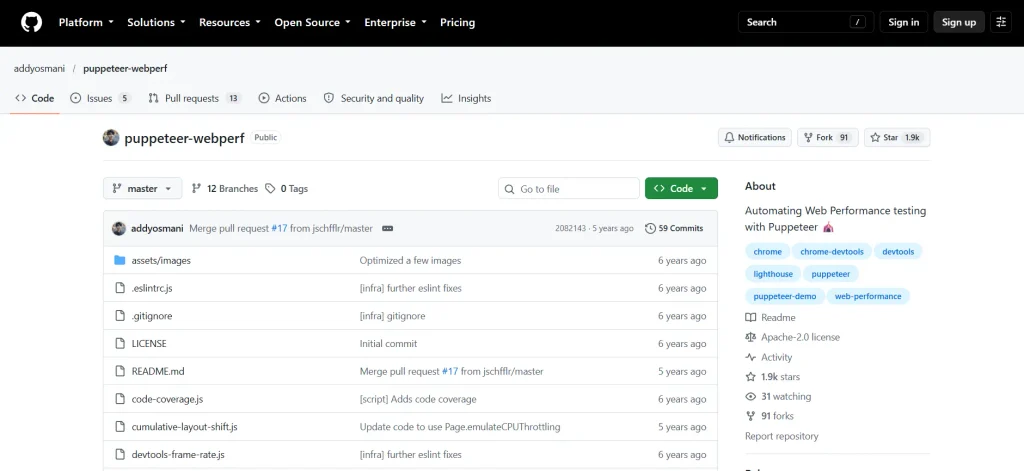
Puppeteer-WebPerf is a Node.js library that provides a high-level API for controlling headless Chrome or Chromium browsers. This tool is designed to help developers and QA teams measure and analyze the performance of web applications by automating the testing process in real browser environments.
Puppeteer-WebPerf allows users to simulate user interactions and gather performance metrics, such as page load times, resource loading, and rendering speeds. By leveraging Puppeteer’s capabilities, Puppeteer-WebPerf enables teams to create detailed performance tests using JavaScript. The tool captures key performance indicators (KPIs) to help identify bottlenecks and areas for optimization.
Key features
- Utilize robust automation capabilities for real browser testing
- Simulate user interactions and capture realistic performance metrics during test execution
- Generate detailed reports on key performance indicators (KPIs) such as load times, resource utilization, and rendering
- Run tests in headless mode and enable integration into CI/CD pipelines for automated performance testing
- Block requests to selected third-party domains to compare performance with and without those resources
Pricing
- Free, as it’s open-source
11. Taurus.
Best for: Teams who want to orchestrate tests using a common YAML-based workflow
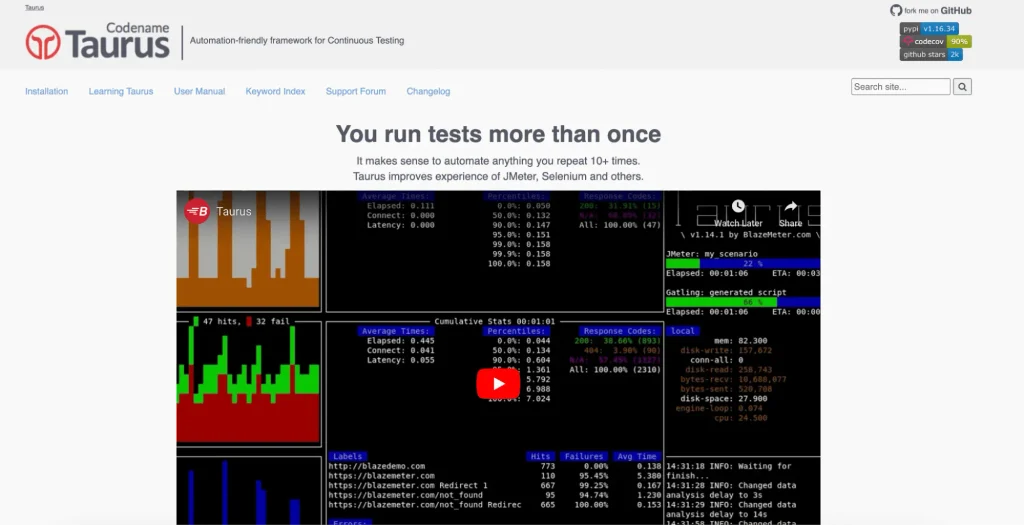
Taurus is an open source automation tool that simplifies load testing by unifying multiple formats, including JMeter, Gatling, Selenium, and Locust, into a single framework. By allowing tests to be written in simple YAML files, Taurus eliminates the need for extensive scripting knowledge, making it accessible to both developers and non-technical team members.
Its command-line interface enables seamless execution across various environments, reducing setup time and enhancing flexibility. Taurus facilitates automated performance testing throughout the development lifecycle, providing early feedback and ensuring a reliable user experience.
Key features
- Simplify test configuration with YAML-based test scripts, which enable easy setup and customization
- Integrate with popular testing tools like JMeter, Gatling, and Locust for versatile testing options
- Incorporate Taurus with your CI/CD pipeline for continuous load testing and immediate feedback on your app performance
- Enable automated testing and connect testing with your development workflows using the command-line interface
- Quickly identify and resolve your performance issues with real-time monitoring
Pricing
- Free, as it’s an open-source tool
Protocol-level load testing tools
These tools allow you to generate traffic directly through protocols such as HTTP, TCP, and WebSocket to measure response times, throughput, error rates, and system behavior under load.
12. Apache JMeter
Best for: GUI-driven testing across diverse application and server protocols

Apache JMeter is a widely used open source load testing tool that enables users to evaluate the performance of applications, servers, and networks. Initially designed for web applications, it now supports multiple protocols, making it suitable for diverse testing scenarios.
JMeter’s GUI-based interface allows the creation of complex test plans, providing robust features for scripting, load generation, and detailed reporting. Capable of simulating large numbers of concurrent users, it helps developers identify bottlenecks, analyze performance under load, and optimize system configurations.
Key features
- Leverage GUI-based test plan creation with support for complex, multi-step test scenarios
- Get multi-protocol support, including HTTP, HTTPS, FTP, TCP, and WebSocket, for comprehensive testing
- Simulate high user loads across multiple machines
- Gain detailed metrics and insights for performance analysis
- Integrate with CI/CD pipelines and third-party tools for automated load testing
Pricing
- Free, as it’s an open-source tool
13. Siege
Best for: Quick performance benchmarking against a single URL or a list of URLs
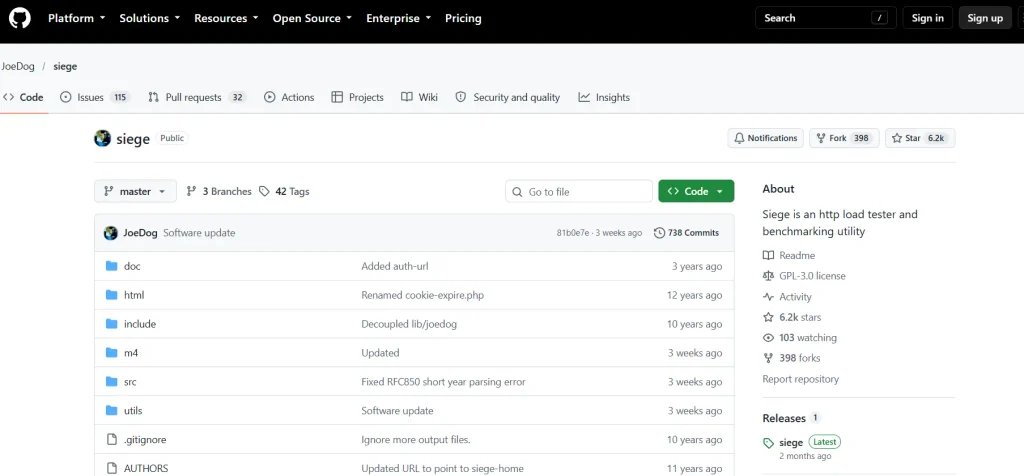
Siege is a load testing and benchmarking tool to evaluate web server performance under heavy traffic. Known for its simplicity and speed, Siege enables developers and system administrators to simulate concurrent user requests, analyzing response times, server stability, and throughput. Supporting HTTP and HTTPS protocols is ideal for basic load testing to ensure web applications can handle expected traffic without performance issues.
Its command-line interface allows quick configuration and execution of tests, while the ability to test multiple URLs concurrently adds flexibility. Siege is an efficient and straightforward choice for small to medium-scale performance testing.
Key features
- Monitor the number of transactions, elapsed time, bytes transferred, transaction rate, and concurrency
- Cover essential web performance testing needs with support for HTTP and HTTPS protocols
- Test multiple URLs concurrently and simulate real-world load across multiple endpoints
- Customize concurrency levels and test durations for flexible load configurations
- Access detailed reports with response times, availability, and throughput metrics to gauge server performance
Pricing
- Free, as it’s open-source
14. Fortio
Best for: Controlled benchmarking, HTTP or gRPC request rates, and detailed latency histograms

Fortio is an open source load testing and benchmarking tool designed to evaluate the performance of HTTP, gRPC, and other network protocols. Developed by Istio contributors, it is optimized for microservices and cloud-native applications, particularly in Kubernetes environments. Fortio combines lightweight resource consumption with ease of use, offering both a web-based and command-line interface for flexible test execution.
You get detailed insights into request latency and throughput under varying load conditions. With support for concurrent endpoint testing and seamless integration into containerized setups, Fortio is a preferred tool for developers and DevOps teams to identify bottlenecks, analyze response times, and ensure applications are production-ready.
Key features
- Execute HTTP and gRPC load testing; Fortio is lightweight and ideal for microservices and Kubernetes environments
- View real-time latency histograms, detailed insights into request latency, and overall app performance
- Run tests through web-based and command-line interfaces with flexible configuration options
- Perform concurrent testing of multiple endpoints and enable comprehensive performance analysis
- Easily integrate with containerized setups; this is particularly useful for cloud-native and microservices architectures
Pricing
- Free, as it’s an open-source tool
15. nGrinder
Best for: Teams who are looking for centrally managed, distributed testing with a web interface and Groovy or Jython scripting

nGrinder is built on the Grinder framework, designed to simplify performance testing with a web-based interface and scalable architecture. It allows users to create, execute, and monitor tests directly from the browser, making it easy to simulate large numbers of concurrent users and evaluate system performance. nGrinder offers the flexibility to design tailored test scenarios for various applications.
Its distributed architecture enables seamless scaling across multiple agents, accommodating both small-scale applications and large enterprise systems. nGrinder helps developers and QA teams identify performance bottlenecks and optimize system configurations to ensure consistent reliability under heavy loads.
Key features
- Create, execute, and monitor load tests via a web-based interface
- Build detailed and complex test scenarios with custom scripting in Groovy and Jython
- Scale testing across multiple agents for high user load simulations
- Get real-time monitoring, detailed reporting, and insights to identify and troubleshoot performance issues
- Integrate with CI/CD pipelines for automated performance testing in development workflows
Pricing
- Free, as it’s an open-source tool
16. Tsung
Best for: Testing distributed, multi-protocol systems which involve web servers, databases, and messaging services
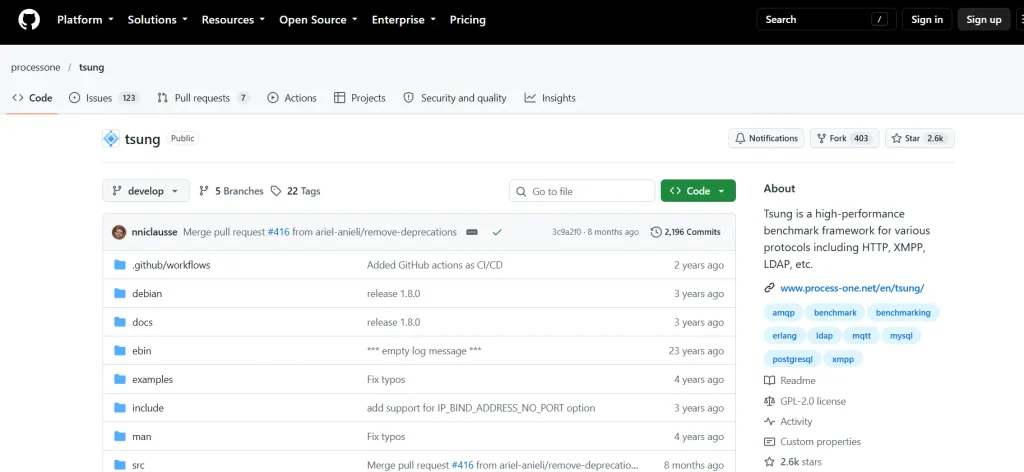
Tsung is a powerful website load testing tool written in Erlang, designed to test and analyze the performance of web, database, and messaging applications under heavy load. Renowned for its ability to handle a high number of concurrent users, Tsung efficiently simulates large-scale traffic while supporting multiple protocols. Its distributed architecture allows deployment across multiple machines, enabling scalable load tests and the simulation of complex scenarios.
With XML-based configuration files for detailed test customization, Tsung offers flexibility and control, making it an excellent choice for teams needing a resource-efficient tool for stress testing and in-depth performance analysis.
Key features
- Load test efficiently with multi-protocol support, including HTTP, WebSocket, LDAP, and PostgreSQL
- Generate load scenarios across multiple machines and leverage large-scale simulations
- Mimic concurrent users and stress test your apps with massive user bases
- Get precise control over load and performance conditions with XML-based configuration and create custom test scenarios
- Track performance metrics and spot potential performance degradations with real-time monitoring and reporting
Pricing
- Free, as it’s an open-source tool
Wrapping Up
As web applications become increasingly complex and user expectations continue to rise, choosing the right load testing tool is crucial for ensuring optimal performance and reliability. The tools discussed in this comprehensive guide offer various approaches to load testing, from open source solutions like puppeteer-webperf and JMeter to commercial platforms like LoadRunner and TestGrid.
The best load testing tools on the market offer a range of advanced features and flexibility to help you accurately simulate real-world user scenarios and measure your system’s performance under various load conditions.
If you’re looking for a comprehensive testing solution with robust load testing, automated execution, real-device testing, cloud/on-premise deployment, and precise performance monitoring with real-time analytics, then TestGrid brings these capabilities together to help you streamline your testing workflows and improve app stability. Request a free trial to explore the platform.
Read also: An intro to Load Testing – The Process, Tools, Best Practices
Frequently Asked Questions (FAQs)
What are the benefits of load testing?
Load testing helps to identify potential performance issues and bottlenecks in software before it is put into production, ensuring a smooth and successful deployment. It also helps to determine the maximum capacity of the application, ensuring that it can handle peak loads without crashing or degrading performance.
What is the best free tool to perform load testing?
There are many tools available for load testing, and the best one for your needs will depend on various factors, such as the type of software you want to test, the performance metrics you want to measure, and your specific testing goals. Some popular free tools for load testing include JMeter, LoadRunner, and LoadUI. It would be best to research and compare the features and capabilities of these and other tools to determine the best one for your needs.
What is the difference between load testing and performance testing?
Load testing focuses on measuring the performance of an application under heavy load, while performance testing involves evaluating various aspects of an application’s performance, such as response time, throughput, and resource utilization.
How do I choose the right load testing tool for my project?
Consider factors such as the complexity of your application, the required level of scalability, the budget, and the skill set of your team.
What are some common challenges in load testing?
Some common challenges include simulating realistic traffic patterns, handling distributed systems, and accurately measuring performance metrics.


