


AI-Powered API Testing Agent, Aligned With Real Execution
You test APIs as part of real usage paths. The API testing AI agent evaluates API behavior as tests run by examining requests, responses, contracts, and runtime conditions, so you can review reliability, correctness, and risk with clear context while decisions remain yours.


When API Testing Requires Execution-Level Insight
Backend services interact with UI and end-to-end flows
Multiple environments (dev, staging, production) need consistent API checks
APIs must be verified after code changes or service updates
Integration issues must be detected before they affect downstream systems
What the API Testing Agent Evaluates During Test Runs
Request and response payload structures
HTTP status codes and headers
Authentication and authorization flows
Contract and schema alignment (for example, OpenAPI)
Execution timing and response performance signals
Environment-specific configuration context
Contract-Aware API Testing in Real Workflows
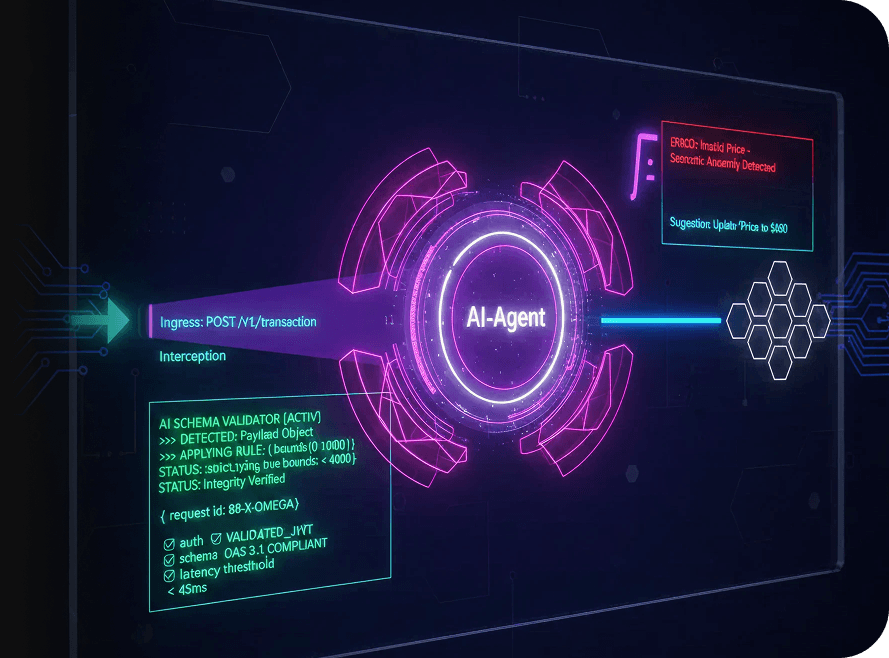
When you use API testing using AI, contracts become part of execution. This agent compares observed requests and responses with expected schemas and constraints as workflows execute, helping you understand where behavior diverges and what downstream impact those changes may introduce.

Secure API Testing With Clear Boundaries
Evaluate how APIs respond within defined access and security constraints. The API Testing Agent operates only with permitted credentials and environments. It doesn’t bypass authentication, escalate privileges, or introduce changes to security controls.
Request Free TrialGovernance and Review Control
The API Testing Agent doesn't enforce outcomes or make release decisions for you. Instead, findings are presented with execution evidence so you can review behavior, assess impact, and decide next steps according to your own standards and processes.

Frequently Asked Questions (FAQs)
When does API testing using AI become necessary?

API testing using AI becomes necessary when API interactions need to be understood in the context of real application flows. Instead of examining endpoints in isolation, the API Testing Agent looks at requests, responses, contracts, and runtime context together so you can see how APIs function across end-to-end paths.
When does API testing using AI become necessary?
API testing using AI becomes necessary when API interactions need to be understood in the context of real application flows. Instead of examining endpoints in isolation, the API Testing Agent looks at requests, responses, contracts, and runtime context together so you can see how APIs function across end-to-end paths.
How is API testing using AI agents different from endpoint-level checks?
Endpoint-level checks focus on individual requests and predefined assertions. API testing using AI agents examines API interactions across flows, connecting observed outcomes to contracts, environments, and dependent services to provide broader context.
How is API testing using AI agents different from endpoint-level checks?
Endpoint-level checks focus on individual requests and predefined assertions. API testing using AI agents examines API interactions across flows, connecting observed outcomes to contracts, environments, and dependent services to provide broader context.
How does the API Testing Agent fit alongside existing API tools?
The API Testing Agent works alongside existing API testing and monitoring tools by adding workflow-aware analysis. You can continue using your current tools while gaining clearer insight into how APIs perform across integrated scenarios.
How does the API Testing Agent fit alongside existing API tools?
The API Testing Agent works alongside existing API testing and monitoring tools by adding workflow-aware analysis. You can continue using your current tools while gaining clearer insight into how APIs perform across integrated scenarios.
What decisions remain under your control when using the API Testing Agent?
The API Testing Agent doesn’t approve releases, block deployments, modify API definitions, or enforce policies. You retain full control over review, prioritization, and release decisions, using the agent’s analysis as input.
What decisions remain under your control when using the API Testing Agent?
The API Testing Agent doesn’t approve releases, block deployments, modify API definitions, or enforce policies. You retain full control over review, prioritization, and release decisions, using the agent’s analysis as input.
In which testing scenarios does API context matter most?
API context matters most during integration testing, end-to-end flows, regression testing, and pre-release reviews, especially when APIs interact across multiple services or environments.
In which testing scenarios does API context matter most?
API context matters most during integration testing, end-to-end flows, regression testing, and pre-release reviews, especially when APIs interact across multiple services or environments.