


See Which Code Paths Your Tests Exercise With An AI Code Coverage Agent
As your app evolves, code coverage often turns into a number that’s easy to track but hard to interpret. This agent correlates executed tests with code-level signals, so you can understand what’s covered, what’s not, and why that matters, without enforcing thresholds or making autonomous decisions.

When to Use AI Code Coverage Analysis in CI and DevOps Pipelines
Tests run as part of CI or DevOps pipelines
Coverage trends need to be reviewed before a release
Teams want to review coverage after a pull request or build
Raw coverage numbers are available but lack actionable meaning
How AI Code Coverage Analysis Interprets Execution Data
Code execution traces generated during test runs
Build, branch, and execution context
Historical execution data across runs
Mapping between tests and exercised code paths
Test cases and workflows executed in QuantumFuze
AI Code Coverage Agent for DevOps Pipelines
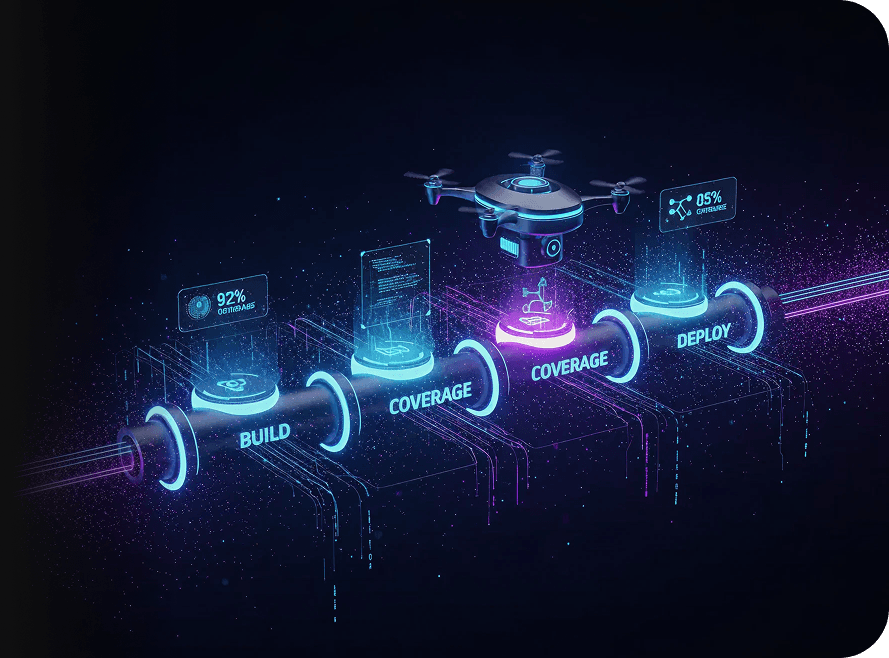
When tests run through your CI or DevOps pipelines, the agent analyzes coverage signals alongside execution results. You can review coverage changes after a pull request or build, during regression cycles, and before promoting a release.

Intelligent Code Coverage Analysis for Support Test Planning and Optimization
Coverage insights are most valuable when they inform action. Leverage the AI code coverage optimization agent to identify code areas that need additional tests and prioritize test creation based on uncovered or weakly-covered logic.
Request Free TrialFrequently Asked Questions (FAQs)
What is AI code coverage?

AI code coverage combines execution data with contextual analysis to help you understand not just how much code is covered, but which code paths are exercised by real tests and why that coverage matters.
What is AI code coverage?
AI code coverage combines execution data with contextual analysis to help you understand not just how much code is covered, but which code paths are exercised by real tests and why that coverage matters.
Is this AI Code Coverage Agent autonomous?
No. While the agent automates analysis, it doesn’t make autonomous decisions or change tests or code. It supports review and planning while keeping humans in control.
Is this AI Code Coverage Agent autonomous?
No. While the agent automates analysis, it doesn’t make autonomous decisions or change tests or code. It supports review and planning while keeping humans in control.
Can this replace existing code coverage tools?
The agent complements existing coverage tooling by adding intelligent analysis and execution context. It doesn’t require you to abandon established workflows.
Can this replace existing code coverage tools?
The agent complements existing coverage tooling by adding intelligent analysis and execution context. It doesn’t require you to abandon established workflows.
When should teams review AI-driven code coverage?
Teams typically review AI-driven code coverage after code changes, during CI runs, and before releases to ensure critical logic is exercised by tests.
When should teams review AI-driven code coverage?
Teams typically review AI-driven code coverage after code changes, during CI runs, and before releases to ensure critical logic is exercised by tests.
What does the AI Code Coverage Agent not do?
To maintain transparency and governance, the AI Code Coverage Agent operates within a clearly defined scope. It doesn’t collect raw coverage data, enforce coverage thresholds, gate builds, modify tests or code, prioritize tests based on code diffs, or replace existing coverage tools. The agent supports review and planning, while humans remain fully in control of decisions.
What does the AI Code Coverage Agent not do?
To maintain transparency and governance, the AI Code Coverage Agent operates within a clearly defined scope. It doesn’t collect raw coverage data, enforce coverage thresholds, gate builds, modify tests or code, prioritize tests based on code diffs, or replace existing coverage tools. The agent supports review and planning, while humans remain fully in control of decisions.