CoTester 2.0 is LIVE! Your Always-Available AI Teammate for Testing.
APIs in modern apps and microservices are connected to multiple backend services, databases, message queues, and third-party systems. Therefore, even a single user request can initiate a chain of interactions across many downstream systems.
So, QA teams now have to verify both individual API functionality and its interactions with dependent services, which can make testing more complex and failures difficult to trace and troubleshoot.
API testing strategies help teams address these problems. In this blog, we’ll learn how to build an effective strategy, where the different testing approaches fit, the challenges, and the best practices to overcome them.
Optimize API functionality, performance, and reliability with TestGrid. Request a free trial.

TL;DR
- An API testing strategy is a blueprint for validating API quality consistently across development, testing, and release cycles
- API testing strategies help you avoid costly bugs, compliance risks, or service disruptions
- Different types of API testing strategies include unit, integration, functional, contract, performance, load, security, negative, and end-to-end testing
- To build an API testing strategy, you should assess your API’s architecture, map out the test scope, define API specs, select testing tools, design test cases, configure the test environment, automate, execute, and analyze results
- Some API testing best practices are designing APIs for asynchronous workflows, isolating dependencies, protecting test data, and maintaining every API version
What Is an API Testing Strategy?
API testing strategy is a structured, documented plan that defines how APIs will be tested throughout their development lifecycle. It establishes testing priorities, execution order, validation criteria, test environments, automation practices, and governance standards.
An effective API testing strategy helps teams align testing efforts based on business impact, user exposure, dependency count, and change frequency.
Also read: API Testing Explained
Types of API Testing
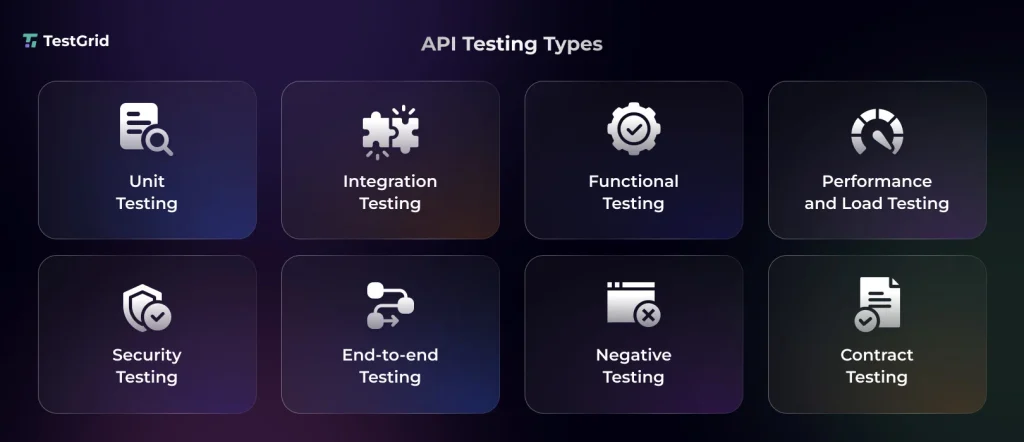
Here’s a gist of when you should ideally be using the different types of API testing strategies.
| Test type | When to use |
|---|---|
| Unit testing | When developing or refactoring API code to detect implementation defects before integration |
| Integration testing | After your unit tests pass and before deploying changes to connected services |
| Functional testing | Throughout the API development lifecycle, particularly after adding new endpoints or modifying existing functionality |
| Performance and load testing | Before production, seasonal peaks, or capacity planning |
| Security testing | Before production release, after updating security controls, and during periodic security assessments |
| End-to-end testing | Before major releases to check complete business workflows across multiple APIs, services, databases, and external systems |
| Negative testing | After functional testing and before production release to verify APIs can handle invalid or unexpected requests |
| Contract testing | Whenever API contracts change, during CI/CD builds, or before deploying provider or consumer services |
1. Unit testing
Unit testing is one of the API testing strategy that allows you to verify the individual components of code that implement an API, such as the controllers, route handlers, service methods, serializers, validators, and utility functions, in isolation by mocking or stubbing the external dependencies (e.g., databases, caches, message queues).
Since API unit tests can be run quickly, they help you identify coding errors early and ensure components behave as expected before integration.
2. Integration testing
Integration testing is done to check if multiple API components and services function correctly when they’re combined. You should ideally validate interactions between your app, databases, authentication services, message brokers, and external APIs to confirm whether data flows accurately across the system.
3. Functional testing
It’s important to assess if your APIs are working according to the functional requirements and specifications. With functional API testing, you can validate that each endpoint processes requests correctly and returns the expected status codes, response payloads, and error messages for different inputs and conditions.
Scenarios you can cover here are:
- Verify supported CRUD operations for each endpoint
- Validate request and response payloads against the API specification
- Check pagination, filtering, and sorting functionality where supported
- Assess error handling and descriptive error messages for invalid requests
Also Read: Functional Testing: Types, Examples, Techniques, and Best Practices
4. Performance and load testing
Performance testing allows you to evaluate how your APIs respond under expected workloads by measuring metrics like response time, latency, throughput, resilience, and resource utilization. Load testing checks how well APIs can handle high user traffic and concurrent requests.
E.g: Verify that the API returns responses within the defined SLA (e.g., 500 ms) when processing 1,000 concurrent requests.
These tests enable you to ensure that APIs can maintain acceptable response times and throughput under peak load without performance degradation and service failures.
Learn More: Performance Testing Tools in 2026
5. Security testing
Security testing examines an API’s ability to protect data, services, and backend resources from unauthorized access.
Here, you mainly check the authentication, authorization, input validation, encryption, and session management mechanisms to ensure APIs enforce secure access controls and safeguard sensitive data.
Complying with industry guidelines such as OWASP API Security and the OWASP API Security Top 10 can help you identify, prioritize, and mitigate common API security vulnerabilities before deployment.
6. End-to-end testing
E2E testing allows you to assess the full user journeys involving multiple APIs, services, databases, message queues, and third-party integrations and check if they work together seamlessly starting from the initial client request to the final system response.
Pro tip: Make sure you perform end-to-end tests only for the critical workflows before production deployment because these tests can be expensive and slow to run.
7. Negative testing
Negative testing is an API testing approach where you intentionally send invalid, malformed, or unexpected requests to an API. This is done to verify if your APIs reject improper inputs, return appropriate error messages, enforce validation rules, and never expose sensitive information or enter an inconsistent state.
Effective negative testing helps you uncover:
- Invalid data types
- Malformed JSON and unsupported HTTP methods
- Missing or extra parameters
- Expired credentials and unauthorized access attempts
8. Contract testing
Contract testing is one of the most important API testing strategy, which ensures that an API provider and its consumers adhere to an agreed interface contract, including endpoint definitions, request and response schemas, data types, headers, and HTTP status codes.
Here you inspect whether changes made by one service affected any dependent apps or microservices. This enables you to detect contract violations and prevent integration failures.
Also Read: AI in API Testing: Benefits, Challenges, Types, and Tools
How to Build an Effective API Testing Strategy
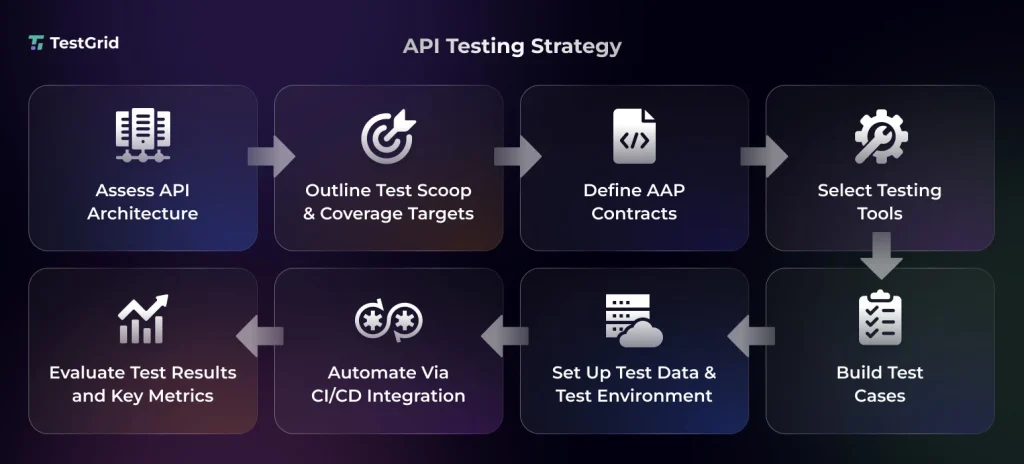
1. Assess Your API Architecture
You need to first understand how your APIs are built, what components they interact with, as well as the primary user workflows they support.
Identify the API architecture (REST, GraphQL, SOAP, or gRPC), service dependencies, authentication mechanisms, databases, message brokers, and third-party integrations.
This architectural assessment is critical so that you can create an accurate test scope and prioritize the high-risk integration points.
2. Define Test Scope and API Test Coverage targets
Next, you should define which APIs, endpoints, business workflows, integrations, and non-functional requirements you’ll include in your test strategy.
Make sure you set clear coverage goals during sprint planning and adopt risk-based testing to focus more on the critical APIs that affect business, high-impact user journeys, and failure-prone components (e.g., payment processing, authentication, inventory sync services).
3. Define API Contracts and Specifications
Create an API contract that specifies endpoint definitions, request and response schemas, data types, headers, query parameters, and expected HTTP status codes.
Standard API specifications such as OpenAPI and RAML (for REST APIs) and WSDL (for SOAP APIs) give you a machine-readable definition of the API and enable consistent implementation, automated request and response validation, and support for contract testing.
4. Choose the Right API Testing Tools
Pick tools based on the type of testing you need to perform, like unit, security, performance, or integration testing, and how easily they integrate with your CI/CD pipeline and development workflow.
You can leverage these tools for your API testing approach:
- K6 – It’s a developer-centric performance and load testing tool from Grafana that defines tests as code, making them easy to version, maintain, and integrate into CI/CD pipelines
- JMeter – An open-source tool that’s designed to load test functional behavior and measure the performance of APIs, databases, and other services; it also supports multiple protocols (e.g., HTTP, HTTPS, SOAP Web Services)
- Gatling – This is a performance engineering platform that enables teams to simulate realistic traffic patterns; it supports modern protocols such as HTTP, WebSocket, gRPC, MQTT, and JMS
- Pact – It is a contract testing framework that verifies API interactions between service providers and consumers without requiring heavy end-to-end integration tests
- Spring Cloud Contract – This is a framework for implementing consumer-driven contracts in Spring-based apps; it automatically generates tests, stubs, and service schemas from contracts and helps you verify API compatibility
For a comprehensive comparison, check out our detailed list of API testing tools.
5. Build your test scenarios and test cases
Design test scenarios that help you validate both expected API behavior and potential failure conditions. Your test cases should include scenarios to assess functional correctness, business rules, authentication and authorization flows, and edge cases.
Your test cases must cover:
- Happy paths: Valid request payloads, authorized user access, successful data retrieval
- Authentication scenarios: Valid token, expired token, missing token, insufficient permissions, wrong role
- Boundary conditions: Minimum/maximum values, empty arrays, null fields, string length limits
- Failover scenarios: Service restarts, node failures, traffic rerouting, backup instance recovery
Also Read: Test Case Template: Free Examples & Formats for QA Teams
6. Configure Test Data and Test Environments
For reliable API testing, you need realistic test data and a production-like test environment.
Prepare representative datasets that cover valid, invalid, and edge-case scenarios, and also ensure that sensitive information is masked or replaced with synthetic data.
Then set up a test environment with production configurations, including databases, third-party integrations, authentication services, and network settings, so that you can produce accurate and repeatable test results.
7. Automate the process with CI/CD integration
Integrating your API test suite into your CI/CD pipeline will help you run tests automatically whenever code changes are committed, merged, or deployed.
You can apply a layered approach here, like executing unit tests on every commit, contract and integration tests during builds, and performance or regression tests before release.
This way you can reduce execution time, get faster feedback, and detect defects in the development process.
8. Analyze Test Results and Monitor
After test execution, review your reports to identify failures, performance regressions, and recurring defects.
At this stage, you must track the critical API testing metrics such as test pass rate, API response time, latency, throughput, error rate (4xx/5xx responses), test coverage, defect density, API availability, and mean time to detect (MTTD) or resolve (MTTR) issues.
Discuss these findings during sprint or release retrospectives to identify process improvements, close testing gaps, and refine your API testing strategy.
Common API Testing Challenges and Best Practices to Address Them
1. Testing Asynchronous APIs
Many APIs process requests asynchronously using message queues, event streams, webhooks, or background jobs. This can make validation more complex because your tests must account for delayed processing, eventual consistency, and operations completing in a different order than requests were received.
| Best Practice You need to design your tests to sync with asynchronous workflows rather than relying on fixed delays. Use polling with configurable timeouts, callback or webhook validation, event listeners, and correlation IDs to verify that background processes complete successfully before asserting the final API state. |
2. Testing Microservices and Third-Party APIs
APIs might depend on multiple internal microservices and external systems in distributed architectures. Changes, downtime, network latency, rate limits, or inconsistent test environments in these dependencies can cause test failures that may not actually be related to the API under test.
| Best Practice You can overcome this problem by isolating non-essential dependencies using mocks, stubs, or service virtualization to reduce failures that are caused by unavailable or unstable services. |
3. Data and Privacy Compliance
API testing normally requires realistic datasets, which may contain personally identifiable information (PII), financial records, or healthcare data. So, without proper safeguards, APIs may leak confidential data and create compliance risks across development and testing.
| Best Practice One of the best ways to solve this issue is using anonymized or masked test data. You can also enforce role-based access controls, encrypt sensitive information, and regularly assess APIs against applicable compliance and regulatory requirements. |
Learn More: Guide on Conformance Testing
4. Managing API Versioning
Your APIs evolve continuously. New fields are added, existing endpoints are modified, and response schemas change over time. However, this can break backward compatibility for dependent apps. Supporting multiple API versions can make testing hard for your team.
| Best Practice You should maintain explicit API versioning, automate contract and regression tests for every supported version, and check backward compatibility before your team deploys API updates. |
Streamline Your API Testing Strategy with TestGrid
TestGrid is an AI-powered end-to-end testing platform that offers you a scalable infrastructure and real device environment where you can run tests to evaluate web apps, mobile apps, and APIs.
You can leverage codeless automation or record and play to create your API tests faster and then automate execution by connecting with CI/CD tools like GitHub Actions, Azure DevOps, Jenkins, and CircleCI.
The platform allows you to test your APIs in parallel across multiple Android and iOS devices as well as browsers like Chrome, Safari, Edge, and Firefox with real device testing. Plus, it has built-in support for JMeter scripts, which enables you to load test APIs seamlessly.
TestGrid provides you with a centralized dashboard for easy test analysis, test data management, real device testing, performance testing, and test case management, all within a single, unified ecosystem.
Build, automate, and scale your API testing strategy with TestGrid. Request a free trial.
Frequently Asked Questions (FAQs)
Why are API testing strategy important?
API testing strategy provide a standardized approach for planning, prioritizing, and executing your API tests. It helps you allocate test resources effectively, maintain consistent quality standards across projects, reduce testing gaps, and improve collaboration between developers, testers, and operations teams.
What should the API testing strategy document include?
Your API testing strategy document should include testing objectives, scope, testing levels, prioritization criteria, environments, data management, automation approach, quality metrics, roles and responsibilities, and the success criteria.
What is API mocking, and when should it be used?
API mocking simulates the behavior of an API without requiring the actual service to be available. It is useful during early development, when dependent services are unavailable or unstable, or while testing edge cases that are difficult, costly, or risky to reproduce using live systems.
How do you prioritize APIs in your test strategy?
You should focus on the APIs as per their business criticality, frequency of use, customer impact, security exposure, integration complexity, and historical defect patterns. APIs that support critical user journeys, financial transactions, or authentication should receive more comprehensive and frequent testing.