CoTester 2.0 is LIVE! Your Always-Available AI Teammate for Testing.
- From Execution to Engineering Intelligence: What Does the Real Shift Look Like?
- The AI Factor in Modern Testing
- How Should You Think About AI in Your Automation Stack?
- The Future Skill Matrix: The New DNA of Automation Engineers
- How Can Automation Engineers Build Balance Across the Three Pillars?
- Automation Engineering Is Moving Into Its Next Chapter
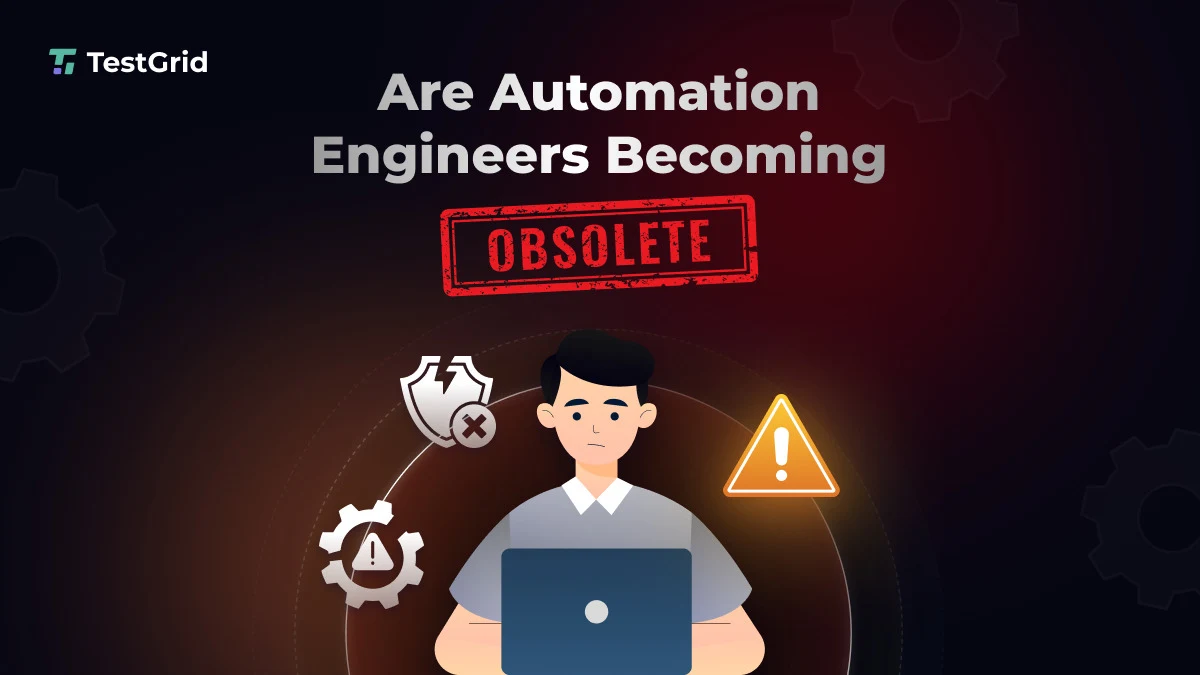
You’ve probably noticed the question coming up more often in boardrooms and leadership calls: are automation engineers becoming obsolete? It’s a fair question to ask. The last few years have brought huge shifts in how we build and test software.
For starters:
Generative AI is writing code.
Test automation frameworks are healing themselves.
Test authoring tools are now promising near-zero scripting.

The story we keep hearing on repeat is that automation is taking care of automation. So it’s understandable to wonder if we still need human expertise in software testing.
Forrester reports that 90% of organizations plan to adopt AI-powered test automation, with many expecting AI to handle more than half of test case generation and maintenance tasks that are currently manual.
But when you talk to teams in the middle of this transformation, a different picture emerges. They don’t see automation engineers disappearing. In fact, they see their roles evolving – as tools grow more capable and automation becomes more intelligent.
And this blog post dissects this school of thought in detail.
From Execution to Engineering Intelligence: What Does the Real Shift Look Like?
For a long time, testing success meant high coverage and short run times. Today, there’s an increased need to know about specific decision metrics rather than execution metrics. Some questions being asked include:
- How quickly can our systems recover when code or environments change?
- How well does automation track risk across releases?
- How reliable are our test results?
Multiple research emphasizes this change: teams with mature automation practices deliver shorter release cycles and higher quality outcomes without increasing overall testing effort. Yet, maintenance still consumes 30%-50% of total automation time in many enterprise setups.
You can also see the impact in how teams are structured.
Automation engineering is embedded within the platform engineering or DevOps team, sharing tooling, telemetry, and budget with production systems. Test automation frameworks are treated as a part of the delivery pipeline.
Engineering Intelligence in Practice
| Focus Area | What It Looks Like |
| Automation | Measures its own stability and technical debt |
| Frameworks | Generate operational data, not just pass/fail results |
| Teams | Treat test reliability as a system health metric |
The AI Factor in Modern Testing
AI is already making real impact in parts of test automation, and there are numbers to prove that:
- In a study using TestPilot (an LLM-based test generator), generated tests achieved median statement coverage of 70.2 % and branch coverage of 52.8% on JavaScript APIs.
- In a broader trend, the AI-enabled testing market is expected to grow from $856.7 million in 2024 to $3,824 million by 2032.
- Between 2024 and 2025, the percentage of teams tracking test effectiveness metrics increased from 19% to 25%.
Despite the positives, it doesn’t mean AI is replacing the engineer who understands context, risk, and even business logic. It simply means that it’s gaining traction in certain parts of the testing stack, like visual regression detection and anomaly identification.
But here’s where the challenges remain:
- An LLM might generate tests that achieve full line coverage. But it sometimes misses edge cases tied to business rules or complex input conditions.
- It’s also possible that some test suites achieve 100% coverage but only 4% mutation score in a mutation-based evaluation, allowing many faults to go undetected.
- Crafting prompts or repairing failed tests often requires human judgment.
How Should You Think About AI in Your Automation Stack?
Use it as a tool to create test scripts, expand data coverage, and automate repetitive validations. Your team should stay responsible for reviewing AI output, embedding business rules, and enforcing test governance.
Their feedback on test failures, flakiness, and production metrics should define what the AI generates next.
The Future Skill Matrix: The New DNA of Automation Engineers
Obviously, as automation matures, the skill set around it will also expand. AI testing tools are also adapting and upgrading. But what still defines strong teams is how they combine engineering depth with systems thinking and strategic awareness.
Here’s what they should be working towards:
| Pillar | Core Focus | Key Skills / Capabilities |
| Engineering excellence | Build stable, scalable, and maintainable systems | Designing test frameworks that adapt to change; API and contract testing; infrastructure as code; test data design; observability; recovery and rerun strategies |
| AI and analytics literacy | Use automation data intelligently | Working with AI-assisted tools; validating generated tests; analyzing test signals and flakiness; connecting test data to release metrics; using logs to find system-level issues |
| Strategic and leadership thinking | Turn automation into business confidence | Measuring automation ROI; setting test priorities by risk; defining quality metrics that matter; communicating impact to stakeholders; leading teams through change |
Another thing to remember is that no one person needs to cover all three pillars completely. However, the team as a whole should. The balance is what makes automation a resilient capability, not a single point of expertise.
Therefore, the next question notably is …
How Can Automation Engineers Build Balance Across the Three Pillars?
See, you already know where your team shines. The real value comes from identifying where that strength creates blind spots and how to fill them. Follow these steps:
1. Start with an honest audit
Review where your team’s energy goes today.
Are they spending too much time maintaining test automation frameworks and too little time measuring the impact? Or maybe their analytics skills are strong but they don’t have sufficient expertise in-house to think about architecture.
Whatever it is, write it down. Clarity comes from seeing the imbalance, not assuming it’s obvious.
2. Create overlap on purpose
Encourage your automation engineers to learn across domains. Pair someone from test architecture with your analytics lead for a sprint. Ask your DevOps engineer to review test design. When people see how other pillars work, they can make better decisions on their own.
3. Make ownership visible
Assign clear responsibility for key parts of your test automation strategy and ecosystem. Closely track framework health, test reliability metrics, reporting cadence, and test automation ROI. When everyone in the team knows who owns what, accountability feels shared, not forced. It also allows them space to lead without waiting for permission.
4. Treat learning as part of delivery
Give your team time to experiment inside their normal work routine. Try a new self-healing test automation strategy, run a small AI-based test generator, or review production logs to find automation blind spots. The best growth happens when curiosity fits into the daily rhythm of things.
Automation Engineering Is Moving Into Its Next Chapter
And this chapter is defined by collaboration between people and intelligent systems. The goal of delivering reliable, efficient, and meaningful testing hasn’t changed. What has changed is how that goal is achieved, and that’s where the CoTester AI comes in.
CoTester AI testing agent is an enterprise-grade solution that generates test cases from uploaded or linked user stories and live URLs, including user stories from Jira.
Its test case authoring agent turns specs into complete, executable test scripts within minutes and supports no-code, low-code, and pro-code modes so teams can approve, edit, or run tests without specialized scripting.
CoTester runs tests on real browsers and devices, delivers logs, screenshots, and execution feedback, and uses its self-healing engine, AgentRx, to detect UI or logic changes and update scripts on the fly during execution.
It pauses at critical checkpoints for human validation, integrates with Jira and CI/CD pipelines, supports private-cloud or on-prem deployment, and keeps test code, data, and ownership under the customer’s control.
What does this mean for automation engineers?
CoTester gives them ample leverage. When an AI agent can generate and maintain tests, engineers gain time to focus on higher-order design, analytics, and system reliability.
They can review AI-generated tests, refine data models, and strengthen governance rather than rewriting scripts after every change. The engineer’s role shifts from writing tests to ensuring the entire automation ecosystem performs dependably across pipelines and releases.
If you want to see how that balance works in practice, book a demo of CoTester. See how an AI teammate can make testing faster, steadier, and more dependable.