CoTester 2.0 is LIVE! Your Always-Available AI Teammate for Testing.
- The Challenge: Failed Tests Did Not Explain Where Investigation Should Begin
- The TestGrid Approach: Start Triage With the Evidence From the Failed Run
- How the Team Narrowed a Failed Recharge
- The Impact: Less Time Reconstructing Failures
- Extending the Approach Beyond Recharge Failures
- Spend Less Time Reconstructing Failed Mobile Tests
A regional telecom provider relied on its Android and iOS applications for recharges, plan changes, account management, billing, and data-pack purchases.
As mobile regression coverage expanded, failed tests became harder to classify. A successful recharge followed by a missing entitlement, for example, could point to application logic, stale test data, assertion timing, device behavior, or a delayed downstream response.
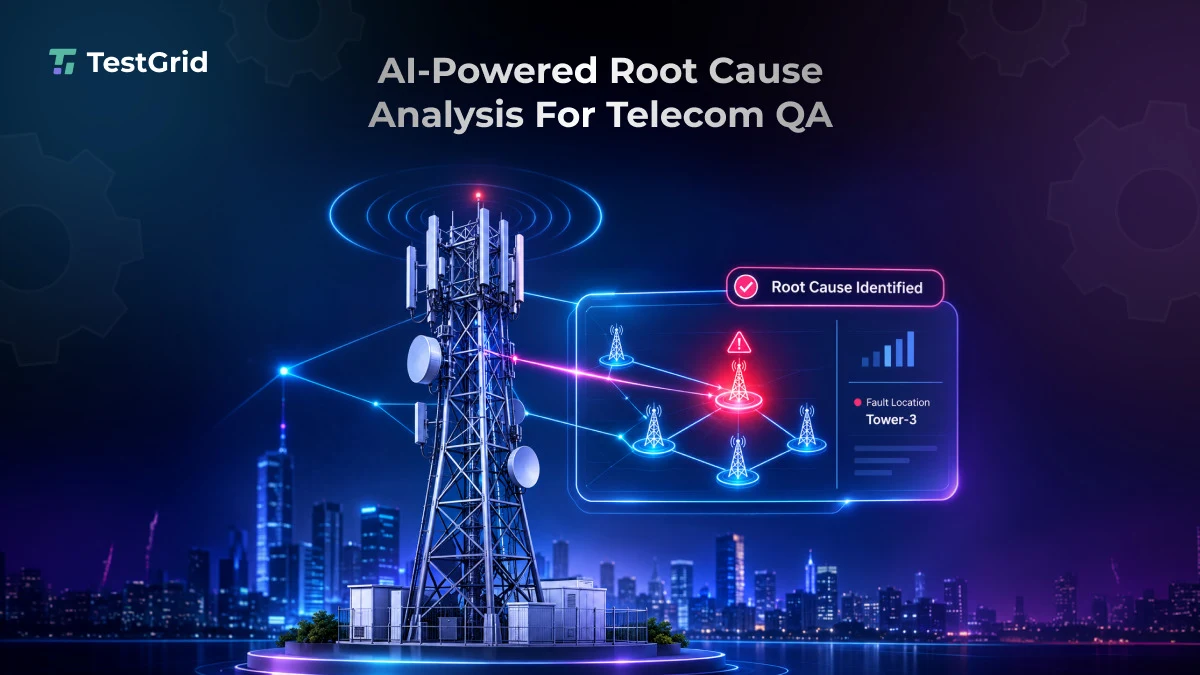
The provider introduced TestGrid’s AI Root Cause Analysis Agent to help QA teams evaluate failed executions using the evidence already captured during the run. Let’s look at how the team applied that approach to mobile failure investigation.
TL;DR
- Initial failure triage became 62% faster: Average classification time for ambiguous mobile failures decreased from 82 minutes to 31 minutes.
- Repeat test runs dropped by 43%: QA engineers could use evidence from the original execution before deciding whether another run was necessary.
- First-review routing accuracy increased from 61% to 86%: More failures reached the appropriate engineering team without repeated reassignment.
The Challenge: Failed Tests Did Not Explain Where Investigation Should Begin
The telecom provider executed regression tests across multiple Android and iOS device and OS combinations. Recharge validation crossed several parts of the customer journey.
The mobile application initiated the transaction, payment confirmation established whether the recharge had succeeded, subscriber account state reflected the purchase, and downstream entitlement processing determined when the data pack became available.
A failure at the final account check could therefore occur even when the payment itself had completed correctly.
When that happened, QA engineers had to reconstruct the execution from test steps, expected and actual results, screenshots, runtime logs, device information, environment details, and test-data state before deciding where the investigation should begin.
In the baseline sample, the team spent an average of 82 minutes reaching an initial classification for these ambiguous failures.
Some scenarios were rerun before the original evidence had been fully evaluated. Others were initially assigned to the wrong engineering team and required another round of triage.
The TestGrid Approach: Start Triage With the Evidence From the Failed Run
The provider added the AI Root Cause Analysis Agent to its existing mobile testing workflow. Tests continued to run on real Android and iOS devices. When a failure occurred, TestGrid retained the execution context from that run.
The RCA Agent correlated evidence such as:
- test-step sequence and checkpoints
- expected versus actual assertions
- runtime logs and error traces
- screenshots and visual evidence captured during the run
- device and OS context
- account and test-data state
- timing between payment confirmation and entitlement validation
From those signals, the agent surfaced likely causes behind each failure and helped QA narrow the areas worth investigating first.
QA engineers checked the suggested explanation against the execution evidence before routing the issue. Engineering teams remained responsible for confirming the actual cause and determining remediation.
How the Team Narrowed a Failed Recharge
During one regression cycle, payment completed successfully for a mobile recharge, but the purchased data entitlement did not appear on the account screen within the expected validation window.
The payment step had passed and the confirmation was correct. The failure occurred when the test checked the updated account state. Previously, the team often reran this type of scenario while separately reviewing logs and downstream behavior.
With the RCA Agent, the QA engineer could review the successful payment steps, the failed entitlement assertion, screenshots, logs, device context, environment details, and account state from the same execution.
The agent ranked a delayed downstream entitlement response among the strongest explanations supported by the available evidence.
The relevant service team confirmed during its own investigation that the entitlement update had arrived outside the expected window. The first escalation therefore began with a narrower, evidence-backed hypothesis and reached the appropriate team on the first pass.
Also Read: AI in Telecom – What to Fix in Legacy Infrastructure First
The Impact: Less Time Reconstructing Failures
The provider evaluated 60 ambiguous mobile failures from the six weeks before rollout and 60 comparable failures from the following six weeks.
The improvement was most visible in failures that previously required several teams to reconstruct the same execution. QA could classify more failures from the first run, avoid reruns performed only to gather missing context, and send issues to engineering with a narrower set of likely causes.
The change also reduced repeated reassignment. More failures reached the appropriate engineering team after the first QA review, which shortened the path from a failed test to a focused technical investigation.
Also Read: Why Conventional QA Fails in Telecom App Testing
Extending the Approach Beyond Recharge Failures
The provider later applied the same investigation workflow to plan changes, authentication failures, account-state updates, and device-specific regressions.
For network-sensitive recharges and data-pack purchases, QA also reproduced failures under controlled network conditions on real devices and compared execution evidence across runs.
This gave the team another way to separate failures associated with timing or connectivity from issues that reproduced consistently under stable conditions.
“Before this, a failed recharge could trigger another run simply because nobody had enough context from the first one. QA, mobile engineering, and the service team could all spend time looking at the same failure from different angles. Now the first handoff starts with enough evidence to narrow where the problem is likely to be.” – Mobile QA Manager, Regional Telecom Provider
Spend Less Time Reconstructing Failed Mobile Tests
If your QA team is rerunning failed mobile journeys just to understand what happened, TestGrid can help you investigate the original execution with the steps, logs, screenshots, device context, and other evidence already associated with the run.
Use the AI Root Cause Analysis Agent to narrow likely causes before the issue reaches engineering, while your team retains control of the final diagnosis and remediation. Book a demo.