 CoTester 2.0 is LIVE! Your Always-Available AI Teammate for Testing.
AI-powered test automation is changing how teams today build tests. These platforms help you create, maintain, and optimize large test suites with very little manual effort through low-code or codeless interfaces.
There are many popular AI testing platforms available, and out of them, Virtuoso QA is a trusted name because of its natural language test authoring, self-healing automation, and intelligent root cause analysis.
But development workflows, testing requirements, team expertise, and budget differ from team to team, which is why Virtuoso QA may not be the best fit for everyone.
In this blog, we’ll compare the best Virtuoso QA alternatives in 2026 to help you identify the one that best matches your automation goals.
Simplify enterprise test automation with TestGrid. Request a free trial.

TL;DR
- TestGrid: AI-powered end-to-end testing with agentic automation, real-device testing, and unified coverage across web, mobile, API, and desktop.
- Testim: AI-driven automation with natural language test creation, intelligent locators, and self-healing for resilient web, mobile, and Salesforce tests.
- Leapwork: No-code AI automation platform for orchestrating enterprise app testing across legacy and modern systems.
- mabl: AI-native testing that automates test creation, maintenance, and execution for continuous quality in Agile and DevOps workflows.
- Functionize: AI-powered functional testing using natural language processing and autonomous test maintenance to simplify automation.
- Katalon: Unified AI-augmented automation for creating, executing, and managing web, API, mobile, and desktop tests in one workspace.
- ACCELQ: AI-enabled codeless automation unifying test design, execution, and lifecycle management across web, mobile, API, and enterprise apps.
- Applitools: Visual AI testing that enhances existing frameworks with intelligent visual validation and UI regression detection.
What Is Virtuoso QA and Why Teams Evaluate Alternatives
Virtuoso QA is an AI-native test automation platform that helps QA teams create tests with natural language and detect and correct typos in real time so that the test flow stays uninterrupted.
The platform’s intelligent Element Identification allows you to make your tests behave like real users. You can test with reusable data to expand coverage and create accurate positive and negative testing scenarios. Virtuoso QA seamlessly integrates with tools such as Jira, Jenkins, TestRail, and Azure DevOps.
Why should you consider Virtuoso QA alternatives?
Although Virtuoso QA is a robust tool, here are some of the reasons why teams look for alternatives:
- High subscription or licensing costs can be a barrier when scaling; Virtuoso QA has custom pricing plans, and users often say that costs can go up when usage increases
- Difficult to adopt and use; because Virtuoso QA is primarily an AI-native tool, a few users report a high learning curve and complex navigation
- Low-code testing may not always provide flexibility for highly customized automation needs
- AI-powered automation can increase execution overhead in large-scale test runs; some Virtuoso QA users have stated slight delays during test execution
- Teams with diverse testing needs may look beyond web-first automation; tools with unified web, mobile, API, desktop, and real-device cloud testing are a key consideration
Also Read: AI in Test Automation: A Detailed Overview
How We Evaluated These Alternatives
The main reason why QA teams prefer using AI-powered test automation platforms is that they can generate, maintain, and optimize test cases faster and minimize manual effort. Therefore, when evaluating Virtuoso QA alternative tools, we focused on the criteria that matter most for modern development workflows.
- Cross-platform support: Coverage across operating systems, browsers, real devices, and app types (web, mobile, desktop, API)
- AI depth and self-healing reliability: AI-powered test generation, self-healing automation, intelligent element recognition, root cause analysis, and autonomous maintenance
- Ease of onboarding: Range of authoring options like no-code and low-code to full-code workflows, as well as documentation, tutorials, templates, and guides
- Pricing model: Availability of free plans or trials, pricing transparency, licensing flexibility, and suitability for startups, growing teams, and enterprises
- Parallel execution capability: Support for executing tests simultaneously across browsers, devices, environments, or cloud infrastructure
- Framework compatibility and integrations: Support for automation frameworks such as Selenium, Playwright, Cypress, Appium, Espresso, and XCUITest
- Enterprise governance and portability: Role-based access control, audit trails, data residency options, code ownership, and the ability to avoid vendor lock-in
Virtuoso QA Alternatives
To help you quickly evaluate the best alternatives to Virtuoso, I’ve put together a comparison table. It highlights their AI-driven features, framework support, code/no-code flexibility, and pricing, so you can see the differences at a glance.
| Tool | AI features | Framework support | Code/No-code | Pricing |
|---|---|---|---|---|
| TestGrid | Agentic AI, AI test generation, self-healing automation | Selenium, Playwright, Cypress, Appium | Low-code, no-code, pro-code | Subscription-based; free trial available |
| Testim | AI test generation, self-healing locators, AI Copilot | JavaScript, Selenium (export), Cypress (migration support) | Low-code, full-code | Custom; free trial |
| Leapwork | AI-powered test generation, AI assistants, visual flow automation | Selenium, Playwright | No-code; limited code extension | Custom |
| mabl | Generative AI, auto-healing, intelligent waits, auto test maintenance | Playwright | Low-code | Custom; free trial |
| Functionize | Natural language authoring, AI test generation, autonomous maintenance | Selenium (export) | Low-code | Custom |
| Katalon | AI Copilot, self-healing, AI test generation, smart execution | Selenium, Appium, Playwright | Low-code, full-code | Subscription-based |
| ACCELQ | AI-assisted test design, self-healing, autonomous automation, impact analysis | Selenium, Appium | No-code | Custom |
| Applitools | Visual AI, AI-powered root cause analysis, layout detection | Selenium, Playwright, Cypress, Appium, WebdriverIO, Espresso | Code-first (SDKs) | Custom |
Best Virtuoso QA Alternatives in 2026
1. TestGrid.io
Best for: Enterprise QA teams needing AI-powered end-to-end automation with agentic testing, real-device validation, and unified test management.

Overview
TestGrid.io is an AI-powered, end-to-end software testing platform. It allows you to design end-to-end tests for your web, mobile, and desktop apps. Plus, if you already have test scripts, you can easily execute them with TestGrid, as the platform offers support for test automation frameworks like Selenium, Appium, and Cypress.
You can assess your websites and apps on real Android and iOS devices and browsers like Safari, Chrome, Edge, and Firefox. Connecting with CI/CD tools like Jenkins, CircleCI, GitHub Actions, and Azure DevOps enables you to run regression tests automatically after every code commit.
You can also execute multiple tests in parallel and reduce the test execution time. Its robust reporting and analytics feature lets you quickly identify and resolve issues. TestGrid has dedicated infrastructure and flexible deployment options, including on-premises and private cloud hosting.
Key features
- Leverage scriptless, record and play, or code mode for creating structured test cases
- Replicate real user interactions to identify areas where navigation or responsiveness might fail
- Write your test cases in English or BDD and upload them via CSV or paste them right into the AI portal
- Automatically repair broken tests by identifying new locators for objects and enhance flaky test management with TestGrid’s AutoHeal technology
- Check usability and visuals of your app’s interface by testing it on real Android and iOS devices
- Get detailed logs, screenshots, and step-by-step results with an advanced analytics dashboard that provides real-time insights after every test execution
Supported integrations
- Azure DevOps, GitHub Actions, CircleCI, Jenkins, Slack, Teams, Selenium, Cypress, Appium
Pricing
- Starting at $199 per seat/month (minimum 4 seats; includes 4 devices/browsers and 5,000 tokens)
Pros
- Flexible scripting options; codeless as well as custom scripting for complex scenarios
- Allows testing across web, mobile, APIs, and desktop for comprehensive coverage
Cons
- The initial setup and feature exploration may take some time, but detailed documentation, guides, and tutorials are readily available
2. Testim
Best for: Development teams wanting AI-assisted web and mobile automation with intelligent test generation.
Overview
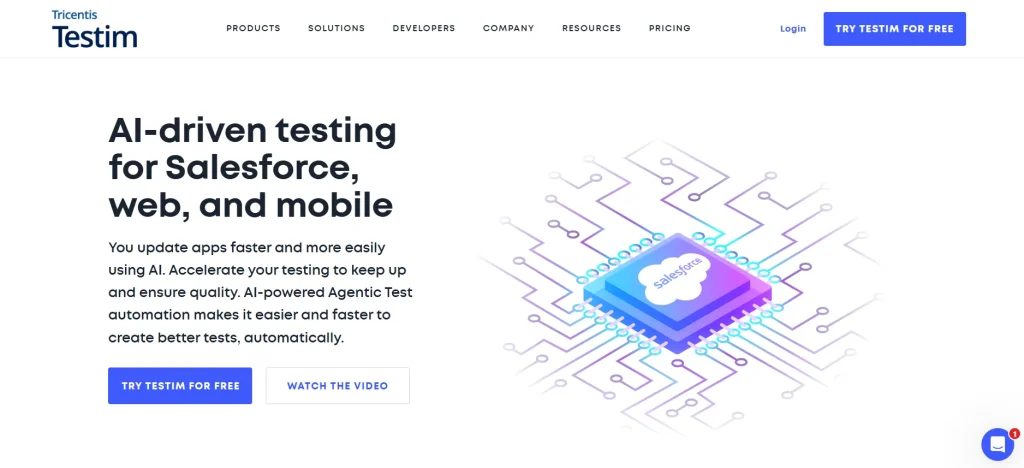
Testim is an AI-powered testing tool that helps you design tests, reduce your time and costs of fixing tests, and make testing a part of your release process. With its AI-based recordings, you can author your tests and capture complex actions easily. This Virtuoso QA alternative gives you unlimited customization options and an option to insert JavaScript where needed.
Key features
- Build tests automatically with the help of custom agent workers; you just need to describe what you want to test
- Identify more elements and learn more about your app with custom locators which use AI and ML
- View which tests map to each change and run the tests based on your changes
- Expedite root cause analysis with error aggregation, suggestions, comparison screenshots, and log analysis
Supported integrations
- Azure Pipelines, Bamboo, CircleCI, Jenkins, TeamCity, GitHub, Bitbucket
Pricing
- Custom plans available on request
Pros
- Users state that the AI-assisted test generation and self-healing significantly save test maintenance
- The interface is easy to navigate and create reusable test steps
Cons
- Advanced test customization may sometimes require coding knowledge
- Some users mention that the initial setup and organizing large test suites can take some time
3. Leapwork
Best for: Enterprises modernizing apps through AI-driven no-code automation and validation across legacy and modern systems.
Overview
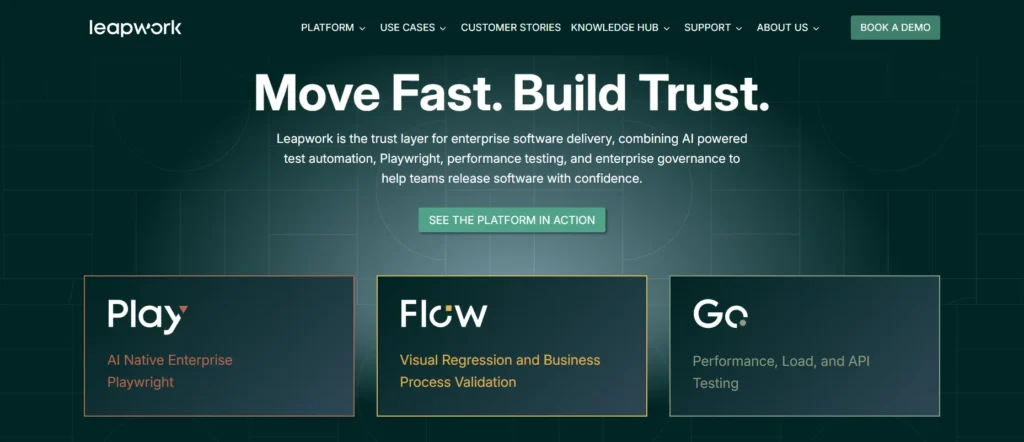
Leapwork is an AI-powered test automation platform with which you can build, manage, analyze, and scale tests for any app or platform. You can create complex test flows visually without code, and pinpoint the root cause of issues via video recordings and activity logs. The platform also allows you to design reusable subflows for common tasks such as login and navigation so you can reduce time spent on scripting and debugging.
Key features
- Keep your testing in pace with AI-driven development across every app
- Leverage deterministic execution to get trusted results across systems so your release decisions rest on evidence
- Bring existing AI models, import Playwright, Selenium, or Cucumber frameworks, and connect GitHub repositories
- Adapt your tests as interfaces shift and reduce manual upkeep with self-healing
Supported integrations
- Jenkins, Azure DevOps, GitLab, GitHub Actions, Playwright, Selenium WebDriver, Cucumber
Pricing
- Request a custom quote for pricing
Pros
- The platform offers a detailed visual view of how automation flow works
- Setting up reusable subflows is easy
Cons
- Some users say that advanced reporting and dashboard features are limited
- Testing native mobile apps can be hard and may require third-party integrations
4. mabl
Best for: Agile & DevOps teams requiring AI-native continuous automation to create, maintain, and recover end-to-end tests.
Overview
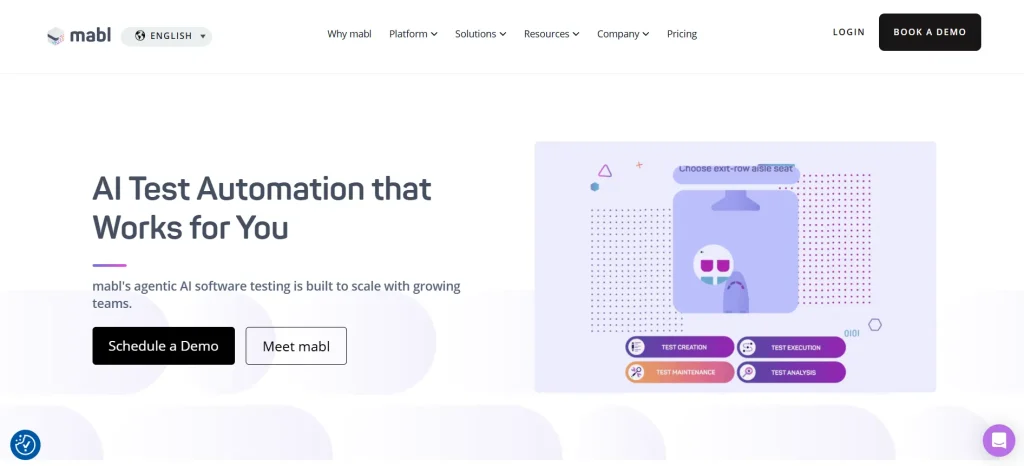
mabl is a unified AI-native cloud-based continuous testing platform that supports web, mobile, and API testing. This Virtuoso QA alternative helps you handle complex elements like Shadow DOM, emails, and PDFs and enables parallel execution of tests across environments. You can discover, reuse, and understand the full context of your test library for faster test impact analysis and simplify testing with mabl’s Agentic Tester.
Key features
- Generate your tests faster in natural language or by pointing to JIRA requirements, for complex scenarios like images and AI chatbots
- Execute your tests seamlessly and proactively watch for performance and visual regressions
- Autonomously triage all failures for immediate root cause insights and actionable recommendations
- Reduce your test maintenance with adaptive auto-healing, which leverages multi-model AI (ML and GenAI)
Supported integrations
- Jenkins, Jira, Azure Pipelines, GitHub, Slack, MS Teams
Pricing
- Customized pricing on request
Pros
- Setting up and implementing systems from scratch is easy
- Creating frontend or API tests is quick
Cons
- Flexibility may be limited for highly custom workflows
- Few users report occasional minor glitches in the interface when scrolling between steps
Also Read: Top 25+ AI Testing Tools and Platforms for QA in 2026
5. Functionize
Best for: QA teams adopting AI with functional test automation, natural language authoring, and autonomous maintenance.
Overview
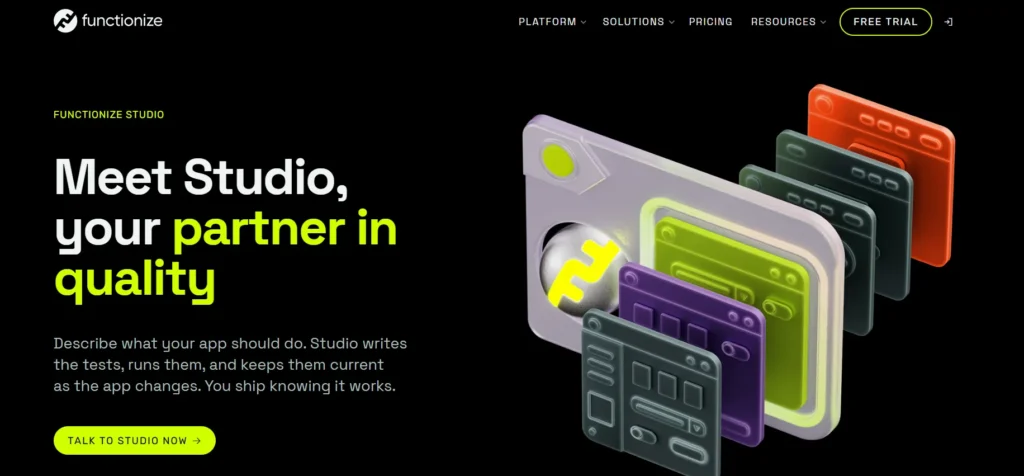
Functionize is an all-in-one AI testing platform that leverages machine learning to understand your site updates and self-heal tests as your app evolves to avoid constant maintenance. With the help of this platform, you can test apps, databases, APIs, .pdf files, Excel sheets, and other digital assets. This is one of the Virtuoso competitors that enables test data generation and highlights bespoke metrics, so you get a deep understanding of your UI performance.
Key features
- Describe your app feature in plain language and automatically build tests, map data, and add them to your suite
- Identify and heal the affected tests mid-run with AI-powered self-healing
- Diagnose a failure, check if it’s a real regression, and fix it
- Map updates with each run and ensure every release has a clear go/no-go signal behind it
Supported integrations
- Jira, TestRail, Azure DevOps, GitHub
Pricing
- Starts at $20 per month; free tier available
Pros
- Advanced algorithms to analyze app behavior reduce the need for manual maintenance
- The platform’s user-friendly interface makes testing accessible to non-technical team members, developers, and QA professionals
Cons
- Advanced AI and NLP-driven features can have a high learning curve
- Some users say that test case execution might occasionally be slow
6. Katalon
Best for: Cross-functional QA teams seeking AI-augmented automation across web, API, mobile, and desktop apps in one platform.
Overview
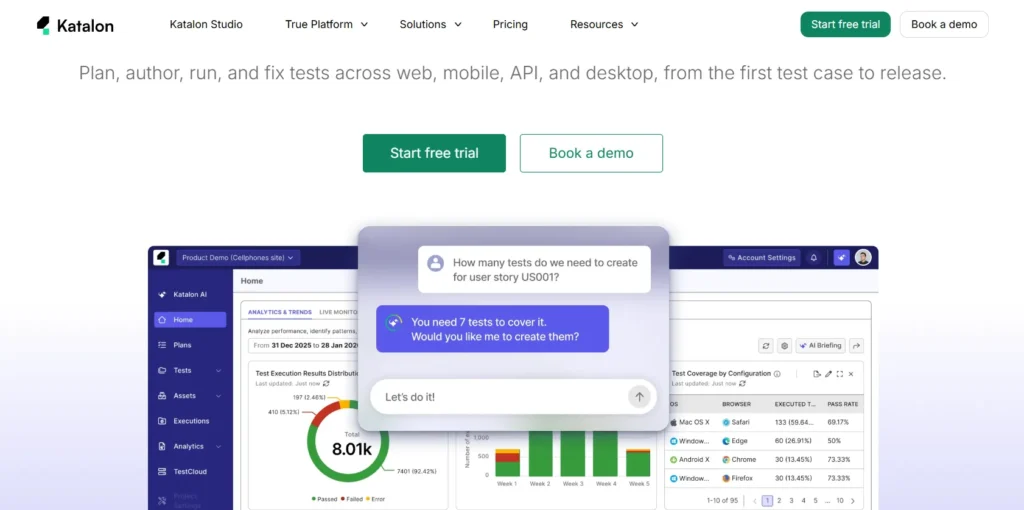
Katalon is an AI-powered test automation platform that helps your testers cut test time, expand coverage, and match quality assurance processes with your release cycles. You can generate, explain, and refine test automation scripts inside Katalon Studio and execute your tests across thousands of devices and browsers in parallel. This is one of the Virtuoso QA competitors that offers support for native mobile testing and REST, SOAP, and GraphQL APIs.
Key features
- Build your automated tests efficiently in no-code, low-code, or full-code
- Leverage AI to optimize your test executions locally, on your CI/CD pipeline, or in the cloud
- Set up your dashboards for real-time visibility into testing progress and coverage gaps
- Observe user interactions, find coverage gaps, and automatically generate missing tests with the help of AI
Supported integrations
- Azure DevOps, Jira, CircleCI, GitLab, Jenkins, GitHub Actions, Cypress, Playwright, Selenium
Pricing
- Starts at $59 per seat per month
Pros
- Users say that customizable scripting and detailed reporting make executing tests easier
- Large online community and customer support
Cons
- The free version of the platform has limited features
- Few users feel that the code merge feature and Git integration need some improvement
7. ACCELQ
Best for: Enterprise testing teams needing AI-enabled codeless automation for test design, execution, and lifecycle management across apps.
Overview
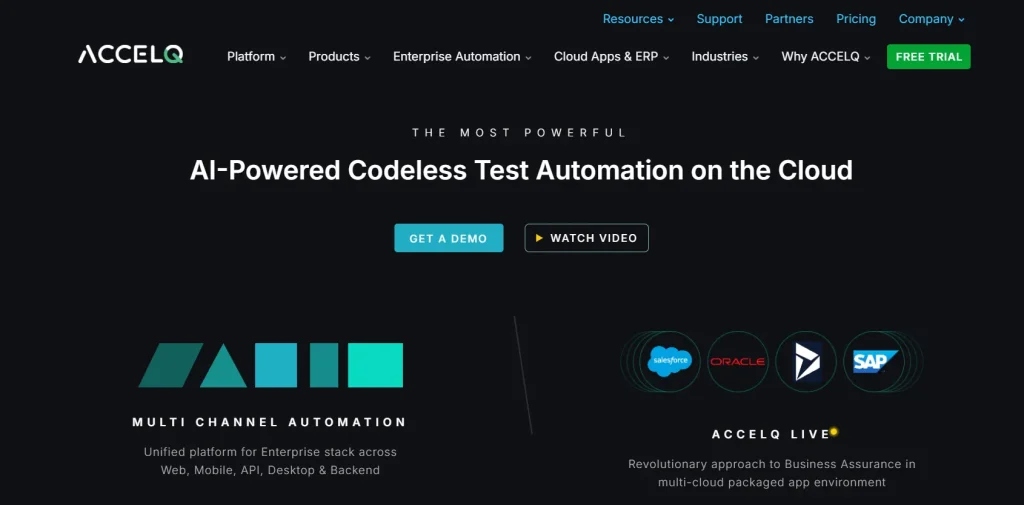
ACCELQ is a cloud-based AI test automation platform, particularly for business processes. Its advanced no-code testing features enable you to create tests for even the most complex real-world scenarios. Its role-based access control helps manage secure collaboration across teams. You can leverage multichannel test automation across mobile, web, desktop, and API, all in a single workflow, and centralize test design, execution, and reporting.
Key features
- Automate faster with AI-powered natural language automation and next-gen recorder
- Build stable automation with intelligent element capture technology and reduce maintenance with self-healing
- Capture the structure of test data based on business semantics
- Run cross-browser tests and cross-platform tests in parallel on cloud or on-premises labs
Supported integrations
- Jenkins, TeamCity, Bamboo, GitHub Actions, CircleCI, Azure Pipelines
Pricing
- Customized pricing available on request
Pros
- The locator-free approach for identifying UI elements using natural language minimizes the scripting effort
- Features like reusable components and centralized test management allow you to improve efficiency
Cons
- Users mention that creating complex test scenarios may sometimes take more time
- The reporting features have limited customization options
8. Applitools
Best for: Teams enhancing automation with AI-powered visual regression testing and intelligent UI validation across browsers and devices.
Overview
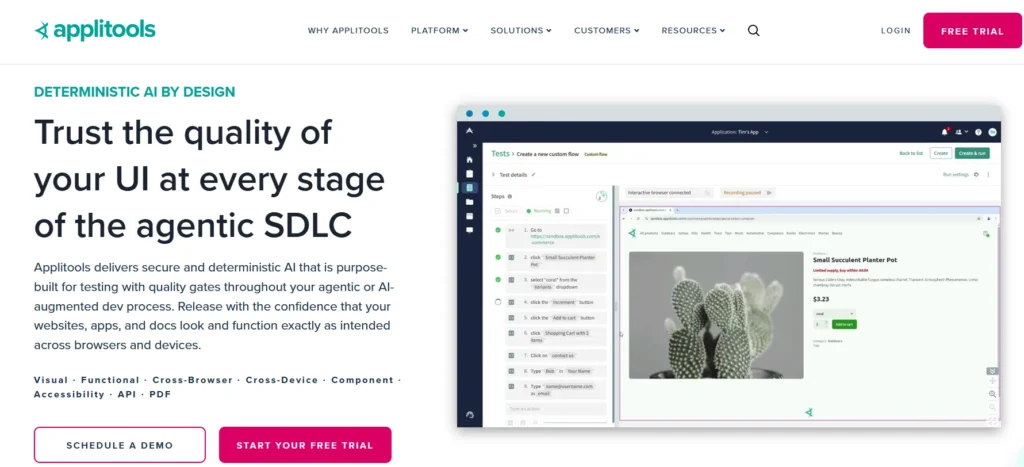
Applitools is an AI-driven testing platform where you can write, validate, execute, and analyze tests as well as eliminate tedious maintenance. You can evaluate your web apps, SaaS apps, B2B browser-based apps, and native mobile apps on iOS and Android devices. This Virtuoso QA alternative supports on-prem and cloud deployment options and is ISO 27001 and SOC 2 Type II compliant.
Key features
- Build end-to-end tests covering visual, functional, and API validation, all within a single test with AI
- Use the recorder to create complex tests without writing code and create synthetic data to expand coverage
- Enter your website or application domain into the site crawler or upload a list of URLs to generate tests automatically
- Reduce test maintenance with the help of self-healing locators
Supported integrations
- Jenkins, GitLab, Travis, GitHub, Jira, Slack, Selenium, Cypress, WebdriverIO
Pricing
- Custom plans
Pros
- The root cause analysis feature is useful for comparing side-by-side DOMs
- Some users state that the visual testing is precise and can help catch even the smallest UI changes that normal automation usually misses
Cons
- Creating and managing baselines might take some time in the beginning
- Test maintenance can be time-consuming if there are a large number of visual changes happening frequently in the UI
Learn More: Top 32 Automation Testing Tools of 2026: What’s New and What’s Next
Which Virtuoso QA Alternative Should You Choose?
The alternatives to Virtuoso QA that you finalize will depend on your unique testing needs, app or product type, and team’s skills.
Testim is a good fit for dev teams who prioritize AI-assisted web and mobile automation with code extensibility. Leapwork suits enterprises standardizing business process automation through a no-code interface.
mabl is ideal for continuous web app testing. You can opt for Functionize if you need natural language-driven functional automation. Katalon offers balanced cross-platform testing for mixed-skill teams.
ACCELQ is suited well for enterprises who’re seeking AI-powered codeless lifecycle automation. And Applitools is the right choice when AI-driven visual validation is the primary requirement.
However, if you’re looking for unified, end-to-end test automation across web, mobile, APIs, desktop apps, and cross-platform testing on real devices and browsers, TestGrid.io is your strongest fit.
The platform allows your team to automate creation, execution, and maintenance of large-scale test suites and also supports self-healing, parallel execution, CI/CD integration, reporting, and test management.
See how TestGrid fits your AI-powered testing strategy and enables long-term automation at scale. Request a free trial.
Frequently Asked Questions
Can you migrate from Virtuoso QA to Virtuoso test automation alternatives?
Yes. But the migration to Virtuoso automation alternatives depends on the target platform and how your tests were created. Since Virtuoso is a low-code platform, you may need to recreate or adapt tests when moving to code-based platforms, while reusing test scenarios, data, and CI/CD integrations where possible.
How do you compare TestGrid vs Virtuoso QA for test automation?
Virtuoso QA is ideal for teams who are prioritizing AI-driven low-code test authoring and simplified test creation. TestGrid is better suited if you’re looking to combine AI-powered automation with flexible authoring options, enterprise-grade governance, and test orchestration from a single platform.
Which is the best alternative to Virtuoso QA for enterprise teams?
Enterprise teams generally look for AI-powered automation that can scale across large test suites, integrate with existing DevOps workflows, enable parallel execution, and minimize maintenance. Some of the strongest Virtuoso QA alternatives include TestGrid, ACCELQ, Katalon, and mabl. Each of these offers enterprise-grade AI capabilities, collaboration features, and scalable cloud execution.
Which Virtuoso QA alternative is better for teams that prefer coding?
Some of the Virtuoso QA alternatives for teams who need scripting flexibility are TestGrid, Testim, Katalon, and Functionize. These have code-first and hybrid authoring alongside AI features such as intelligent test generation, self-healing, and automated maintenance.


