CoTester 2.0 is LIVE! Your Always-Available AI Teammate for Testing.
- What Does the Use of Machine Learning Mean in Test Automation?
- Machine Learning Techniques That are Applied in Test Automation
- Where Exactly Does Machine Learning Help in Test Automation
- Different Test Types Where You Can Leverage Machine Learning
- Problems of Machine Learning in Testing and How to Solve Them
- Leverage Machine Learning for Smarter Test Automation with CoTester
- Frequently Asked Questions (FAQs)
- 1. What is machine learning in test automation?
- 2. How does ML differ from traditional test automation?
- 3. What are the key use cases of machine learning in software testing?
- 4. How does ML enable self-healing tests?
- 5. Can ML-based testing be integrated into existing CI/CD pipelines?
- 6. What ML algorithms are most commonly used in software testing?
- 7. What types of bugs does ML-powered testing catch best?
- 8. How does ML improve regression testing efficiency?
Machine learning (ML) is not merely experimental anymore. Organizations across industries are applying it for different tasks like fraud detection, customer support automation, demand forecasting, and personalized recommendations.
In the test automation sector as well, QA teams are increasingly leveraging machine learning to relieve the burden of manual testing, streamline failure analysis, and optimize overall testing effectiveness.
A study shows that machine learning is the dominant sub-segment of AI-enabled testing, capturing an estimated 37.48% of the total market share.
In this blog, we will learn about machine learning in test automation, the testing activities it can enhance, its limitations, and the best practices for implementing it effectively.
Leverage intelligent test automation with CoTester. Request a trial.
TL;DR
- Machine learning in test automation refers to the use of data-driven algorithms that learn from historical testing data to improve quality assurance decisions and outcomes
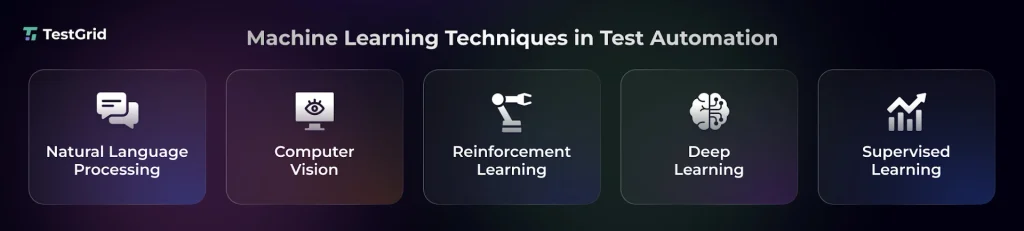
- Different techniques of machine learning in test automation include natural language processing, computer vision, reinforcement learning, deep learning, and supervised learning
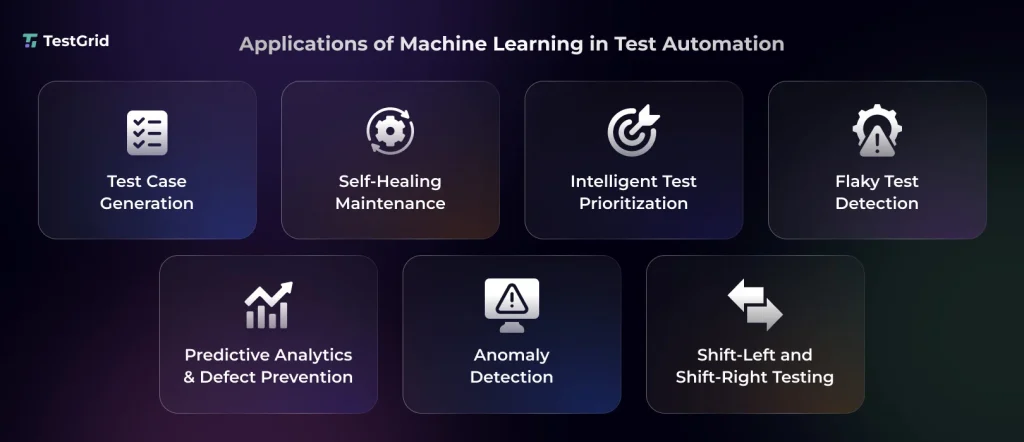
- You can use machine learning for test case generation, self-healing maintenance, test prioritization, flaky test detection, defect prevention, and anomaly detection
- The different types of tests machine learning can enhance are regression, visual, unit, API, UI, cross-browser, and continuous testing
- Some of the challenges of machine learning in test automation are bad predictions, explainability issues, and integration complexity
- Challenges of testing in ML can be solved by implementing data-driven pipelines, retraining models, verifying model reasoning, and implementing phased adoption to reduce compatibility issues
What Does the Use of Machine Learning Mean in Test Automation?
Machine learning is basically a subset of AI that enables software testing systems to learn from data and improve their outputs without explicitly being programmed for every scenario.
ML models can assess quality signals from sources like code repositories, test executions, production telemetry, application logs, and user interactions, and then assist your QA team in different testing operations like test generation, predictive selection, defect resolution, test suite health monitoring, and fault localization.
Since testing environments and apps are becoming more complex, some QA teams are adopting automated machine learning (AutoML) because it’s making model development easier by automating tasks such as model selection, feature engineering, and hyperparameter tuning.
Machine Learning Techniques That are Applied in Test Automation
These are some of the software testing machine learning algorithms techniques that you must know about.
1. Natural language processing
NLP (natural language processing) allows the test automation tools to understand and interpret natural human language from the user stories, requirements, test scenarios, and bug reports, and then automatically generate tests from them.
Many modern NLP systems use transformer-based models to convert your plain language instructions into executable test scripts.
NLP can be particularly helpful for customer journey-driven testing where the ML systems extract end-to-end user workflows, map critical interaction paths, and generate test scenarios that closely resemble expected user behavior.
2. Computer vision
Computer vision enables the test automation systems to analyze the visual elements of your app, just like human testers. It leverages deep neural networks and image recognition models to identify the UI components, spot visual regressions, and verify your app’s layouts.
Computer vision can be extremely helpful if you want to automate visual testing for dynamic interfaces.
3. Reinforcement learning
Reinforcement learning is an ML technique where your AI testing tool or agent interacts with the app, receives feedback on their actions, and learns through trial and error.
You can apply this approach to explore your app’s workflows, identify effective test paths, and optimize your test execution strategies over time by continuously improving decisions based on test outcomes, rather than depending on predefined rules.
Monte Carlo Tree Search (MCTS) is often used alongside reinforcement learning to explore different app paths and determine the high-value workflows for testing.
4. Deep learning
Deep learning mainly leverages multi-layered neural networks to recognize complex patterns in large volumes of data.
Deep learning models like RNNs (Recurrent Neural Networks) and LSTMs (Long Short-Term Memory) can process sequential data, including your execution logs, test results, defect histories, failure patterns, and user interactions, and uncover trends for predictive testing.
You can apply deep learning for intelligent test generation, defect prediction, and anomaly detection.
Also Read: Why Small Language Models Are the Quiet Game-Changers in AI
5. Supervised learning
Supervised learning algorithms like KNN (K-Nearest Neighbors) train on labeled historical datasets, where the correct output is already known. The model learns from the relationship between inputs and outcomes to make predictions on the new data.
So, in machine learning automation testing, you can use supervised learning to classify test cases, analyze failures, and prioritize tests for high-risk modules.
Many teams combine supervised, unsupervised learning (pattern discovery from unlabeled data), and semi-supervised learning (training with both labeled and unlabeled data) to build more accurate machine learning systems for test automation.
Where Exactly Does Machine Learning Help in Test Automation
Here are some important purposes of testing in machine learning.
1. Test case generation
ML testing tools, which have generative AI integration, can help you efficiently generate test cases at scale for broader code coverage by evaluating the requirements, your app’s behavior, expected outcomes, and your existing test repositories.
Rather than manually mapping out the test scenarios, ML models can recommend relevant test cases, uncover missing coverage areas, and suggest edge cases based on patterns they found in your past test data and test artifacts.
ML-powered testing systems also implement genetic algorithms to refine test inputs and explore app flows that may be difficult to reach via test cases that are designed manually.
2. Self-healing maintenance
Machine learning in automation testing can help you significantly minimize your manual test maintenance efforts through self-healing mechanisms.
When your UI elements change because of updates in attributes, labels, or page structure, similarity models can compare the modified elements with previously identified ones to find the closest match, so the test can adapt to minor interface changes and continue execution instead of failing immediately.
3. Intelligent test selection and prioritization
You can optimize your test execution by selecting and prioritizing the tests that are most likely affected by a code change.
Models like GBMs (Gradient Boosting Machines), XGBoost, and LightGBM can assess your past test results, code modifications, and execution data to predict risk levels across different app areas.
With the help of these predictions, your QA team can prioritize executing critical tests first, reduce test suite bloat through test reduction, and shorten overall test execution time.
4. Flakiness detection
ML testing systems allow you to detect flaky tests that generate inconsistent results despite no changes in your app’s code.
Autoencoders are a type of neural network which studies your previous test results and data to learn what normal looks like and then highlights in case there are any deviations.
So if any of your tests show unusual failure patterns, execution times, or result inconsistencies, the model flags it so you can differentiate genuine defects from flaky tests.
5. Predictive analytics and defect prevention
Decision trees can make predictions by following a series of branching decisions based on your input data, and random forests help improve prediction accuracy by combining the results of multiple decision trees.
These models and algorithms (like Naïve Bayes) evaluate developer activity metrics, project data, and code complexity to forecast the areas of your app that can contain defects.
This helps you perform risk-based testing, accelerate root cause analysis, and fix potential defects before they affect your users.
6. Anomaly detection
Anomaly detection models are designed to identify outliers within established patterns which lets you pinpoint system irregularities, unexpected failures, or performance degradations in your app.
Some ML-based test automation systems leverage SVMs (support vector machines) to spot anomalies by learning the boundary of normal system behavior and identifying data points that fall outside that boundary.
Also Read: AI Model Testing: Methods, Challenges, and How to Test AI Models
7. ML-powered shift-left and shift-right testing
Machine learning in test automation can support shift-left testing by helping you identify quality risks earlier in the development cycle using signals from code changes, testing data, and static code analysis results.
With the help of test automation and machine learning models, you can also assess production metrics, testing signals, and user feedback to uncover issues that happen after deployment and enhance shift-right testing.
This can be particularly useful in agile development and continuous delivery because your team gets quality feedback throughout the SDLC.
Different Test Types Where You Can Leverage Machine Learning
Machine learning in software testing enables you to improve multiple types of tests that cover all the critical functions and workflows of your app, and helps you strengthen test coverage, test analysis, prioritization, maintenance, and defect resolution across your software development lifecycle.
These are some of the most important tests that machine learning can optimize:
- Regression testing highlights the high-impact test cases and forecasts which areas of your app may get affected because of code changes
- Visual testing detects visual regressions, layout shifts, rendering issues, and UI inconsistencies across different screens and devices that your users rely on
- UI testing enables self-healing automation by identifying UI elements when locators or attributes change
- API testing assesses API responses and behavior patterns to uncover anomalies, failures, or unexpected changes
- Unit testing recommends which tests to include and finds code modules that have a higher probability of containing defects
- Cross-browser testing detects browser-specific rendering issues and tests in environments that are likely to experience compatibility failures
- Continuous testing – optimizes test execution pipelines by selecting and running the most relevant tests for each build
- In-production testing (e.g., canary testing) – monitors production metrics and user behavior to find potential issues before full-scale deployment
Problems of Machine Learning in Testing and How to Solve Them
1. Poor data leads to bad predictions
Testing machine learning models is effective only when you train them with good-quality data.
Since many testing tools support autonomous testing, incomplete, outdated, inconsistent, or biased training data, or errors in historical defect data and execution logs, can lead to inaccurate predictions, unreliable risk assessments, and irrelevant test case prioritization.
| Best practice You can implement data-driven pipelines that collect, validate, and update data from reliable sources continuously. Also, regularly check the training data to find incomplete records and retrain your models periodically with fresh execution data to improve prediction accuracy. |
2. Explanability and trust issues
ML models that work like black boxes can make it tough for your QA team to understand how a prediction or recommendation was generated. If your model flags an anomaly but doesn’t give you clear reasoning for it, your team may hesitate to trust the output.
| Best practice Conduct a gap analysis between your model’s predictions and the actual test outcomes. Make sure you minutely review the false positives, missed defects, and incorrect recommendations. This will help you recognize the model’s weaknesses, optimize outputs, and build reliability over time. |
Learn More: How to Ensure Trust in AI Testing
3. Complex integration
It may be difficult to integrate machine learning testing systems with your existing test management tools, CI/CD pipelines, defect trackers, or monitoring platforms because these systems may use different data formats, APIs, and integration mechanisms.
Compatibility issues can complicate your model training and deployment.
| Best practice Start with one critical use case, like test case generation. Integrate the required data sources first, check the results in a controlled environment, and expand adoption gradually when you’re confident about the model’s performance. |
Leverage Machine Learning for Smarter Test Automation with CoTester
CoTester AI testing agent leverages agentic AI and machine learning to help QA teams with automated test generation, execution, and maintenance while requiring minimal manual effort.
You can share your requirements docs, user stories, or paste URLs, and explain to the agent what your testing goals are in plain language. It understands your product’s context and then generates detailed executable tests for you.
You can easily refine your tests via a chat interface, self-heal tests if your UI elements undergo changes, and schedule test runs aligned with your delivery timelines.
This agent enables you to automate test execution across real devices and browsers, provides detailed results including logs and screenshots, and continuously learns from every feedback loop to improve the accuracy and efficiency of your test automation processes.
CoTester keeps your teams in control through human validation checkpoints, editable test steps, and custom pipeline hooks.
Build more adaptive test automation with CoTester. Request a free trial.
Frequently Asked Questions (FAQs)
1. What is machine learning in test automation?
Machine learning in test automation is basically the use of algorithms that learn from past testing data, app behavior, and test execution history to improve testing activities. ML systems identify patterns, make predictions, and generate insights that help you optimize tasks such as test generation, bug prediction, test prioritization, and anomaly detection.
2. How does ML differ from traditional test automation?
Traditional test automation generally depends on predefined scripts, rules, and assertions to perform tests and verify expected outcomes. Machine learning in software testing adds an adaptive layer, which helps QA teams assess large volumes of testing information and improve testing activities over time.
3. What are the key use cases of machine learning in software testing?
You can apply machine learning software testing for test case generation, self-healing test maintenance, intelligent test selection, predictive analytics, bug classification, anomaly detection, debugging assistance, synthetic test data generation, and test log interpretation.
4. How does ML enable self-healing tests?
Machine learning enables testing systems to interpret element attributes, DOM structures, and historical execution data to identify alternative locators when UI elements change or update. This allows your tests to adapt rather than failing.
5. Can ML-based testing be integrated into existing CI/CD pipelines?
Yes, you can easily integrate ML-based testing into your existing CI/CD pipelines. Tools like CoTester connect with the major CI/CD platforms like Azure DevOps, Jenkins, and GitHub Actions and let you automate test creation, execution, analysis, and maintenance at scale.
6. What ML algorithms are most commonly used in software testing?
Some of the most common machine learning test automation algorithms include decision trees, random forests, support vector machines (SVMs), neural networks, clustering algorithms like K-means clustering, and anomaly detection models.
7. What types of bugs does ML-powered testing catch best?
You can catch issues like regression defects, flaky tests, performance degradations, UI inconsistencies, compatibility issues, flaky failures, and unexpected behavior changes in your apps with ML-driven testing.
8. How does ML improve regression testing efficiency?
Machine learning QA can help you improve regression testing by flagging the areas in your app that were affected due to a code change, so that you run only the relevant tests. This way, you can reduce test suite execution time and redundant testing and get feedback faster.