


Trigger Tests Directly From Code Change With A Version Control Agent
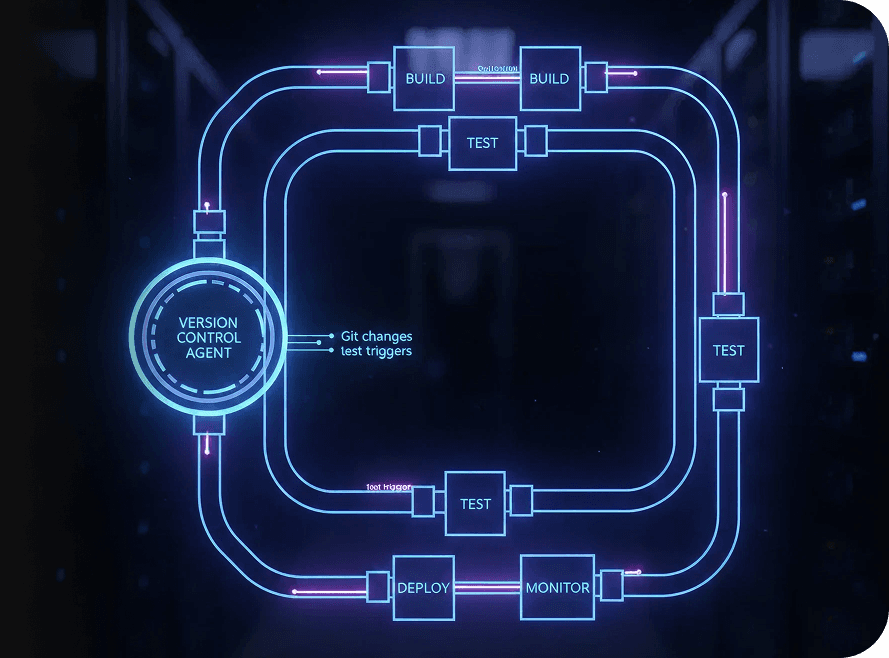
Ensure every change made to test suites, test data, and testing projects is automatically recorded in version control. Our agent commits updates into your repository so test assets follow the same governance, history, and traceability standards as application code.


When the Version Control Agent Activates
Commits pushed to monitored branches
Pull request creation or updates
Merges into shared or release branches
Tag creation or release markers
What the Version Control Agent Analyzes
Files and directories changed in each commit
Branch context and merge targets
Commit scope, frequency, and proximity to release
Historical test coverage associated with modified areas
Change-Based Test Execution Without Pipeline Noise
Rather than launching full regression on every Git event, the agent enables change-based test execution. Tests associated with modified code paths are prioritized, while unrelated suites are deferred. This reduces unnecessary pipeline load.


Automated Test Triggering With Human Oversight
The Version Control Agent initiates automated test execution, but it doesn’t bypass approval workflows or quality gates. You decide which branches trigger tests, which changes require expanded validation, and which test suites are mandatory regardless of change size. Nothing executes invisibly.
Request Free TrialWorks Within CI/CD, Not Outside It
The Version Control Agent integrates with existing CI/CD systems to coordinate Git-based test triggering. It doesn’t replace your pipelines or introduce parallel execution paths. Its role is to improve signal quality at the entry point of testing by ensuring execution starts for the right reasons.
Frequently Asked Questions (FAQs)
How is a version control agent different from standard CI triggers?

Standard CI triggers rely on static rules such as branch names or schedules. A version control agent evaluates Git activity itself, enabling Git-based test triggering that responds to what actually changed in the code rather than blindly triggering every test run.
How is a version control agent different from standard CI triggers?
Standard CI triggers rely on static rules such as branch names or schedules. A version control agent evaluates Git activity itself, enabling Git-based test triggering that responds to what actually changed in the code rather than blindly triggering every test run.
Does Git-based test triggering replace my existing CI/CD setup?
No. The version control agent works within your existing CI/CD pipelines. It coordinates CI/CD test triggering based on Git changes but doesn’t replace pipelines, build tools, or approval workflows.
Does Git-based test triggering replace my existing CI/CD setup?
No. The version control agent works within your existing CI/CD pipelines. It coordinates CI/CD test triggering based on Git changes but doesn’t replace pipelines, build tools, or approval workflows.
Can the version control agent trigger different tests for different branches?
Yes. The agent supports change-based test execution by evaluating branch context. You can configure different test triggering behavior for feature branches, release branches, and protected branches.
Can the version control agent trigger different tests for different branches?
Yes. The agent supports change-based test execution by evaluating branch context. You can configure different test triggering behavior for feature branches, release branches, and protected branches.
How does the agent handle large commits or batch merges?
For large or high-risk changes, the version control agent can trigger expanded validation. Change magnitude, commit frequency, and proximity to release are considered when initiating automated test triggering.
How does the agent handle large commits or batch merges?
For large or high-risk changes, the version control agent can trigger expanded validation. Change magnitude, commit frequency, and proximity to release are considered when initiating automated test triggering.
What happens if teams want to override test execution decisions?
All test execution from Git changes remains fully visible and configurable. Teams can override triggers, force additional test runs, or mark critical test suites as mandatory regardless of detected change impact.
What happens if teams want to override test execution decisions?
All test execution from Git changes remains fully visible and configurable. Teams can override triggers, force additional test runs, or mark critical test suites as mandatory regardless of detected change impact.