CoTester 2.0 is LIVE! Your Always-Available AI Teammate for Testing.
- What is Functionize?
- Why Teams Look for Alternatives to Functionize
- Top Functionize Alternatives
- Functionize Alternatives for Test Automation
- How to Choose the Right Functionize Alternative
- Rounding Off
- Frequently Asked Questions (FAQs)
- What is the best alternative to Functionize?
- Which Functionize alternatives support agentic AI for test automation?
- Which Functionize alternative is best for real device testing?
- Which Functionize alternative is best for teams with no coding skills?
- Which Functionize alternatives are best for small to large teams?
If you frequently add updates or new functions to your app, you must have noticed that managing tests can become extremely difficult, particularly when speed and accuracy are your priorities.
AI-powered automated UI testing uses artificial intelligence to create, execute, and maintain UI tests with less manual effort. Most QA teams today use AI-driven test automation tools to reduce manual effort, scale testing, and efficiently manage large test suites. One prominent platform in this space is Functionize.
However, different testing needs often lead teams to evaluate alternative solutions. In this blog, we’ll help you compare the best Functionize alternatives in 2026 by exploring why teams look beyond Functionize and the key factors to consider before choosing a platform.
To access an AI-powered, enterprise-grade test automation platform, opt for a free trial with TestGrid.

TL;DR
- TestGrid: AI-powered test automation platform offering codeless scripting, real device cloud testing, and scalable web, mobile, API, and cross-browser coverage
- Testim: AI-driven test automation tool that enables fast test creation, self-healing locators, and parallel execution for modern web and mobile apps
- Applitools: Visual AI testing specializing in detecting UI regressions across browsers, devices, and screen resolutions with high accuracy
- Mabl: Cloud-native, AI-powered test automation platform that supports end-to-end web, API, and accessibility testing
- TestComplete: Scripted and keyword-driven functional test automation for desktop, web, and mobile apps with strong data-driven testing support
- Virtuoso QA: AI-first test automation platform with natural language test authoring, self-healing execution, and end-to-end workflow validation
- UiPath: Enterprise-grade test automation solution offering low-code authoring, agentic AI capabilities, and deep integration with complex business apps
- Autify: No-code test automation tool for web and mobile apps with self-healing tests and parallel cross-browser execution
- Sauce Labs: Continuous testing cloud providing real device and browser coverage, CI/CD integrations, and scalable execution for web and mobile testing
- Tosca: Model-based, codeless test automation platform designed for enterprise environments with end-to-end, risk-based testing
What is Functionize?
Functionize is an AI-powered test automation platform that offers you a collection of GenAI testing tools to automate tests for web applications, APIs, and other complex applications.
Functionize leverages machine learning to understand site updates and self-heal tests automatically as your app changes. The platform also comes with an automation cloud to help you eliminate infrastructure overhead.
Why Teams Look for Alternatives to Functionize
We know Functionize is a strong and capable AI-powered automated UI testing platform that offers advanced features like object recognition, codeless test creation, and intelligent test maintenance. But it also has certain limitations.
- Switching tabs when you’re recording a test with Architect can cause screenshot issues
- Users may face Safari-related limitations. File uploads are restricted by Safari’s security features, and video playback with Safari or Mobile Safari is not supported.
- It offers custom pricing, which can make it difficult for teams to estimate costs
- Tests may consume more time and resources when working with large datasets.
- You may need time to understand and optimize the AI-driven features
Top Functionize Alternatives
Functionize is an AI-powered test automation tool known for self-healing and codeless testing. However, many teams look for alternatives when they need better scalability, wider integrations, more control over test execution, or lower costs.
Below will cover the top alternatives to Functionize for web, mobile, API, and visual testing, helping teams choose the right tool based on testing needs, CI/CD compatibility, and long-term automation goals.
| Tool name | Best features | Integrations and plugins | Pricing |
|---|---|---|---|
| TestGrid.io | AI-powered web, mobile, API, cross-browser, visual, and performance testing; agentic test automation, self-healing intelligence | Appium, Selenium, Cypress, CircleCI, TravisCI, GitLab, Jira | Starts at $199 per month; free tier available |
| Testim | AI-driven test authoring, root cause analysis with error suggestions, flexible execution across web, mobile, and Salesforce apps | Jenkins, Azure DevOps, Selenium, Appium, Slack, Teams | Custom |
| Applitools | Visual AI to detect UI changes across screens and devices, self-healing tests, autonomous test creation, and execution | Cypress, Selenium, WebDriverIO, Playwright, Watir, Appium, Expresso, Jenkins | Starts at $969 per month |
| Mabl | Agentic test automation for web, mobile, and APIs, cross-browser testing, parallel execution, advanced accessibility, and performance checks | Jira, Azure Pipelines, Jenkins, Bamboo, CircleCI, GitHub, Slack | Custom |
| TestComplete | Record and playback test creation, integrated text visualizer, supports extension, and SDK for custom plugins | Jira, Jenkins, GitHub Actions, LoadNinja, GitLab, Zephyr, Selenium, Appium | Custom |
| Virtuoso QA | Natural language test authoring, UI testing, API testing, detailed reports, and analytics for faster root cause analysis | Microsoft Azure, GitHub, Jenkins, CircleCI, XRay, Jira, Slack | Custom |
| Leapwork | Fully visual, no code test authoring, native CI/CD integrations, compliance-ready audit trails, hyper-visual debugging | Jenkins, Azure DevOps, Bamboo, TeamCity, Jira | Custom |
| UiPath | Enterprise agentic testing, low code and full code test creation, parallel execution, full test management with version control | Azure DevOps, Jenkins, GitHub Actions, Jira, Snowflake | Starts at $25 per month |
| Autify | No-code test automation for web and mobile apps, flexible locator maintenance, supports cross-browser and cross-device testing | GitHub, CircleCI, Jenkins, GitLab, Azure Pipelines | Starts at $3600 per pear; free plan available |
| Sauce Labs | Unified continuous testing cloud, AI-powered insights, access to real devices, performance measurement | GitHub Actions, Jenkins, CircleCI, Travis CI, Selenium, Espresso, Appium, Playwright | Starts at $49 per month |
| Tosca | Model-based test automation, codeless test creation, offers cloud, hybrid, and on-prem deployments | Selenium, Cucumber, Jenkins, Jira, VersionOne | Custom |
Functionize Alternatives for Test Automation
1. TestGrid.io

TestGrid.io is an AI-powered end-to-end testing platform designed to build, execute, and maintain web and mobile app tests at scale. Its codeless automation feature helps you write complex test cases easily and build logical workflows.
It offers you integrations with CI/CD tools such as Jenkins and CircleCI, and support for multiple testing frameworks and languages such as Selenium, Cypress, JUnit, Python, Java, and C#.
The platform also offers an enterprise-grade AI agent for software testing, TestGrid CoTester, which helps you create and execute tests faster. Its autoheal engine, AgentRx, automatically repairs your broken tests by identifying new locators for objects. This makes test maintenance easy.
Key features
- Write your test cases in English or BDD and upload them via CSV or paste them right into the AI portal
- Upload and inject images, barcodes, and QR codes into the device camera during tests so your app handles various formats accurately and extracts information reliably
- Catch even the slightest visual deviations without adding any external SDK with the advanced visual testing feature
- Perform UI and API tests for comprehensive coverage and to detect issues early
- Test usability and visuals on your app’s interface by testing it on real Android and iOS devices
- Test for key KPIs, such as response time and error rate, with performance testing
Pricing
- Starter Package: Starts at $199 per seat/month (minimum 4 seats; includes 4 devices/browsers and 5,000 tokens)
- Growth Package: Custom pricing (includes all Starter features + marketplace integrations)
- Enterprise Test Infra (On-Prem / Hosted): Custom pricing (dedicated test lab for segregated enterprise teams)
Use cases
- Best choice for teams who need flexible testing infrastructure (private cloud, public cloud, on-premise)
- Low-code/no-code test automation works well for both technical and non-technical users
Limitations
- If your team is new to AI test automation, it might need some effort during onboarding, but support is always readily available
2. Tricentis Testim

Testim is an AI-powered testing platform that helps you create tests autonomously using natural language and execute them on a wide variety of virtual devices in the cloud. You can also run parallel, cross-browser tests on Selenium-compatible grids. Integrate Testim across your CI/CD process to test every code check-in and end-to-end tests, as well as schedule full regression suites.
Key features
- Create tests by recording simple actions like clicks and text entry, and even more complex actions like drag-and-drop
- Share steps and groups of steps across tests, and reduce duplication and simplify maintenance
- Modify recorded tests in the Testim visual editor; delete, record, or add steps
- Insert custom JavaScript into any test step to perform front-end and server-side actions
Pricing
- Testim Salesforce
- Testim Web
- Testim Mobile
- Testim Copilot
Custom pricing available for all pricing plans.
Use cases
- Best when you need to scale across browsers, platforms, and devices in parallel
- Supports AI-driven smart locators that adapt to app changes and make it easier for you to maintain dynamic mobile/web apps
Limitations
- Heavy reliance on JavaScript for flexibility may not suit teams that prefer codeless testing
- You might experience performance lags when executing large volumes of tests
3. Applitools

Applitools is an all-in-one platform that allows you to write, validate, execute, and analyze tests while eliminating tedious maintenance. You can test your web apps, SaaS apps, B2B browser-based apps, and native mobile apps on iOS and Android devices. Applitools can be deployed in your own infrastructure inside your firewall for maximum security or run in a dedicated cloud on Amazon, Azure, or GCP.
Key features
- Author your tests in plain English, with a test recorder, or using frameworks like Selenium, Cypress, and Playwright
- Execute your tests across thousands of different browsers and devices
- Validate your UI for functional, accessibility, and visual errors in a single command
- Automate test updates and analysis, create powerful dashboards, and pinpoint errors
Pricing
- Starter: $667/month, billed annually.
- Public Cloud: Custom pricing with unlimited users and executions.
- Dedicated Cloud: Custom pricing with private cloud, SSO/SAML, dedicated support, and custom SLAs.
Use cases
- Advanced visual UI testing is ideal for apps with rich or graphic-intensive interfaces
- Smart recording and self-healing capabilities make Applitools suitable when you need powerful automation without writing or maintaining a lot of code
Limitations
- Pricing can be comparatively more expensive than other tools; this can be a barrier for small teams
- The tool may struggle to handle highly dynamic content that changes frequently
4. Mabl

Mabl is an AI-native test automation platform that offers you comprehensive and reliable quality assurance across web, mobile, and APIs. The platform supports unlimited parallel execution and helps you seamlessly handle complex elements like Shadow DOM, emails, and PDFs. Mabl’s agentic Copilot interacts with apps and websites just like a real user. It intelligently perceives, interprets, and records your app’s state, and applies deep reasoning to make informed decisions autonomously.
Key features
- Simplify test creation, execution, analysis, and maintenance with Mabl’s Agentic Tester
- Discover, reuse, and understand the full context of your test library for faster test impact analysis
- Seamlessly integrate with Jira, XRay, IDEs, and third-party agents to automate more complex agentic workflows
- Autonomously triage all test failures, get failure insights and recommendations directly into Jira tickets or your IDE
Pricing
- Request a quote to get customized pricing.
Use cases
- Supports low-code automation; suitable for QA teams who want to reduce manual scripting
- Works well for testing end-to-end user journeys
Limitations
- Some advanced features may have a steep learning curve
- Customization options are limited, which can be restricting if you prefer highly tailored testing environments
Also Read: Top Automation Testing Tools of 2026
5. TestComplete
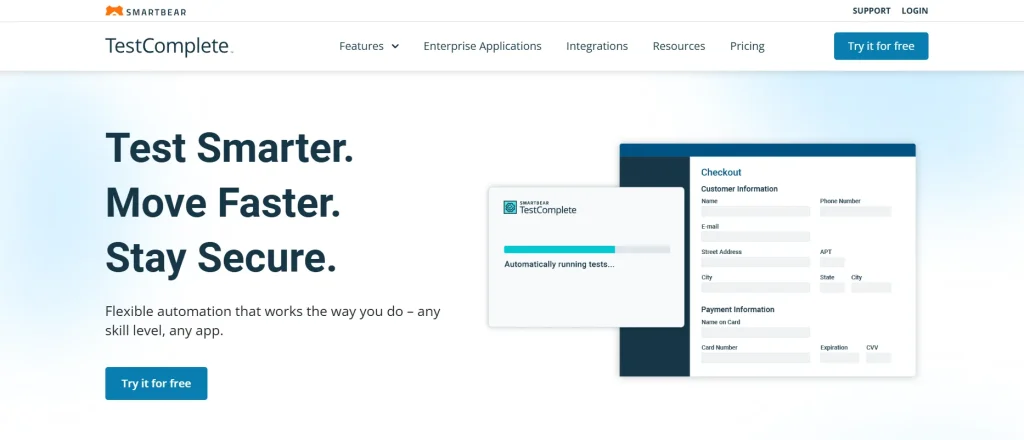
TestComplete is a test automation platform that supports desktop, web, mobile, and cloud-based AI-powered testing. It supports integrations with multiple tools, including Jenkins, Jira, Git, Azure DevOps, and GitHub Actions, to keep your workflows running smoothly. With TestComplete, you can easily convert keyword-driven test scripts to various scripting languages, export your tests to be managed by exploratory testers, or access unit test frameworks such as MSTest, TestNG, and JUnit.
Key features
- Instantly create realistic, reusable test data tailored to your use cases with the help of AI test data generation
- Easily test dynamic content like scanned documents and PDFs, and ensure accuracy across all your apps
- Use AI to filter out false positives and focus only on the changes that matter, so your app looks perfect
- Reduce your test maintenance burden by automatically adapting to UI changes; free up time to focus on more strategic tasks
Pricing
- Custom pricing available on request.
Use cases
- TestComplete is useful when you want to automate UI tests for your desktop and mobile apps
- Keyword-driven testing is helpful for teams comprising both technical and non-technical users
Limitations
- TestComplete currently supports only Windows; this can be an issue if you mainly use Mac or Linux
- Since the tool bundles a lot of features into its IDE, it can be quite resource-heavy
6. Virtuoso QA

Virtuoso QA is an AI-native platform designed to automate QA with natural language, machine learning, and self-healing automation. It uses intelligent Element Identification to make your tests behave like real users. With the help of natural language prompts, Virtuoso’s bots can identify page elements even when their selectors change. Plus, you can seamlessly integrate it with tools such as Jira, Jenkins, TestRail, and Azure DevOps.
Key features
- Write tests in natural language and detect and correct typos in real time so your flow stays uninterrupted
- Test with reusable data to expand coverage and create accurate positive and negative testing scenarios
- See at a glance how many tests have passed and failed through a centralized dashboard
- Gain detailed insights into the DOM, page console logs, and network performance to understand where tests have failed and how to fix them
Pricing
- Core: Custom
- Enterprise: Custom
Use cases
- Virtuoso QA has built-in AI and machine learning capabilities that adapt tests when app changes; this is beneficial if your UI gets frequent updates
- Seamless integration with CI/CD tools and parallel execution is helpful for agile teams that need continuous feedback loops
Limitations
- The mobile testing features of Virtuoso QA may be less advanced and comprehensive
- Some users find the navigation complex, which can make it challenging to run multiple tasks
7. Leapwork
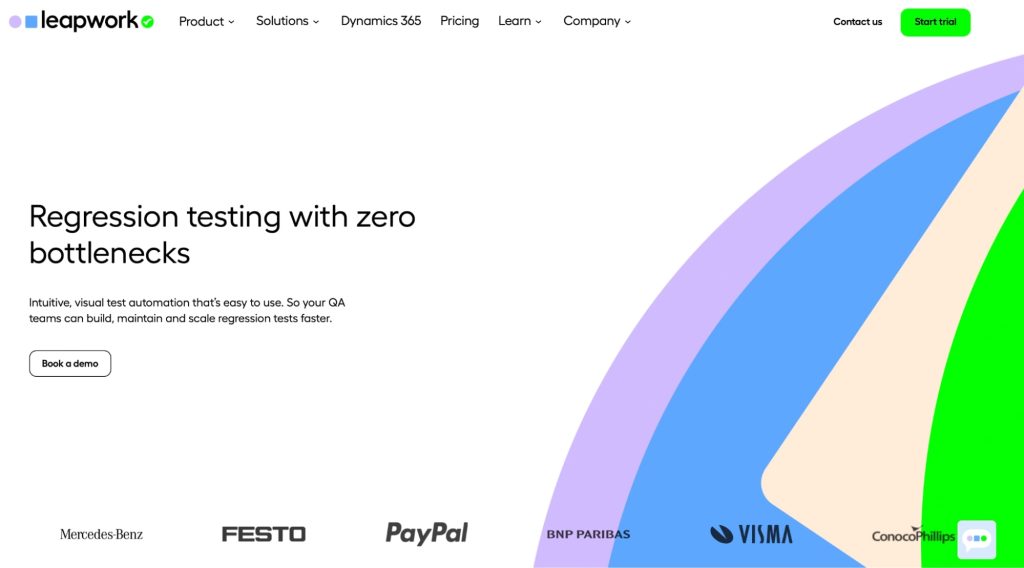
Leapwork helps you build, manage, maintain, analyze, and scale AI-powered automated testing for any app or platform. You can run multiple test cases simultaneously across different environments, browsers, and devices. Also, Leapwork allows you to efficiently build complex test flows visually without code, and pinpoint the root cause of issues via video recordings, data-level insights, and activity logs.
Key features
- Compose complex data-driven tests faster via a visual no-code interface and AI-powered smart recorder
- Build reusable subflows for common tasks such as login and navigation to reduce time spent on scripting and debugging
- Perform regression testing at scale with dynamic, instantly applied updates across all subflows containing logic
- Reduce risk with video-based reporting and dashboards, tamper-proof audit logs, and access control with full Active Directory support
Pricing
- Request a quote for tailored pricing
Use cases
- Codeless visual test automation is best for teams with members having mixed skills
- Leapwork is a solid choice if you need scalable test campaigns with clear metrics
Limitations
- Testing native mobile apps can be difficult and may require third-party integrations
- Limited advanced reporting and dashboard features
8. UiPath

UiPath is an agentic testing platform that helps you integrate UiPath agents, third-party agents, UI automations, and API-based workflows to automate end-to-end business processes for your enterprise. With UiPath, you can test any UI or API covering modern ERP apps, including SAP, Oracle, Workday, Salesforce, and ServiceNow. The platform’s CI/CD integrations, ALM integrations, version control, and webhooks ensure your testing meets the highest standards of safety, security, and governance.
Key features
- Use the low code, pro code, and prebuilt agent templates to build agents and automation that transform entire processes, not isolated tasks
- Orchestrate every AI agent, robot, system, and human from a single intelligent control plane
- Safely scale testing with built-in compliance, governance, and controlled agency
- Deploy prebuilt, industry- and use case-tailored automation solutions with robots and AI agents
Pricing
Basic: Starts at $25/month for individuals and small teams.
Standard: Custom pricing for scalable enterprise automation.
Enterprise: Custom pricing with advanced security, governance, self-healing automation, and flexible deployment options.
Use cases
- The tool is apt if you want to eliminate manual effort and improve accuracy across functions like finance, HR, and operations
- Agentic automation to handle unstructured data and decision-driven workflows makes UiPath a strong choice for teams who need automation for complex business processes
Limitations
- Non-English input may reduce the quality and reliability of the agent runtime
- App projects in Studio Web do not support page export or import
9. Autify
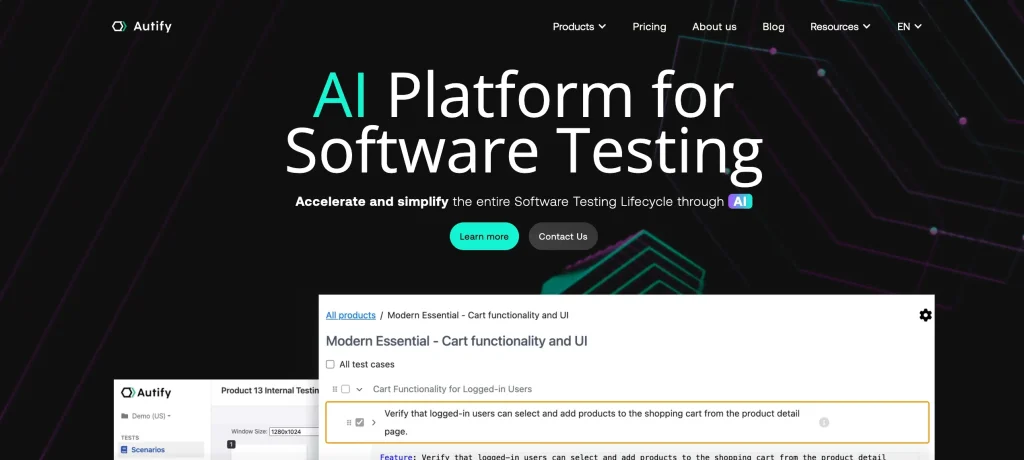
Autify is an AI-powered software testing platform for managing test creation, execution, reporting, and maintenance. Its product suite includes Autify Aximo, an autonomous AI tester that creates and executes web and mobile tests using natural-language instructions; Autify Nexus, a GenAI test automation platform built on Playwright that combines no-code authoring with editable test code; and Autify Genesis, an AI agent that analyzes application code and converts it into structured, executable tests.
Key features
- Turn plain English into test steps; just describe the user flow, and the recorder captures it as a structured, editable test
- Upload your product requirements via PRDs, user stories, or specs, and Autify Nexus translates them into detailed test cases
- Use AI Prompt Assertions to dynamically interpret text and visuals on screen, and enable context-aware checks that adapt automatically as apps evolve
- Add conditional logic, loops, or dynamic validations – all within the visual test editor
Pricing
Aximo – Autonomous AI testing for web and mobile applications
- Free: $0
- Core: $99/month billed annually or $120 month-to-month
- Team: $450/month billed annually or $550 month-to-month
- Enterprise: Custom pricing
Nexus – Playwright-based AI test automation with no-code and editable-code workflows
- Free Trial: Free for 14 days
- Professional: Starts at $3,600/year or $400 month-to-month
- Enterprise: Custom pricing
Use cases
- Real-time data synchronization between business apps, which is ideal when you need to keep customer, transaction, or financial data aligned across multiple systems
- Helpful for QA teams who want to standardize data flow and simplify integration maintenance
Limitations
- Few users find the limited integrations of Autify restrictive, which affects collaboration and workflow flexibility in development projects
- Managing large or highly complex test suites may require higher-tier plans and additional configuration
- Advanced capabilities such as on-premises deployment are limited to Enterprise plans
10. Sauce Labs

Sauce Labs is a unified platform for automated testing and error monitoring. It allows you to test your apps and websites on different browsers such as Chrome, Firefox, Edge, and Safari, operating systems like Windows, macOS, and Linux, as well as real Android and iOS devices. With Sauce Insights, you get a detailed dashboard with an overview of your test failure patterns and trends.
Key features
- Assess functionality and user experience in real time with live testing
- Run multiple test suites across every browser and OS combination you need
- Detect visual regressions, verify designs, and fix visual errors across browsers, web, and mobile apps
- Run automated tests at scale early in the development cycle with Android emulators and iOS simulators
Pricing
- Live Testing: $39/month billed annually or $49 month-to-month for one parallel test.
- Virtual Device Cloud: $149/month billed annually or $199 month-to-month for one parallel test.
- Real Device Cloud: $199/month billed annually or $249 month-to-month for one parallel test.
- Enterprise: Custom pricing with Sauce AI agents, SSO, private device cloud, enterprise security, and premium support.
Use cases
- Ideal choice for teams who need cross-browser and cross-platform testing at scale
- Continuous testing with CI/CD workflows helpful for teams working under tight delivery schedules
Limitations
- Extensive configuration may require a steeper learning curve
- Limited customization options may restrict you from tailoring testing experiences
11. Tosca

Tosca is a test automation platform that comes with built-in agentic AI, which lets you create, adapt, and analyze tests without the need for scripting or heavy setup. It covers every type of testing, from accessibility, functional, and regression to API, UI, and system integration testing. You can deploy Tosca in the cloud, locally, or in a hybrid model based on your enterprise needs. Plus, it supports multiple integrations such as GitHub, GitLab, Jira, and Jenkins.
Key features
- Generate test cases through natural language prompts
- Prioritize testing for business-critical functionality and make smarter go/no go release decisions with risk-based test optimization
- Automatically create and provision on-demand (synthetic, masked, or imported) stateful data for complex scenarios
- Configure Personal, Team, and Cloud Agents for test execution at the test case level.
Pricing
- Custom pricing available upon request
Use cases
- Suitable for teams who are looking for a model-based, codeless testing approach for enterprise apps
- Helpful when you need to prioritize critical tests in large test suites
Limitations
- A few users find the browser compatibility challenging; this can complicate cross-environment testing
- Licensing costs can be higher compared to other tools
How to Choose the Right Functionize Alternative
1. Consider integration support
When evaluating alternatives to Functionize, consider how well each platform fits into your existing delivery pipeline. A platform that integrates seamlessly with your testing ecosystem can accelerate testing and enable smoother collaboration among your QA, development, and product teams.
So, make sure the platform you select integrates with CI/CD tools like Jenkins or Azure DevOps, supports native connections with test management tools such as Zephyr or XRay, and integrates with issue trackers like Jira.
2. Assess testing needs
Before you choose a Functionize alternative, it’s essential to map the tool to what you actually need to test. And that depends on your app’s features and functions. Apps that have complex integrations with third-party systems, APIs, and backend services need a platform that supports testing scenarios across UI and API. While graphic-rich interfaces need advanced visual validation.
3. Check for ease of maintaining tests
Consider how each platform handles test maintenance. Your test automation process can struggle if your tests need constant rewrites or frequent updates. Look for features like built-in flaky test detection and self-healing locators that’ll help you minimize manual fixes and keep your app stable through changes.
4. Plan to scale
A tool that works for a small test suite may break when your apps and team grow. Therefore, while assessing different Functionize alternatives, check if it supports parallel test execution, offers cross-platform coverage across browsers, devices, and operating systems, and provides a scalable infrastructure (cloud or hybrid) so you can run large test suites easily.
5. Factor in cost considerations
Some Functionize alternatives charge based on test runs or the number of users, while others charge extra for advanced features such as visual testing, analytics, and customizable dashboards. Before making a final decision, assess how well each platform’s pricing aligns with both your current and long-term testing requirements.
Rounding Off
As we approach the end, remember that when choosing a Functionize alternative, the pricing model should align with your budget and team size. Use the free trials or demos to know about the interface, usability, and capabilities. Involve your team in the evaluation process so they can select a platform that fits their workflows. Check for active community forums, documentation, or user guides, and responsive customer support.
And, if you want hands-on experience with one such platform, start your free trial with TestGrid.io today.
Frequently Asked Questions (FAQs)
What is the best alternative to Functionize?
If you’re looking for a Functionize alternative that offers an all-in-one AI-powered solution for automating test creation, execution, management, and reporting, then TestGrid.io stands out as an ideal choice. Other top alternatives include Testim, Mabl, Applitools, and Autify.
Which Functionize alternatives support agentic AI for test automation?
Functionize alternatives that offer agentic AI automation are TestGrid.io, UiPath, Virtuoso QA, Tricentis Tosca, and Mabl.
Which Functionize alternative is best for real device testing?
TestGrid.io is the best option for teams who want advanced real device testing. It offers 500+ Android and iOS devices and helps you test your app on them under real usage conditions like GPS simulation, volatile network, and high traffic.
Which Functionize alternative is best for teams with no coding skills?
Platforms like TestGrid.io, Leapwork, Testim, TestComplete, and Autify come with features like natural language test authoring, record and playback, and model-based testing that help you create tests without extensive coding knowledge.
Which Functionize alternatives are best for small to large teams?
TestGrid.io’s pricing plans start from $25 per month, which is lower compared to most Functionize alternatives. Plus, it also offers you a free plan, which can be beneficial for teams that are just starting.