CoTester 2.0 is LIVE! Your Always-Available AI Teammate for Testing.
- What is Blockchain Testing?
- Key Concepts in Blockchain Testing
- What Makes Blockchain Testing Challenging?
- Types of Blockchain Application Testing
- Blockchain Platforms and Ecosystems
- How to Test Blockchain Applications
- How to Assess the Performance and Scalability of Blockchain Apps
- 5 Popular Blockchain Testing Tools
- Best Practices for Blockchain Software Testing
- Test Your Blockchain Applications with TestGrid for End-to-End Quality
- Frequently Asked Questions (FAQs)
Blockchain is moving past being labeled as an ‘emerging technology’ and becoming more mainstream. We can expect the global blockchain technology market size to touch $1431 billion by 2030 from $31 billion in 2024.
Although it’s finding use across industries like healthcare, gaming, supply chain, and real estate, most apps in blockchain belong to the finance sector. And when real money is involved, security risks are far more severe.
In fact, the crypto industry saw over $3.4 billion in theft between January 2025 and early December 2025.
This is why blockchain testing is extremely important. In this blog, we’ll know what blockchain is, how to test blockchain applications, and the tools you can use for comprehensive testing.
Deliver secure, high-performing blockchain apps with TestGrid. Request a free trial.
TL;DR
- Blockchain testing is a method of validating smart contracts and decentralized networks to ensure security, functional integrity, and performance reliability
- Because of factors like decentralization, immutability, forks, security threats, and compliance regulations, testing blockchain apps can be challenging
- For testing and deploying robust blockchain apps, you should start by understanding the blockchain architecture, building test cases, preparing the test environment, executing tests, and thoroughly analyzing the defects
- Different blockchain testing types include performance, functional, security, regression, API, interoperability, UX, and consensus mechanism testing
- Some important metrics you can monitor to measure the performance of your blockchain apps are TPS (Transactions Per Second), latency, and block time
- Top blockchain testing platforms in 2026 include TestGrid, Ethereum Tester, Hardhat, Truffle, Manticore, and Hyperledger Caliper
What is Blockchain Testing?
Blockchain testing is the process of verifying that blockchain systems and applications work as expected and enable secure communication between components. The goal is to ensure these apps can protect sensitive user and financial data, perform secure transactions, and handle simultaneous access from many network participants without degrading.
Blockchain was introduced by Satoshi Nakamoto in 2008 as the public distributed ledger underpinning Bitcoin. Since then, it has evolved far beyond cryptocurrency, bringing new and complex testing challenges across diverse applications.
Key Concepts in Blockchain Testing
Before diving into the testing process, here are three foundational concepts you’ll encounter throughout this guide.
Decentralized apps
Apps that run on blockchain networks, not traditional servers, and rely on peer-to-peer networks to function. What this means is there’s no single owner that’s controlling the backend. Users interact with the blockchain systems directly. In terms of testing, you need to check the frontend experience of dApps as well as how it connects with the blockchain layer.
Web3 Ecosystem
The broader environment where dApps operate wallets, decentralized exchanges, protocols, and blockchain-based services that work together to deliver transparency, user ownership, and control over data and digital assets.
Gas Fees
Gas fees are basically the transaction costs that users have to pay to perform actions on a blockchain. Every operation you carry out, like sending tokens, deploying smart contracts, swapping tokens, or interacting with DeFi protocols, consumes computational resources, which users pay for as gas.
Also Read: Financial Application Testing: Fintech QA Guide
What Makes Blockchain Testing Challenging?
1. Immutability: In traditional software systems, you have the flexibility to resolve issues and roll back changes. But you don’t have this option with blockchains. Data written once cannot be changed. It’s permanent, which means flaws in smart contracts or transaction errors can’t be undone. Since changes are irreversible, pre-deployment testing, simulation, and auditability are very important.
2. Decentralization: Blockchain generally runs across many distributed nodes, where each maintains its own copy of data. Each of these nodes processes transactions independently, and this can create timing differences, latency issues, and temporary state inconsistencies. Your testers may find it hard to reproduce bugs.
3. Security risks: Flaws in consensus mechanisms or smart contract design can create security vulnerabilities, such as:
- Double-spending, which happens when someone spends the same digital asset twice because of weak transaction validation
- Reentrancy attacks that exploit smart contracts by repeatedly calling a function before a previous execution finishes
- Unauthorized access where attackers can obtain control over funds, data, and contract functionality; this can lead to financial loss
You have to rigorously test transaction flows, state updates, and contract execution order for catching these exploit paths.
Learn More: List of Best Open Source Security Testing Tools
4. Forks: Forks increase the complexity of your blockchain QA process even more. Forks happen when your blockchain network divides into different paths, mostly because of changes in its rules or protocol.
A soft fork is a backward-compatible update where older nodes can still function but may not fully recognize new rules. Hard forks create a permanent split and make two separate chains. This is what makes testing challenging because now you have to ensure your app works correctly across both versions.
5. Regulatory complexity: When you’re building blockchain apps, particularly for industries like finance, healthcare, and supply chain management, regulatory compliance can be a major concern because many blockchain apps don’t depend on a single centralized authority.
Regulations like GDPR and HIPAA mandate data privacy, and KYC and AML requirements demand identity verification and fraud monitoring. So, your testing needs to ensure that apps meet these compliance standards without compromising the immutability of the ledger.
Types of Blockchain Application Testing
There are many different tests with which you can examine your blockchain apps, but these blockchain testing types are the most critical ones.
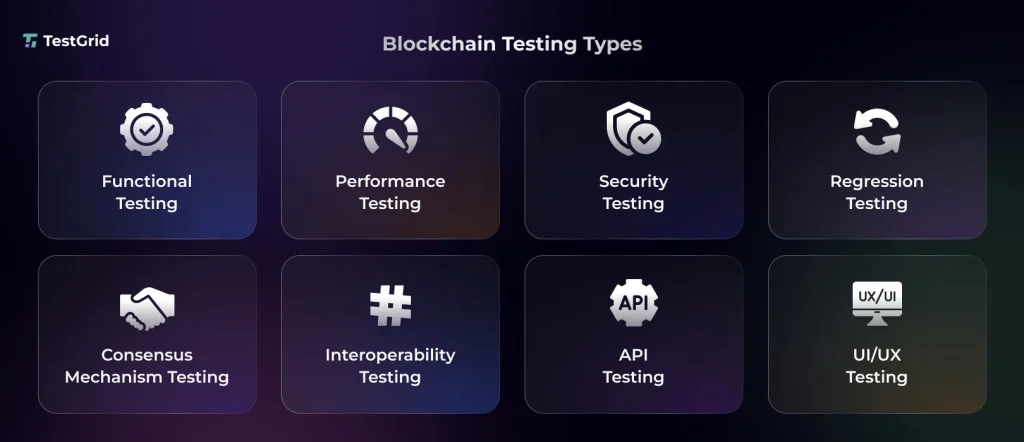
1. Functional testing: Functional testing in blockchain apps or systems is about checking if the critical functions work as intended. For that, you validate transactions, smart contracts, and how data is recorded on the chain. You also examine the inputs and outputs and make sure every request returns the expected outcome.
For e.g., if one of your users sends funds or triggers a contract function, your system should process this transaction, update the balances correctly, and then reflect changes across the network.
2. Performance testing: Can your blockchain apps effortlessly handle a surge in transactions without crashing? Blockchain performance testing helps you check that by evaluating the transaction speed, throughput, and network latency when many users access at the same time.
And since blockchain depends on network-wide validation, your testers should also assess how quickly blocks are processed when usage grows.
3. Security testing: Security testing helps you find vulnerabilities early in the development cycle so that attackers cannot exploit your systems. You check for gaps in smart contracts, verify the access controls, inspect private key management, and validate encryption methods.
Blockchain apps deal with real money and sensitive user data; therefore, you should test your system thoroughly to ensure there are no weak authentication or authorization issues that can be misused.
4. Regression testing: Blockchain apps usually go through updates frequently. These could be either performance improvements, security patches, or feature enhancements. These changes can create new bugs or affect the existing functionalities.
Since changes are difficult to reverse in blockchain, any issue overlooked can have long-term consequences. E.g., a bug in a smart contract may permanently lock a user’s funds.
This is why regression testing after every change is absolutely critical. You rerun the existing test cases and confirm that core functions are still intact.
5. Consensus mechanism testing: Different blockchain systems use different consensus mechanisms like Proof of Stake, Proof of Work, or Byzantine Fault Tolerance. Your testers must assess that transactions are validated correctly, blocks are added in the right order, and the network is consistent even under node failures.
Other than this, you should also cover edge cases, fork scenarios, and malicious nodes to ensure your apps are secure.
6. Interoperability testing: Here, you check how your blockchain systems communicate with other blockchains, external APIs, cross-chain bridges, and third-party services like oracles.
Many blockchain apps work with data and services outside their network. That’s why you should test data flow, compatibility, and communication between systems and ensure there is no scope for data mismatches, delays, or failed transactions.
7. API testing: Blockchain apps use APIs to connect with external systems, wallets, and dApps. And end-to-end testing of the APIs helps you ensure integrations are reliable and can complete requests smoothly.
In API testing, you mainly verify request and response handling, authentication mechanisms, data integrity, and error handling to avoid communication failures.
8. UI/UX testing: Your blockchain app’s backend could be solid, but if the interface is confusing, it can result in mistakes like sending funds to the wrong address or misinterpreting transaction status. Your testers should check if the UI is responsive and clearly communicates the critical information.
Learn More: UI Testing: A Complete Guide With Techniques, Tools, & Best Practices
Blockchain Platforms and Ecosystems
Public blockchains
- Ethereum – this is probably one of the most popular platforms that runs on Ethereum Virtual Machine (EVM) and is used to build blockchain apps and power non-fungible tokens (NFTs); you can use Ethereum for dApps, DeFi projects, and digital collectibles
- Solana – it’s built for high-speed and low-cost transactions; this is ideal for high-throughput apps like gaming and DeFi that need fast transaction processing
- Avalanche – it supports custom blockchain networks and is generally used for DeFi and enterprise-grade apps; Avalanche focuses mainly on scalability and quick finality
Private/enterprise blockchains
- Hyperledger Fabric – this is an open-source blockchain framework behind the IBM blockchain platform; it’s designed for private networks with strong permission controls and modular architecture
- Corda – this one is made for businesses, particularly in finance, and enables secure and private transactions without exposing data to the entire network
How to Test Blockchain Applications
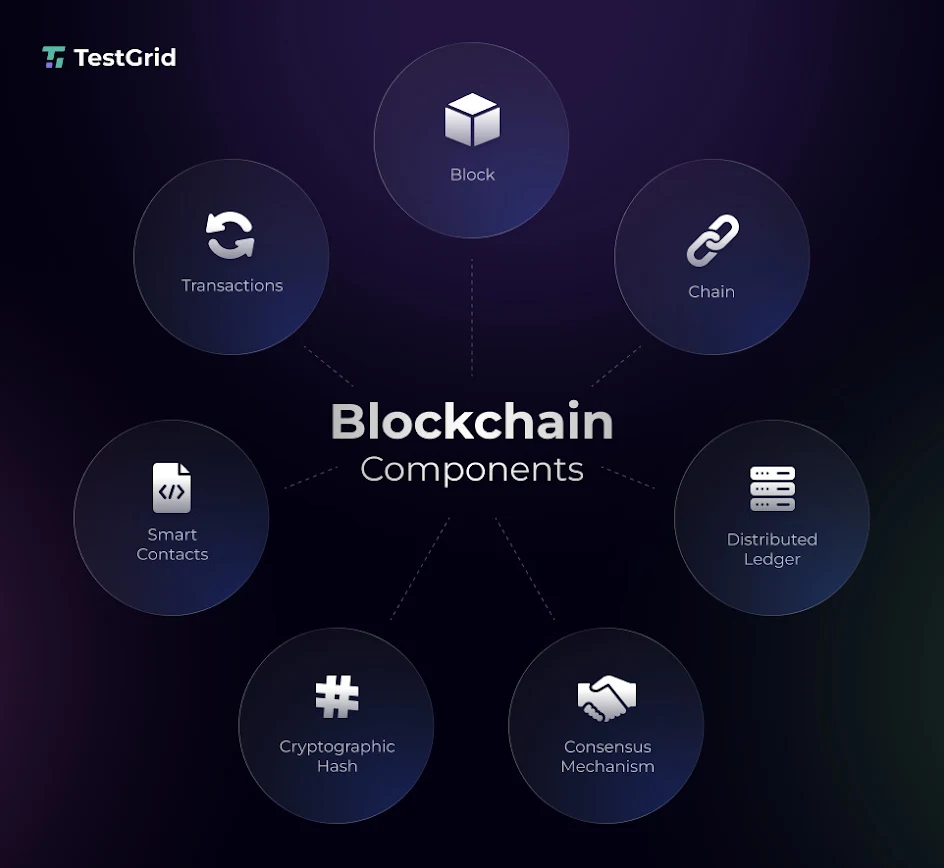
1. Understand the blockchain architecture: First, get a clear idea about how your blockchain system is built. This means you need to know about the critical components like peer nodes, consensus mechanisms, the core database, cryptographic hashes, and the network layers.
This step is important because you wouldn’t understand where errors can happen if you don’t have the complete view of how components interact or how data is stored and validated across the system.
2. Outline your test strategy and build the test cases: Next, you need to map out your test strategy. Since blockchain QA can be quite expensive, you have to prioritize testing the critical areas, like transaction flow or security. For that, you’ll have to decide:
- What you want to test, like smart contracts, network behavior, or the APIs
- How would you test them, manual or automated
- And where you’ll be running your tests, such as local setups, testnets, or mainnet
Based on this information, you have to create the test cases that cover real user scenarios, functional and non-functional aspects of your app, and failure instances.
3. Set up the test environment: Now, after designing the tests, you would need a safe space to run your tests so that the real assets won’t be at risk. You can set up local blockchain environments, private networks, or use testnets to simulate real-world conditions.
You also have to configure nodes, deploy smart contracts, and replicate how transactions happen in production.
Also Read: Test Environment in Software Testing: What it is, Why it Matters
4. Execute the critical tests: Run your test cases by triggering smart contract functions with test inputs and simulating transactions between accounts. At the same time, capture the outputs, logs, and events, and observe how the state changes after each transaction.
5. Record and analyze the defects: Record the defects you found during test execution with details related to where the defect occurred and the steps to reproduce them. This is particularly important for blockchains because issues can be tough to track in these distributed systems.
Spot the defect patterns, evaluate the root cause, and address the issues based on severity.
How to Assess the Performance and Scalability of Blockchain Apps
When your app scales, there’s always a concern about whether it can maintain its performance and efficiently use compute resources.
Here we’ll be talking about the metrics you can track to evaluate performance and some gas cost optimization strategies to help you scale smoothly.
| Area | Focus | How to assess |
| Key metrics | TPS (Transactions Per Second) | This tells you how many transactions your blockchain can handle at once; higher TPS means better capacity. |
| Latency | It’s the delay between submitting a transaction and getting confirmation; you want this to be as low as possible. | |
| Block time | Block time is the duration it takes to add a new block to the chain. Shorter block times usually mean faster confirmations. | |
| Network throughput | This helps you measure how much data or how many transactions the network can process over time. | |
| Scalability | Layer 1 vs Layer 2 | Layer 1 is the main blockchain like the base network where transactions are recorded, and Layer 2 solutions are built on top to handle extra load and improve speed. You should test how both layers manage high load. |
Learn More: Software Testing Metrics: How to Track the Right Data Without Losing Focus
Gas cost optimization for scalability
When your app consumes fewer computational resources per transaction, the network is able to process more transactions efficiently. And this, in turn, reduces congestion and improves speed. These are some strategies you can employ:
- Write efficient smart contract interactions to avoid unnecessary computations
- Minimize storage usage because storing data can be expensive
- Batch transactions rather than processing them individually
- Reuse code and variables to lower execution cost
5 Popular Blockchain Testing Tools
1. Ethereum Tester
Ethereum Tester, or eth-tester, is a lightweight blockchain testing tool made mainly for testing Ethereum apps in a controlled, local environment. The tool gives you an in-memory blockchain that allows your developers to simulate transactions, execute smart contracts, and check behavior without connecting to a live network. You can use this tool for your unit and integration testing along with frameworks like pytest and Web3 libraries.
2. Hardhat
Hardhat is an Ethereum development and blockchain testing platform where you can deploy your contracts, run Solidity tests, and debug your code. When transactions revert, this platform shows you actionable errors like “Non-payable function was called with value 1,” along with the detailed Solidity stack traces so you can easily pinpoint exactly where and why your code fails. Apart from this, you can write unit tests, integration tests in TypeScript, and fuzz tests to spot edge cases.
3. Truffle
Truffle helps you build, test, debug, and deploy smart contracts using the Truffle CLI. You can write scripts and plugins to automate common processes, use the Truffle debugger to get a deep understanding of the transactions, and use console.log to get insights into your code. The platform also allows you to deploy contracts and sign transactions with your wallet using the Truffle Dashboard.
4. Hyperledger Caliper
Hyperledger Caliper is a performance benchmarking tool for your blockchain apps. It helps you measure the performance of blockchain networks like Hyperledger Fabric and Ethereum by simulating workloads and via indicators like success rate, transaction/read throughput, latency, and resource consumption (CPU, memory, Network IO).
5. Manticore
Manticore is a symbolic execution tool that you can use to analyze smart contracts and binaries. You can generate test cases, execute a program with symbolic inputs and explore all the possible states it can reach, and detect crashes and other failure cases in smart contracts. This tool can be very effective for deep security testing of your blockchain apps.
Best Practices for Blockchain Software Testing
1. Audit and test smart contracts: Since smart contracts are hard to alter once deployed, you cannot patch security flaws easily. This is why testing them properly and resolving issues early should be your top priority. You can use static code analysis tools to detect defects, run manual audits, and use different testing methods like unit, integration, and fuzz testing to minimize security risks.
2. Optimize scalability and performance from the start: Blockchain systems generally face high traffic, so checking performance is critical. You should use load testing tools to replicate actual load scenarios and assess how your blockchain apps process transaction spikes.
3. Check for security threats and attack vectors: Blockchains operate with financial data, and that’s why they are susceptible to sybil attacks, private key vulnerabilities, and 51% attacks. You must perform penetration testing before deployment to detect security gaps that can lead to these risks. Security key management and multi-factor authentication will help protect your apps against unauthorized access.
4. Ensure seamless integration with external systems: Most blockchain apps integrate with legacy systems, cloud platforms, and third-party services. And these connections need to be tested to verify stable data exchange. You can use middleware solutions and mock testing to simulate external dependencies, check responses, and spot mismatches or delays.
Test Your Blockchain Applications with TestGrid for End-to-End Quality
Multiple environments, APIs, user interfaces, and external integrations can make testing blockchain apps complex.
What you need is a platform where you can perform dApp testing across real environments, evaluate blockchain workflows, and enable continuous testing for Web3 development.
TestGrid is an AI-powered testing platform that lets you test your blockchain application’s web, mobile, and API layers in one place. It supports both manual and automated testing, helping you validate user experiences and integrations around your blockchain workflows.
With TestGrid, you can:
- Test on real iOS and Android devices and across browsers at scale
- Validate biometric authentication, including fingerprint and facial recognition
- Create and execute test cases without scripting with codeless automation
- Run API tests to verify data exchange between your app and blockchain services
- Simulate high user and API load scenarios to assess performance under stress
You can integrate TestGrid with CI/CD tools like Jenkins and Azure DevOps, automate user journeys involving blockchain interactions, and leverage built-in reports for early defect detection. Build trust into every transaction flow with TestGrid. Request a free trial today.
Frequently Asked Questions (FAQs)
How is blockchain software testing different from traditional software testing?
Traditional software testing usually focuses on a central database, but blockchain testing verifies a distributed network where data is permanent. You aren’t just checking the UI; you’re also validating smart contracts, consensus rules, and data integrity across multiple nodes to ensure the system is secure and synchronized globally.
How to implement blockchain test automation?
You can take the help of tools like Hardhat or Truffle to write and execute automated test scripts for your blockchain apps. You can automate tests like API, integration, smart contract, load, and regression testing by integrating the tools with your CI/CD pipeline. Testing usually involves simulating transactions, verifying state changes in local or test networks, and checking system behavior under network delays, invalid inputs, and node failures.
How do you ensure data privacy in blockchain applications?
You can maintain data privacy in your blockchain apps by minimizing on-chain sensitive data, using cryptographic techniques like hashing and encryption, and implementing permissioned access where needed. Methods like zero-knowledge proofs and private transactions can also help you protect data.
What are the risks of not properly testing smart contracts?
In case you don’t properly test the smart contracts, you might overlook critical vulnerabilities that can lead to security breaches, financial losses, or irreversible errors. Incorrect state updates or access controls can affect your app’s functionality and user experience.