CoTester 2.0 is LIVE! Your Always-Available AI Teammate for Testing.
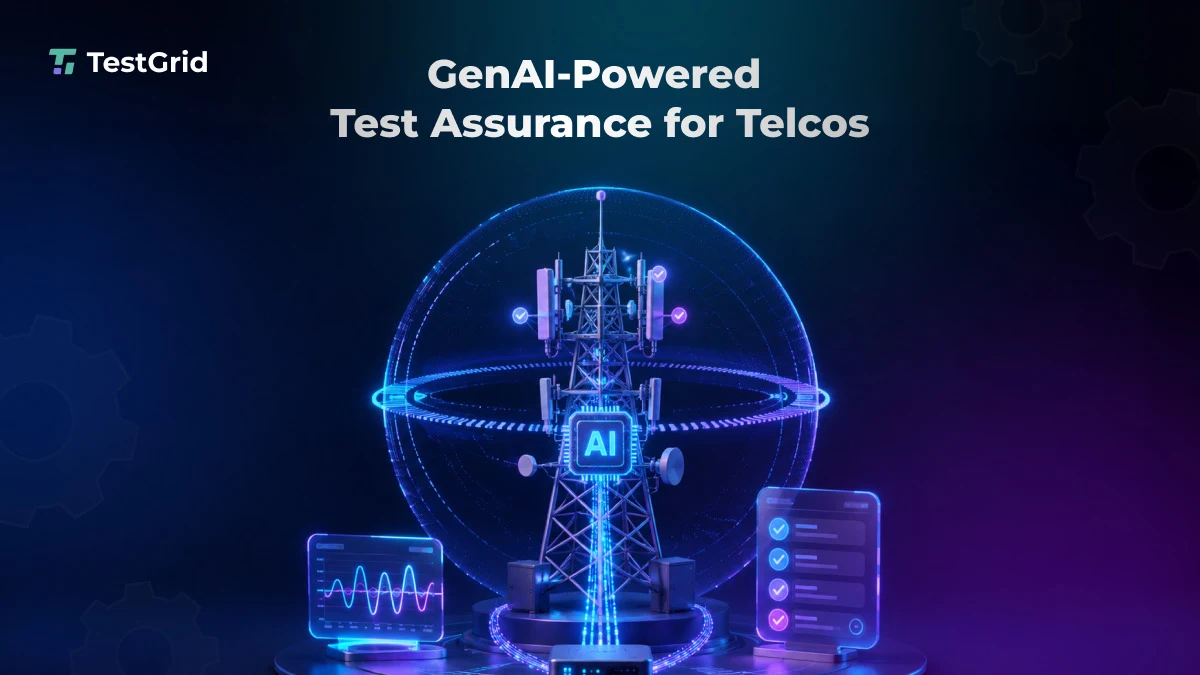
Telecom environments are changing from hardware-centric networks to software-driven ecosystems where features, integrations, and updates are released continuously.
5G, Open RAN, cloud-native network functions, virtualization, edge computing, OSS/BSS platforms, customer and partner portals, APIs, and network management interfaces are making telecom software systems more complex and expanding the scope of what needs to be tested.
Conventional script-based automation can struggle to keep pace with frequently changing telecom applications, APIs, and operational workflows. You need a more adaptive testing layer that can respond to application changes while preserving traceability and human control.
In this blog, we’ll see how generative AI is enabling telecom quality engineering teams to optimize test design, execution, and assurance.
Simplify telecom software testing with CoTester. Request a free trial.
TL;DR
- Traditional test automation may fail when telecom apps, APIs, and business workflows change constantly
- AI can help simplify requirement analysis, test creation, execution, and validation across the software delivery lifecycle
- GenAI allows you to spend less time interpreting complex documentation and more time validating critical business workflows
- Building testing context from requirements, specifications, and existing assets with AI help creates more relevant, traceable, and maintainable test cases
- Effective AI-assisted telecom testing depends on combining automation with domain knowledge, reliable test data, human review, and operational governance.
The Move from Script-Based Automation to AI-Assisted Test Assurance
Traditional automation relied on fixed scripts to speed up the process of repetitive testing. Although this can help you improve the execution efficiency, you still have to depend on predefined rules and human effort for creating, updating, and maintaining tests.
As telecom applications become more cloud-native, integrated, and frequently updated, conventional script-based automation can become expensive to maintain.
Common challenges include:
- Tests which are created with manually written scripts and static locators require frequent updates
- Small UI or app changes can invalidate large regression suites; this increases your maintenance work
- Requirements, test cases, execution results, and defects are often stored in separate tools, which can make traceability, collaboration, and root cause analysis slower
- Scaling traditional automation across multi-vendor ecosystems may need significant scripting effort
AI-powered testing agents can interpret requirements, generate and refine test scenarios, adapt execution when applications change, and provide richer context for understanding failures. Now, let’s take a look at how AI enhances telecom testing:
1. Requirement-driven test generation
Rather than designing every test manually, you can use user stories, requirements, test plans, or change tickets as inputs for generating structured test cases.
2. Human-reviewed test refinement
Generated tests can be reviewed, reordered, edited, expanded, or reduced before execution. This allows you to validate the flow, expected results, and coverage before automation begins.
3. Execution feedback and test refinement
AI-assisted execution can capture failures, logs, screenshots, and step-level evidence. You can use this information to investigate defects, update test coverage, and improve subsequent test cycles.
4. Self-adaptive testing
Self-adaptive testing uses visual, structural, and contextual signals to identify interface elements when layouts, labels, controls, or dynamic identifiers change.
This can reduce failures caused by brittle locators, although substantial application changes may still require human review or test updates.
5. Governed automated execution
AI-assisted tests can run through CI/CD pipelines or scheduled regression cycles with limited manual intervention.
For telecom applications, however, autonomy should remain governed. Approval checkpoints, human review, traceability, and defined escalation rules are necessary before critical test results influence release or operational decisions.
Learn More: Boost Your Telecom Testing Strategy: Steps to Achieve Seamless Connectivity
How GenAI Supports Standards-Driven Telecom Testing
Commercial mobile networks are largely based on 3GPP specifications, which define architectures, interfaces, protocols, procedures, and expected behavior across radio access, core, service, and management domains.
Because these specifications span numerous interdependent documents and releases, finding and cross-referencing the correct requirements can be time-consuming.
GenAI can assist by retrieving and organizing relevant content from standards, requirements, call flows, interface definitions, and acceptance criteria.
This can support test design, coverage analysis, and troubleshooting, but the outputs should remain subject to review by telecom domain experts.
| Best practice: Tie every AI-generated test to the exact specification release, version, and source clause used to create it. Treat the output as a draft until a domain expert confirms that the procedure, expected result, and interpretation are technically correct. |
Also Read: Why Conventional QA Fails in Telecom App Testing
Practical Telecom Testing Use Cases of CoTester
1. Network-slice ordering and management workflow validation
If you plan to launch a network slice, the applications and workflows used to order, configure, provision, modify, suspend, and terminate the service need to function correctly.
AI-assisted testing can generate and execute tests across the relevant customer, administrator, OSS/BSS, and orchestration-facing workflows.
It can also validate API exchanges and confirm that SLA-related metrics such as latency, packet loss, and jitter are presented correctly in management portals.
These tests validate the software workflows surrounding the network slice. They don’t independently measure or certify the performance, availability, isolation, or SLA compliance of the network slice itself.
2. Open RAN management and integration workflows
AI-assisted regression testing can help teams check whether software and management workflows surrounding multi-vendor deployments continue to function correctly after changes. Relevant areas include:
- Role-based access and user permission scenarios
- Vendor management portal workflows and administrative functions
- API integrations between OSS, management, and operational apps
- Configuration and policy management workflows across management apps
- Regression behavior after software updates, configuration changes, or new vendor integrations
3. Post-remediation workflow validation
An autonomous network can automatically detect and fix a fault. But you should not consider the issue resolved until you verify that the service and the operational processes associated with that service are functioning correctly.
You can re-execute tests for critical customer and operator journeys, confirm that management portals remain accessible, and verify that alarms, service states, and status information are displayed correctly after remediation.
Learn More: Why Load Testing Is Critical for Telecom Apps in 5G and Cloud-Native Era
4. Edge and private-network application testing
Apps which run on edge and private networks allow you to manage users, connected devices, and operational tasks like production monitoring, asset tracking, and remote equipment control.
AI-assisted testing can cover administration portals, user onboarding, device-registration workflows, configuration interfaces, access-control behavior, and business applications running in private-network environments.
5. Telecom release and regression validation
When telecom applications, APIs, and business workflows change, executing an entire regression suite can take significant time. AI-assisted testing can help teams:
- Convert Jira stories or functional requirements into regression test cases
- Execute only the relevant workflows through CI/CD or scheduled regression runs
- Review and refine tests before release sign-off
- Collect execution evidence and defect records to simplify release reviews and audit readiness
Also Read: 7 Standard Reasons Why Test Automation Fails
Toward More Intelligent Telecom Software Assurance
GenAI can help telecom teams create efficient test engineering by enabling them to interpret complex 3GPP procedures, understand test requirements, and turn reviewed specifications into structured tests.
Autonomous assurance in the long term will depend on connecting intelligent testing agents with network data, orchestration systems, domain knowledge, and operational governance.
CoTester applies some of these principles to telecom-facing applications and operational workflows by supporting requirement-based test generation, application-level execution, adaptive UI testing, and human review.
With CoTester, you can:
- Generate tests from Jira stories, requirement documents, specifications, application URLs, and natural-language instructions
- Create and refine tests using prompt-driven, record-and-play, low-code, or full-code approaches
- Execute UI, API, and non-UI tests across web and mobile environments, with scheduled runs and integration into delivery pipelines
CoTester’s multimodal Vision-Language Model interprets application visuals, text, layout, and structure, while AgentRx uses this context to respond to UI changes such as shifted elements, changed labels, dynamic identifiers, and major redesigns.
This helps reduce the repetitive maintenance associated with brittle, locator-dependent automation. The AI software testing agent also supports continuous validation through customizable execution and CI/CD integration.
Its logs, screenshots, step-by-step results, and root-cause context help teams investigate failures and accelerate issue triage without relying only on basic pass-or-fail outcomes.
The path to the autonomous telco doesn’t begin by removing engineers from testing. It begins by giving them an intelligent testing agent which can adapt to change and preserve human control over every critical decision.
Bring intelligence into telecom testing and create smarter test workflows with CoTester. Request a free trial.
Frequently Asked Questions (FAQs)
1. How is telecom testing different from traditional software testing?
Telecom application testing often involves more domain-specific dependencies than testing a standalone application. In addition to functional behavior, you may need to validate integrations across OSS/BSS platforms, provisioning systems, APIs, customer portals, network management applications, and multi-vendor operational workflows.
2. Which telecom apps can benefit from GenAI-powered testing?
GenAI-powered testing can help you assess multiple telecom apps including customer self-service portals, billing systems, CRM apps, network management portals, order management systems, service provisioning platforms, enterprise APIs, and mobile apps.
3. What challenges should organizations consider before adopting AI-assisted telecom testing?
Some of the challenges associated with AI-assisted testing are fragmented test data, complex legacy and multi-vendor integrations, and overreliance on AI outputs without adequate review. You can address these issues by establishing clear requirements, maintaining reliable test data, and implementing human review and governance.