CoTester 2.0 is LIVE! Your Always-Available AI Teammate for Testing.
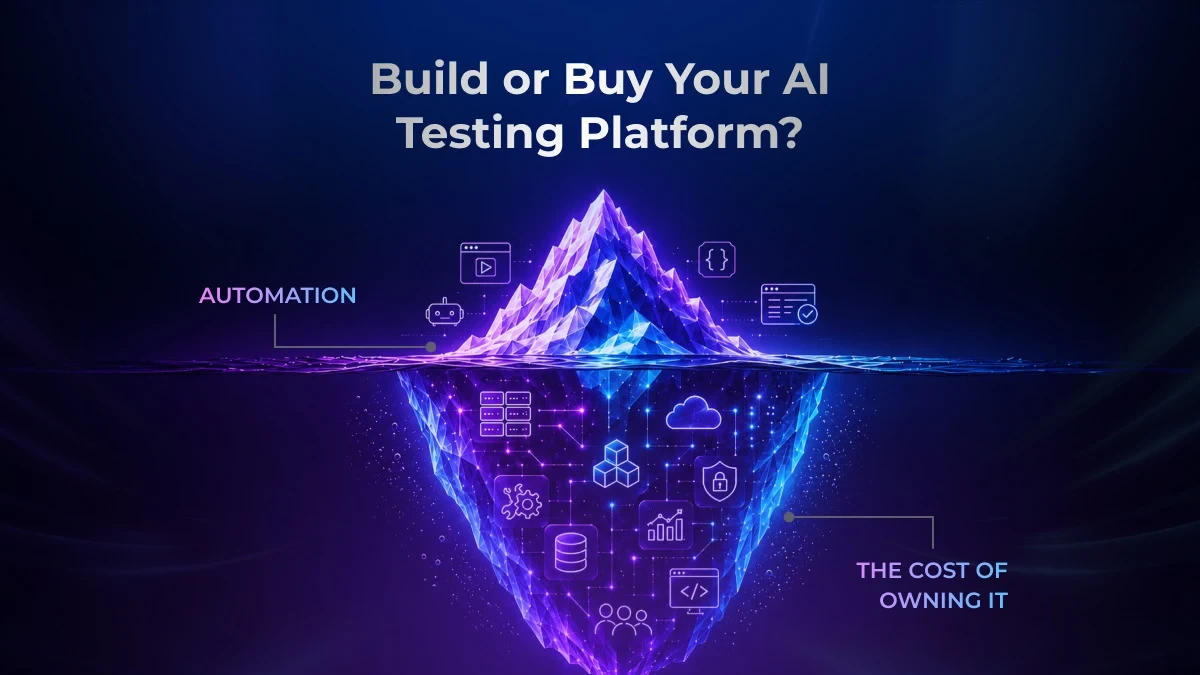
AI has made building automated tests with Playwright fast enough that many teams can skip buying a platform. The real decision is what happens after the first test. If your needs stay contained, build. If testing must scale across teams, devices, governance, and traceability, buy. The question is what you want to own three years from now.
A few years ago, building an internal test automation capability came with an obvious trade-off: engineering teams gained control, but they also took on substantial development effort. Today, AI has disrupted that calculation.
Coding assistants can now turn plain-language instructions into test scenarios and executable scripts in a fraction of the time traditional automation development required.
Playwright, particularly, has made the internal route even more accessible for modern web applications.
As a result, “we can build this ourselves” is no longer an ambitious proposition for many engineering teams. In fact, in some cases, it’s a perfectly reasonable one. AI has made the build-versus-buy decision more interesting than it used to be.
For your team, the next step is to look more closely at what AI-generated test automation can already handle, and where engineering responsibility begins to extend beyond test creation.
TL;DR
- AI reduces the effort required to create and update automated tests, but it does not eliminate the cost of owning the surrounding testing capability.
- AI plus Playwright can be a strong internal option for focused web applications when the necessary execution, reporting, traceability, and defect-management systems already exist.
- Building internally still leaves your team responsible for infrastructure, environments, test approval, integrations, security, governance, reporting, and ongoing maintenance.
- Faster test generation can simply move the bottleneck downstream if review, execution, analysis, and maintenance cannot absorb the additional volume.
- Buying becomes more attractive as the number of teams, environments, devices, integrations, governance requirements, and traceability needs increases.
- The decision should be based on the testing capability you want to own long term, not simply how quickly or cheaply AI can generate the first test.
What You Get From AI-Generated Playwright Tests
AI can shorten the path from a testing instruction to an executable web test. You can use it to propose scenarios, generate test steps, write Playwright code, suggest locators and assertions, explain failures, and recommend changes after an application update.
Playwright then gives you the execution and debugging layer for web automation. You can run tests locally or through CI across Chromium, Firefox, and WebKit. Its HTML, JSON, and JUnit reporters show what happened during a run, while its traces help you investigate failures.
For a focused web application, these capabilities may cover your test authoring, execution, and debugging requirements. You can reach the first executable test faster and reduce the engineering hours spent on routine scripting.
For the build-versus-buy decision, assume that the generated test is accurate, maintainable, and ready to run. The next question is what your team must provide before and after that test is created.
What You Still Need to Build Around the Generated Test
Let’s see what those additional engineering responsibilities look like in practice:
Define the test intent and approve it
Before you automate a test, you need to decide what it must verify. A manual test case converts a requirement into preconditions, actions, test data, and expected results. This is test design: you define the required behavior before choosing how to automate it.
Suppose a requirement allows account owners to refund a payment.
Your test case must establish:
- Whether partial refunds are supported
- Which roles have permission
- What happens after a duplicate request
- How currency differences are handled
- Which audit record should be created
If you automate before resolving those questions, you may receive a technically correct script that validates incomplete or incorrect behavior. AI can draft the test case, identify negative paths, and suggest edge conditions.
Your reviewer then confirms the scope and expected result.
| CoTester, TestGrid’s AI software testing agent, supports this stage by generating test logic from Jira stories, documents, URLs, or described workflows. You can refine and approve the test before it runs, keeping human validation between the original requirement and automated execution. |
Explore: CoTester vs Playwright MCP
Provide the execution infrastructure and environments
Once you approve the test, you need compute capacity, browser dependencies, credentials, test data, network access, scheduling, concurrency, and retry rules. You can provide these through your CI environment.
Your team then owns the availability and maintenance of that setup. Your release matrix may also extend beyond what Playwright provides out of the box.
Browser-version coverage is one example.
Playwright ships browser builds tied to the Playwright release. If your regression matrix requires the same suite to run against specific browser versions, your team needs to provide and maintain that version-management layer separately.
Cross-platform execution creates a similar requirement. If a Windows-based team needs macOS or Safari coverage, it needs infrastructure capable of providing those environments.
Playwright Test targets modern web applications and provides mobile-browser emulation. If you test native Android or iOS applications, however, you need mobile automation frameworks and access to relevant devices.
You also need physical-device testing when behavior depends on hardware, operating-system versions, gestures, biometrics, cameras, or network conditions.
| TestGrid’s Real Device Cloud gives you physical Android and iOS devices, browser environments, parallel execution, and CI/CD integration. It supports Appium, XCUITest, Espresso, and other mobile automation frameworks. You can extend execution across web, mobile web, native, and hybrid applications on TestGrid without maintaining your own device lab. |
Connect each result with the requirement and defect
Playwright’s reports tell your engineers which tests passed, failed, or became flaky during a run. Its traces provide step-level information for debugging. When you manage testing across several releases, teams, and environments, you need a connected record.
You should be able to identify the originating requirement, approved test case, automation version, execution environment, result, previous failures, and related defects.
Analytics should also help you track pass rates, recurring failures, and environment-specific patterns across runs.
| TestGrid can bring Jira work items into the testing workflow and maintain traceability between requirements, tests, and execution outcomes, while execution runs capture logs, screenshots, step-level results, and debugging context. That gives your team the evidence required to investigate and report a defect without reconciling separate records after every run. |
Control and maintain the shared testing system
As more people rely on your automation, you need rules for who can create, approve, edit, execute, and view tests.
You also need shared test conventions, credential protection, audit history, and a process for accepting AI-generated or AI-modified test logic.
Your testing workflow must connect with CI/CD pipelines, issue trackers, test-management systems, databases, and team communication tools.
Each integration requires authentication, configuration, monitoring, and updates when its API or workflow changes. Maintenance continues as your application, browsers, devices, test data, and integrations change.
AI can identify changed elements, repair locators, summarize failures, and update test logic. Your team still needs to confirm that each update reflects the intended product behavior and produces a reproducible test.
This is where an internal automation approach becomes an internal platform-ownership decision. Each capability your existing stack doesn’t provide needs an owner, an implementation, a backlog, monitoring, and ongoing maintenance.
AI may help your engineers build or update those components faster, but your organization still owns them for as long as the testing system depends on them.
What AI Removes From Your Cost Model, and What Remains
AI changes the economics of automation most dramatically at the creation layer. Your team may spend fewer engineering hours generating test cases, writing scripts, analyzing failures, and making routine updates.
But creation is only one component of ownership.
If you build internally, your cost model still needs to include execution infrastructure, browser and device access, CI capacity, test data, integrations, security controls, reporting, traceability, run monitoring, failure triage, upgrades, and support.
Those costs continue for as long as your teams depend on the testing capability.
AI can make the first test cheaper. However, it doesn’t make the surrounding testing platform free.
The 2025 DORA research provides useful context for this decision. DORA describes AI as an amplifier whose value depends on the surrounding engineering system, including platform quality, workflows, and team alignment.
The same principle applies to test automation. Faster generation means more test cases and scripts can enter review, execution, analysis, and maintenance.
If your capacity across those stages can’t absorb the additional volume, faster authoring moves the constraint elsewhere in the testing workflow.
Should You Build or Buy an AI Testing Platform?
An internal approach may fit when:
- You have a focused web application and a limited browser matrix.
- Your existing systems already cover execution, historical results, traceability, and defect management.
- One product team owns and uses the automation.
- You have engineers available to maintain the tests, integrations, and execution environment.
In this situation, AI plus Playwright can make a strong internal route. The automation problem is contained, the surrounding systems already exist, and your team is intentionally accepting responsibility for whatever remains.
An AI testing platform may fit when:
- You need physical-device or native-mobile testing.
- You need requirements-to-defect traceability and shared reporting across teams or releases.
- Your release process requires formal test approval and controlled access.
- You need many browser, operating-system, and device combinations.
- You want to reduce the engineering time spent maintaining testing infrastructure and integrations.
The buy route becomes more attractive as the number of teams, environments, devices, integrations, governance requirements, and traceability requirements increases.
Evaluate the Full Testing Capability Before You Decide
AI will continue to make automation easier to create. The cost of generating code is unlikely to become the difficult part of this decision again. That means engineering leaders may need to evaluate testing investments differently.
As generation becomes increasingly accessible, the differentiator will shift toward what happens after creation: how reliably a testing capability can support changing products, teams, environments, release expectations, and engineering priorities over time.
An internal platform may be exactly the right investment for an organization that wants testing infrastructure to become part of its engineering capability.
For another organization, the better decision may be to keep that responsibility outside the product-engineering roadmap.
Before committing to an internal build, look beyond the first release. Consider whether your engineering team will still want to maintain, govern, and evolve that testing capability three years from now.
TestGrid combines CoTester’s AI-assisted test generation, refinement, and human approval and AgentRx self-healing with browser and real-device testing infrastructure, reporting, traceability, and CI/CD integrations.
See how TestGrid can support your testing workflow. Book a demo.