 CoTester 2.0 is LIVE! Your Always-Available AI Teammate for Testing.
- Reservation Changes Created More Decision Paths Than QA Could Author Efficiently
- We Added CoTester at the Requirement-to-Test Step
- One Successful Modification Still Produced the Wrong Terms
- A Policy Change Required Fewer Test Updates
- More Reservation Scenarios Reached Release Regression
- Apply CoTester to Complex Hospitality Workflows
A regional hotel group operated 34 properties across three markets, with most direct reservations coming through its website. A centralized nine-person QA team supported biweekly releases across booking, account, payment, and reservation-management journeys.
Requirements and booking policies were maintained in Jira. The client had already automated its highest-volume booking and cancellation flows. The harder problem began after a reservation was confirmed.
A change to dates, occupancy, or room category could affect pricing, cancellation terms, deposits, and confirmation details at the same time.
The hotel group used CoTester to generate and run more of those scenarios from approved requirements, on TestGrid’s browser infrastructure with parameterized test data.
TL;DR
- 60% less test-creation effort: Preparing the reservation-modification suite fell from approximately 20 QA hours per release to 8.
- 2.5x more decision paths covered: Release regression expanded from 18 to 45 reservation-change scenarios.
- 40% less maintenance after policy changes: Updating affected tests after a rate or cancellation-rule change dropped from about 10 hours to 6.
- 36% fewer modification defects reached UAT: Booking-rule defects found in UAT fell from 14 to 9 across three comparable releases.
Reservation Changes Created More Decision Paths Than QA Could Author Efficiently
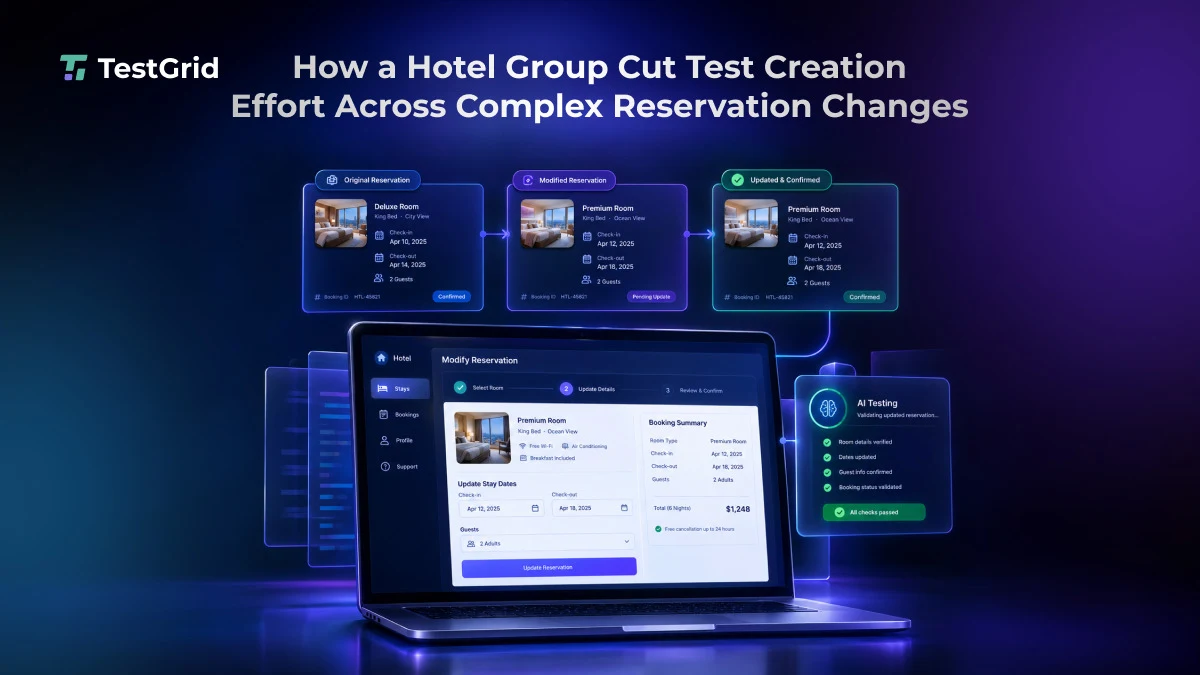
One reference scenario involved a three-night reservation on a flexible rate with a first-night deposit already paid. The guest moved the arrival date by two days, added a second occupant, and upgraded to a higher room category.
A successful Modify Booking action wasn’t enough. QA also had to verify the revised rate, amount due, cancellation deadline, deposit treatment, room eligibility, and confirmation details.
The number of valid paths increased quickly.
The requested room could be unavailable for the new dates. An advance-purchase rate might prohibit changes. The financial outcome could differ depending on whether the request happened before or after the cancellation cutoff.
We Added CoTester at the Requirement-to-Test Step
The client supplied the Jira story for reservation modifications together with the relevant booking requirements for flexible, advance-purchase, and promotional rates.
The acceptance criteria covered changes to reservation dates, occupancy, and room category, along with the expected pricing, cancellation, deposit, and confirmation behavior.
CoTester used that context to generate structured test cases with steps and validation points. QA reviewed the generated scenarios against the approved requirements, refined the conditions and expected outcomes, and approved what moved into execution.
One scenario kept the requested room available. Another made it unavailable. A third applied an advance-purchase rate, where the change should be blocked. Additional cases checked behavior on either side of the cancellation cutoff.
QA and Product Kept Control of Expected Outcomes
Product owners reviewed the business outcomes, while QA refined the generated steps and validation points. The scenarios proceeded only after human approval.
That kept CoTester focused on generating and executing approved tests, while the hotel group remained responsible for defining correct business behavior.
The Client Reused Parameterized Data Across Approved Scenarios
Rates, dates, cancellation cutoffs, and reservation states were stored once and referenced across the reservation tests.
The same approved flow could then be exercised with different reservation dates, occupancy levels, room categories, rate plans, and reservation states without recreating the core test logic for each combination.
When shared values changed, QA could update the relevant data and review the affected scenarios rather than editing every test separately.
CoTester Executed the Approved Tests on TestGrid
After approval, CoTester drove execution of the scenarios using TestGrid’s browser infrastructure. CoTester handled the agent-driven workflow within TestGrid, which provided the execution environment and captured the evidence associated with each result.
One Successful Modification Still Produced the Wrong Terms
One execution showed why the additional scenario coverage mattered. The guest changed the reservation dates and room category successfully. The reservation remained active, the new room appeared, and the revised total was displayed.
But the confirmation still showed the cancellation deadline from the original reservation dates. The workflow had completed, but one approved business expectation had failed.
Because the test included the expected cancellation deadline as a validation point, the scenario failed. CoTester flagged and logged the issue during execution, while TestGrid captured the screenshots and logs associated with the failed step.
Engineering could review the failed interaction together with the reservation conditions that produced it. The defect was fixed before the release reached UAT.
A Policy Change Required Fewer Test Updates
A few releases later, the hotel group extended the free-cancellation cutoff on its flexible rate from 48 to 72 hours before arrival.
Previously, QA would have had to identify every scenario that assumed the 48-hour cutoff and update each affected value and expected result.
With the cutoff externalized as parameterized test data, the client updated the shared value and reviewed the affected scenarios and expected outcomes against the new rule. Boundary cases were adjusted around the new 72-hour cutoff.
The update took about six hours instead of approximately ten. Most of that effort went into confirming the new business behavior rather than searching through individual tests for repeated policy values.
More Reservation Scenarios Reached Release Regression
Reservation-modification coverage increased from 18 to 45 decision paths, while test-creation effort fell from about 20 hours per release to 8.
QA spent less time creating scenario variations and more time reviewing whether the important combinations and expected outcomes were correct.
Across three comparable releases, modification defects reaching UAT fell from 14 to 9 as more pricing, cancellation, deposit, and reservation-state issues were caught during release regression.
CoTester gave the client a faster path from approved requirements to reviewable, executable tests. TestGrid supplied the data-parameterization capabilities, browser infrastructure, and evidence required to execute those tests and investigate failures.
Apply CoTester to Complex Hospitality Workflows
One guest change can trigger several business rules at once. CoTester helps your QA team generate, review, and run tests from requirements on TestGrid’s browser infrastructure, with step-level evidence to investigate failures.
Book a demo to see how CoTester creates and runs tests for your web booking and reservation flows.


