CoTester 2.0 is LIVE! Your Always-Available AI Teammate for Testing.
- What Is Agentic AI?
- What Is Generative AI?
- A Comparative Analysis: Agentic AI vs Generative AI
- Security Risks and Ethical Considerations: What to Watch Out For
- Agentic AI vs Generative AI Examples: Real-World Uses
- Meet CoTester: Your AI Agent for Software Testing
- The Way Forward
- FAQs About Agentic vs Generative AI
In the last decade or so, we have seen an explosion of artificial intelligence (AI) technologies and how they are changing the way industries function. And the two most talked-about fields in AI are: agentic AI vs generative AI.
Two different concepts, each with unique qualities, and yet equally powerful in their impact.
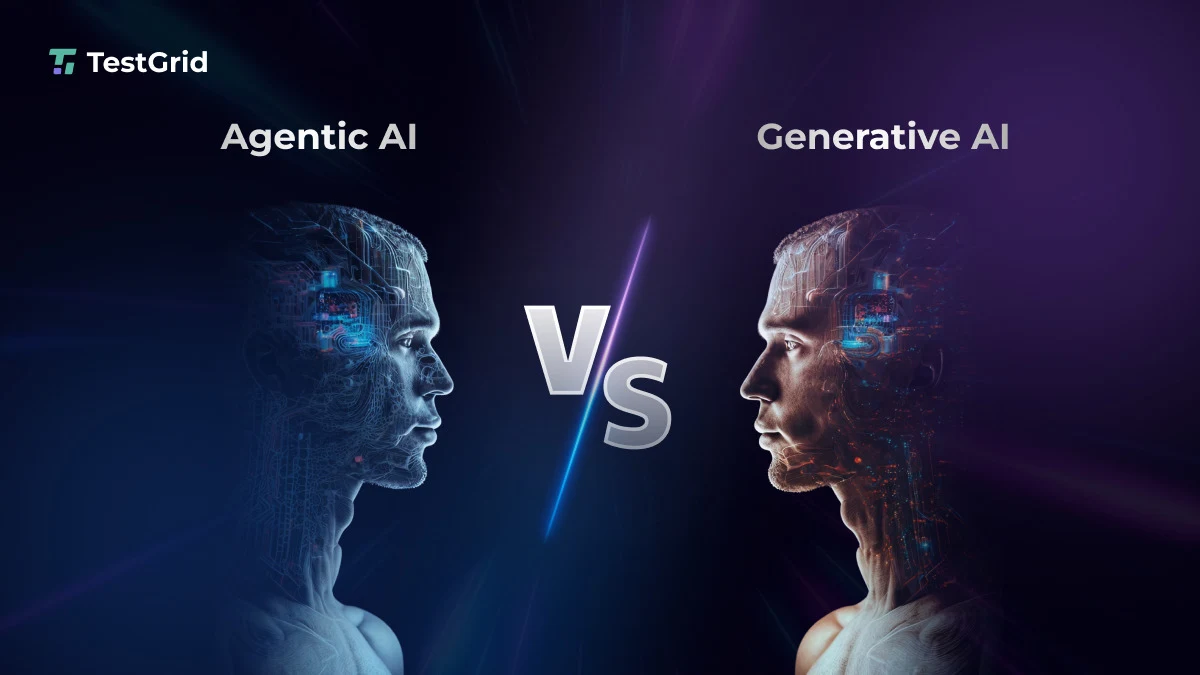
Generative AI assists you in brainstorming ideas and creating new content in different formats, while agentic AI takes initiative. This distinction is key in the broader agentic vs generative AI discussion.
In this blog, we’ll talk about agentic AI vs generative AI, what sets them apart, how businesses are using them in the real world today, and how you, too, can leverage the power of both to optimize resources and deliver exceptional user experience.
- Agentic AI vs Generative AI: Agentic AI autonomously executes goal-oriented tasks, while generative AI creates new ideas and content like text, code, or images.
- The key difference between gen AI and agentic AI lies in purpose, output type, reasoning, and interaction style.
- Agentic AI excels in customer support, threat detection, and supply chain automation, whereas generative AI dominates content creation, app development, and translation.
- Popular agentic AI vs generative AI examples include AI agents for testing, logistics, and cybersecurity vs Gen AI tools for writing, design, and code generation.
- Risks to consider in both agentic vs generative AI models: data breaches, black-box decisions, and model drift affecting accuracy over time.
What Is Agentic AI?
Agentic AI is a system built to behave and make decisions on its own with minimal human input or supervision. You train it by defining goals, desired outcomes, and setting rules, and once configured, it works like an autonomous agent.
The agent mimics real user actions, learns from external environments, adapts to changing conditions, and performs complex tasks.
And how do AI agents work?
They function in a structured way to:
- Gather data from various sources (databases, APIs, and user feedback)
- Analyze the information to make decisions
- Decide how to act based on analysis (executing a command or generating a response)
- Learn from results to improve future decisions
We’ll dissect how AI agents actually work in detail, but first, let’s check out their core characteristics.
Related read: Agentic AI Testing Guide
Main traits of Agentic AI
1. Autonomy
AI agents can work independently without constant instructions from humans. You only need to design a plan, set objectives, and define your goal using text, voice, or digital channels. The agent will autonomously gather information, decide what actions to take, and execute tasks. It can even assess past interactions and available tools before performing a task.
2. Interactivity
AI agents don’t just wait for fixed inputs to initiate an action. They actively engage with you and the outside environment, including digital interfaces, devices, and data streams to make decisions and carry out tasks. Take the example of a self-driving car. It constantly analyzes its surroundings, examines traffic conditions, and makes safe and accurate driving decisions.
3. Problem-solving
Agentic AI usually follows a structured process to solve a problem. When you input a goal, the agent immediately starts collecting data and information from interactions, logs, and user behavior. The agent analyzes this information, understands your goal, and breaks it into smaller tasks. It then integrates with other tools and frameworks to execute the tasks.
4. Adaptability
The agents learn from their experiences, take in feedback, process any new information available to them, and then change their behavior, strategies, and decisions accordingly. For example, a customer service AI agent, instead of relying on rigid scripts, can personalize responses based on customer queries.
Organizations all over the world are using agentic AI to optimize their workflows. In fact, a PwC survey shows that 66% of the companies using agentic AI have seen an increase in productivity.
How Does Agentic AI Work?
Now we come to the crux of the matter: how do AI agents actually act? This process typically involves four steps: perception, reasoning, memory, and action.
1. Perception
When you set a goal, an AI agent extracts data from its environment using sensors, APIs, and databases. It then uses these initial pieces of data, including your prompts, to understand context and recognize patterns, and decides what actions it needs to take.
2. Reasoning
In order to plan actions, form goals, and make decisions, AI agents mainly rely on certain reasoning techniques. Although techniques might vary for different types of AI agents, the most common approaches are:
- Symbolic reasoning (knowledge graphs, rule-based logic)
- LLM-based chain-of-thought reasoning
- Planning algorithms such as search-based planners or task decomposers
3. Memory
AI agents store, retrieve, and use past data and experiences to be able to make decisions. When an agent does a task for you, it needs memory to retain context, track the progress, and learn from the mistakes it makes.
This helps agents improve efficiency over time and make better decisions for you. Memory can be in the form of long-term knowledge bases, episodic logs, or dynamic buffers.
4. Action and learning
This is the final step when the agent completes the tasks to achieve the goal you set. It can even integrate with other tools and frameworks that might help in performing the tasks. After achieving a goal, the agent collects feedback and uses reinforcement learning to refine strategies over time.
Related read: Agentic AI Testing Guide
What Is Generative AI?
Generative AI (Gen AI) is a branch of artificial intelligence built on deep learning models. Understanding generative AI in the context of agentic vs generative AI helps clarify their distinct functions.
It can create original ideas, text, videos, stories, images, and music. You can train gen AI models to learn human languages, programming languages, and any complex subject, such as art, science, and math.
A 2025 McKinsey survey states that 71% of organizations say they use gen AI regularly. This number is up from 65% in early 2025.
Main traits of Generative AI
1. Data synthesis
Gen AI can be trained to replicate real-world data to create synthetic datasets, which you can use to train models for activities such as demand forecasting and fraud detection. This can be particularly helpful in situations where you cannot use sensitive real user data because of privacy or security concerns.
2. Content creation
One of the core characteristics of gen AI is creating content. This could be anything from generating images and videos to writing lists and solving math equations. You can even generate code from simple natural language prompts.
3. Hyperpersonalization
Gen AI models can pick up patterns and user preferences by studying actual user inputs. You can use this information to personalize user experiences at scale and with speed. You can even create personalized alerts, notifications, and emails, as well as custom offers based on previous purchases and browsing history.
How Does Generative AI Work?
Gen AI models typically rely on a foundation model such as a large language model (LLM) that enables them to produce content in the form of text based on natural language prompts. There are other foundation models for images, videos, and audio.
The developers first train the models using either supervised or unsupervised learning.
Under supervised learning, you provide labeled data and allow the models to learn specific outputs for given inputs. In unsupervised learning, deep learning algorithms are trained on large amounts of raw, unlabeled, and unstructured data to create foundation models.
The models analyze the data and predict the next action in a process or task. In language processing, for example, gen AI breaks text down into small, manageable units usually called tokens. Tokens can represent whole words, subwords, or even individual characters, depending on the model’s design.
Token processing allows models to better understand the relationship between words, handle linguistic variations, and generate more nuanced outputs. This, in turn, improves the model’s ability to create coherent sentences and maintain context over long conversations.
Learn More: How to Use Generative AI in Software Testing
A Comparative Analysis: Agentic AI vs Generative AI
Let’s closely examine the difference between gen AI and agentic AI to understand how both systems function, the type of output they deliver, how they learn, and the underlying technologies that power them.
This detailed agentic AI vs generative AI comparison will clarify how each contributes to modern automation workflows.
| Points of difference | Agentic AI | Generative AI |
|---|---|---|
| Definition | Autonomous AI that decomposes tasks, plans actions, and integrates with external systems to achieve a specific goal | AI designed to create new content or data based on specific inputs and the data they are trained on |
| Core functionality | Analyzes a goal, breaks it into smaller subtasks, and reasons and plans autonomously to complete those tasks | AI is designed to create new content or data based on specific inputs and the data they are trained on |
| Output type | Delivers functional tasks such as developing strategies, adjusting them, automating workflows, and continuous monitoring | Output is usually static and non-actionable. This can include articles, lists, diagrams, code, sound, and graphics |
| Interaction style | Doesn’t need to constantly interact with humans in order to make decisions; however, it does collaborate with other tools and frameworks and decides the best course of action to reach a goal | Collaborative. Gen AI models interact with humans via text, images, or voice to create content |
| Learning | Continuous learning and improvement from feedback and interaction with the external environment | Mainly pre-trained on datasets and minimal to no feedback during content generation |
| Technologies used | Robotics frameworks, decision trees, reinforcement learning, and sensor fusion | Mainly pre-trained on datasets and with minimal to no feedback during content generation |
Now that you know the main difference between gen AI and agentic AI, we also need to make sure their use is ethical and compliant with regulatory standards.
Also read: Best Generative AI Testing Tools
Security Risks and Ethical Considerations: What to Watch Out For
As many perks as agentic AI vs generative AI have, it also comes with certain risks, which you must account for to ensure secure, transparent, and reliable usage.
1. Security threats and data breaches
Since AI systems, both generative vs agentic AI, interact with multiple databases and systems, they often need to access sensitive user information. And if you don’t set up proper guardrails, it can lead to security mishaps such as prompt injection attacks where adversaries can manipulate inputs to influence system behavior and extract sensitive information.
| Pro tip: Enforce rigorous controls, including regular monitoring, access management, and encryption, to tackle this risk. You must make sure sensitive data is protected by data security protocols. Comply with standards like PCI DSS and GDPR, and also embed privacy-by-design principles when you develop AI systems to ensure data protection from the start. |
Related read: Security Testing from Requirements to Release: A Full-Stack Approach
2. Model drift
New data, trends, and patterns are always coming in. And the information you use to train AI systems may not remain relevant over time, causing the AI performance to gradually decline. This is what model drift is. It can negatively affect the decision-making ability of AI systems and lead to bad predictions.
| Pro tip: Implement model drift detectors and monitoring tools that will allow you to detect when an AI system’s accuracy decreases below a preset threshold. Also, periodically test AI systems in preproduction to detect bias and generate continuous reports to analyze performance. |
Also Read: What Is Decision Table Testing? A Beginner’s Guide
3. Reliability and transparency
AI systems, particularly AI agents, make decisions with limited human involvement. But this ‘black box’ nature raises questions about how these systems make decisions. Plus, LLM hallucinations add to concern.
| Pro tip: Audit AI agents continuously with humans in the loop, as well as include source verification to trace how the agents are extracting information and making decisions. |
Maintaining these governance strategies of generative vs agentic AI will help you build user trust and ensure ethical and consistent outcomes.
Related read: Why Hallucinations Still Break AI in Production
Agentic AI vs Generative AI Examples: Real-World Uses
Here are some fields where agentic AI vs generative AI comparison across purpose, output, technologies, and use cases, helping you understand the key differences between the two.
Agentic AI examples
| Domain | What AI agents do |
|---|---|
| Threat detection | Constantly scan for anomalies and simulate attacks to identify vulnerabilities, score user activity in real time, and update firewalls |
| Customer support | Triage and route tickets based on urgency, detect system anomalies and open tickets automatically, update documentation, and tailor responses based on user queries |
| Supply chain | Predict supply needs and trigger inventory reorders automatically, adjust delivery routes in real time, track supplier performance and flag risks |
| Research and discovery | Formulate research hypotheses, design and monitor experiments, incorporate new data, gather and clean data from multiple sources (databases, journals, APIs) |
Check Out: 7 Real-World Agentic AI Use Cases in Software Testing
Generative AI examples
| Domain | What AI agents do |
|---|---|
| SEO content creation | Write SEO-friendly articles and blogs, design keyword-optimized landing pages, repurpose blogs into newsletters or FAQs, and suggest CTA ideas |
| Financial analysis | Convert financial data into reports and dashboards, generate hypothetical market scenarios for testing, and produce anonymized financial datasets for model training |
| App development | Write functional code snippets from natural language prompts, generate documentation for APIs, design interfaces based on design briefs, and suggest new features and workflows |
| Language translation and localization | Generate translated voiceover scripts, align language translation with tone and intent, and understand cultural context and idiomatic expressions during translation. |
These were some of the most prominent use cases of gen ai vs agentic ai across different sectors. And another domain where agentic AI is making a difference is software testing.
Meet CoTester: Your AI Agent for Software Testing
AI agents particularly have a big role to play in the software testing industry. Owing to the growing customer expectations, businesses are constantly under pressure to launch new apps, upgrade existing ones, and offer exceptional user experience.
Cotester AI Test Agent by TestGrid, an enterprise-grade AI agent specifically for software testing, can help combat this issue and ensure reliable releases.
Here’s a quick peek at CoTester’s best features:
- Learn your product context when you upload user stories, requirement docs, and tests, or paste the link to staging/production web pages
- Gives you a thorough description of the test cases along with a step-by-step editor that demonstrates the automation workflow on prompting
- Produces step-by-step results after every test execution, including detailed logs and screenshots
- Stores all uploaded files and generated assets in a searchable repository
Plus, integrate it into your CI/CD workflows and scale rapidly without the risk of brittle automation and meet your delivery goals.
Book a demo and experience agentic testing in action.
Learn More: AI Testing Explained: Tools, Trends, and What QA Teams Need to Know
The Way Forward
Both agentic AI vs generative AI have unique capabilities, and one isn’t better than the other. Gen AI helps you enhance creativity and personalization through high-quality content creation, while agentic AI acts, decides, and learns autonomously to accomplish complex tasks and improve productivity.
But with increasing use of agentic vs generative AI, you must ensure the technology is developed and deployed ethically, and with transparency and accountability. Practicing human-in-the-loop is critical to ensure every decision made by AI is backed by human supervision. And for reliable and transparent software testing that your team can trust, book a demo with CoTester now.
FAQs About Agentic vs Generative AI
What is agentic AI?
Agentic AI systems act autonomously toward goals, for instance, AI-driven test automation or supply chain optimization. This clarifies what an agentic AI example is in real-world use.
Do you need technical expertise to use agentic AI and generative AI?
Not necessarily. Many agentic AI and generative AI platforms are built with user-friendly interfaces that help you leverage their capabilities without technical knowledge. Software testing AI agents like CoTester allow you to create tests in no-code/low-code approaches.
Can agentic AI and generative AI be used together?
Yes. You can use generative AI to create content like reports or emails, and use agentic AI for the next steps, like scheduling, sending, adjusting timelines, and triggering updates. The combination of both helps you automate tasks as much as possible and optimize resources.
What is the difference between agentic AI and generative AI in terms of task handling?
Agentic AI typically handles complex, chained tasks such as breaking objectives into subtasks, interacting with tools, and making autonomous decisions. Generative AI focuses on discrete, single tasks such as creating content, drafting, or summarizing.