CoTester 2.0 is LIVE! Your Always-Available AI Teammate for Testing.

- What Is a Device Farm?
- Benefits of Using Device Farms
- Steps for Testing on Device Farms
- Top 8 Device Farms for Android and iOS Testing
- Choosing the Right Device Farm for Mobile Testing
- Frequently Asked Questions (FAQs)
- What is a device farm in mobile testing?
- How do you test apps using a device farm?
- What are the benefits of using device farm tools?
- What is a cloud device farm, and how does it work?
- How do you choose the right mobile device testing cloud?
- What are the best device farm tools for Android and iOS testing?
- Conclusion
On average, people spend 6 hours and 37 minutes a day looking at their phones. Today, the internet traffic from mobile devices has surpassed desktops, signifying how people consider mobile devices not just as devices to connect to the world but as an integral part of their lives, especially for millennials who spend 25% of their waking lives using a mobile phone.
Mobile manufacturers have not sidelined this fact and have understood that releasing newer mobile devices is much more profitable than releasing newer laptops at the same pace.
However, with each new device release, mobile app testers require one more testing device and more test cases associated with it. This creates an issue of procurement, setup, and maintenance of thousands of devices that keep increasing each day. It is certainly a problem in the mobile world, and the best solution to it is using device farms!
TL;DR
- TestGrid: Real-device cloud for Android and iOS testing with support for manual testing, automation frameworks, CI/CD integrations, and device reservation features.
- AWS Device Farm: Cloud-based testing service that runs automated tests on real Android and iOS devices hosted on AWS infrastructure.
- Samsung Remote Test Lab: Free remote access to real Samsung Galaxy devices for testing Android applications.
- Firebase Test Lab: Google’s testing infrastructure that allows automated Android and iOS testing on real and virtual devices through Firebase and Google Cloud.
- Kobiton: Mobile device cloud supporting manual and automated testing with AI-assisted test automation features.
- Sauce Labs: Cloud testing platform providing real device testing along with simulators and emulators for automation workflows.
- Perfecto: Enterprise-grade device cloud supporting real devices, network virtualization, and both scripted and scriptless testing.
- Headspin: Global device infrastructure optimized for testing mobile apps under real-world network and geolocation conditions.
What Is a Device Farm?
A device farm is a testing infrastructure that provides access to multiple real physical devices, allowing you to run app tests across different hardware and operating system environments. Much like how a vegetable farm houses vegetables, a device farm houses real, procured devices, each unique in its own configuration. For instance, a farm might contain two Samsung Galaxy S24 devices, but with different RAM or ROM setups.

Instead of maintaining your own physical device lab, you can connect to devices hosted remotely through a platform and execute tests instantly, with no hardware purchases and no setup overhead.

The main purpose of a device farm is to meet the demands of mobile app testing, covering both Android and iOS environments. It eliminates the cost of procuring devices individually, allowing testers to simply select a device, upload their application, and begin testing right away.
The need for device farms grew rapidly alongside the explosion in mobile device sales and the sheer volume of applications being developed across operating systems. This demand led to the rise of device farm platforms offered by various companies, each bringing its own set of features to serve development and QA teams. Today, they are a standard part of mobile testing workflows across organizations of all sizes.
Benefits of Using Device Farms
Let’s take a look at where device farms come in handy:
1. Faster test cycles through parallel execution: A cloud device farm runs tests on multiple devices simultaneously. Parallel execution reduces build validation time and helps you move releases through CI pipelines faster.
2. Lower infrastructure overhead: Physical device labs require procurement, OS updates, device maintenance, and replacement. A mobile device farm manages this infrastructure, enabling you and your team to focus on test coverage and software release quality.
3. Access to real device coverage: The mobile ecosystem includes thousands of device and OS combinations. Device farm tools allow you to validate app behavior across a wide range of Android and iOS devices using a mobile app testing platform with real-device cloud coverage and tablets with different OS versions, screen sizes, and hardware configurations.
You can run manual sessions or automated test suites using frameworks such as Appium, Espresso, or XCUITest.
4. Consistent test environments: Device farms provide a stable, repeatable environment. Each session starts with a clean device slate, which helps you reproduce issues and analyze failures more reliably.
Also Read: Building a User Experience Lab – How To Validate Real-World App Performance
Steps for Testing on Device Farms
Testing on a device farm follows a straightforward workflow:
1. Upload your app build: Start by installing the latest version of your mobile app to the device farm platform. For Android apps, this is usually an APK or an AAB file. For iOS apps, you upload an IPA file. Once that’s done, the platform prepares the app for it to be executed across the available devices.
2. Select target devices: Device farms provide access to many Android and iOS devices with different operating system versions, screen sizes, and hardware configurations. Most platforms allow you to filter devices based on criteria such as OS version, manufacturer, and device popularity.
Selecting a representative set of devices helps you validate real user environments.
3. Configure your test framework: If you’re running automated tests, connect your existing testing framework to the device farm. Common app testing frameworks include Appium, Espresso, and XCUITest. Then, configure the test scripts and execution settings that define how tests should run across the selected devices.
4. Execute the tests: After configuration is complete, start the test run. The device farm installs the app on the selected devices and executes the tests.
Most platforms support parallel execution, which allows multiple tests to run across different devices at the same time. This helps you verify builds faster during development cycles.
5. Review results and debug issues: When the test run finishes, the device farm dashboard displays the results for each device. You can review test outcomes, inspect logs, and watch recorded test sessions.
Top 8 Device Farms for Android and iOS Testing
The following device farms serve as the best options in the current times, with lucrative features and impressive performance.
1. TestGrid
One of the top mobile device farms that not only lets you connect in a few seconds but also provides hardware settings control to the testers is TestGrid.
The platform supports multiple testing needs, including mobile, cross-browser, API, performance, and automation testing within the same environment. It provides real devices with their farm, constantly upgrading with newer ones from time to time.

The most attractive features of TestGrid are as follows:
- Device lock-in facility: Most device farms will reassign the device once the tester’s session closes or they log out of their account. However, TestGrid provides a facility to lock in a device for a certain period, allotting the device completely to the tester.
- Real device support: TestGrid provides real devices for testing that are placed on their premises, ready to begin the testing work.
- Beyond mobile application: TestGrid provides full device-level access, allowing testers to interact with system settings and navigate the device beyond just the application under test. That means the tester gets complete control of the device, with which they can also make hardware settings changes and navigate across the device as they would on a real device.
- Wide variety of testing: TestGrid supports a wide variety of testing domains, including performance testing, API testing, cross-browser testing, automation testing, and visual testing.
- Codeless support: Organizations adopting a codeless testing paradigm can achieve the same using TestGrid’s record-and-play feature without writing any line of code.
- Biometric support: TestGrid device farm supports biometric functionality testing that includes facial recognition and fingerprint verification through their real device.
- Deep integration: Testers get integrated software, such as JIRA, and tools that facilitate the CI/CD pipeline, such as Jenkins.
| Bottom line: TestGrid provides real-device testing infrastructure for Android and iOS with advanced device control and support for both manual and automated testing workflows. It provides a wide spectrum to work on with codeless support for all types of enterprises. |
Pricing
- CoTester Starter Package: Starts at $199 per seat/month (minimum 4 seats; includes 4 devices/browsers and 5,000 tokens)
- CoTester Growth Package: Custom pricing (includes all Starter features + marketplace integrations)
- Enterprise Test Infra (On-Prem / Hosted): Custom pricing (dedicated test lab for segregated enterprise teams)
For detailed pricing, click here.
2. AWS Device Farm
Source: AWS Amazon Device Farm
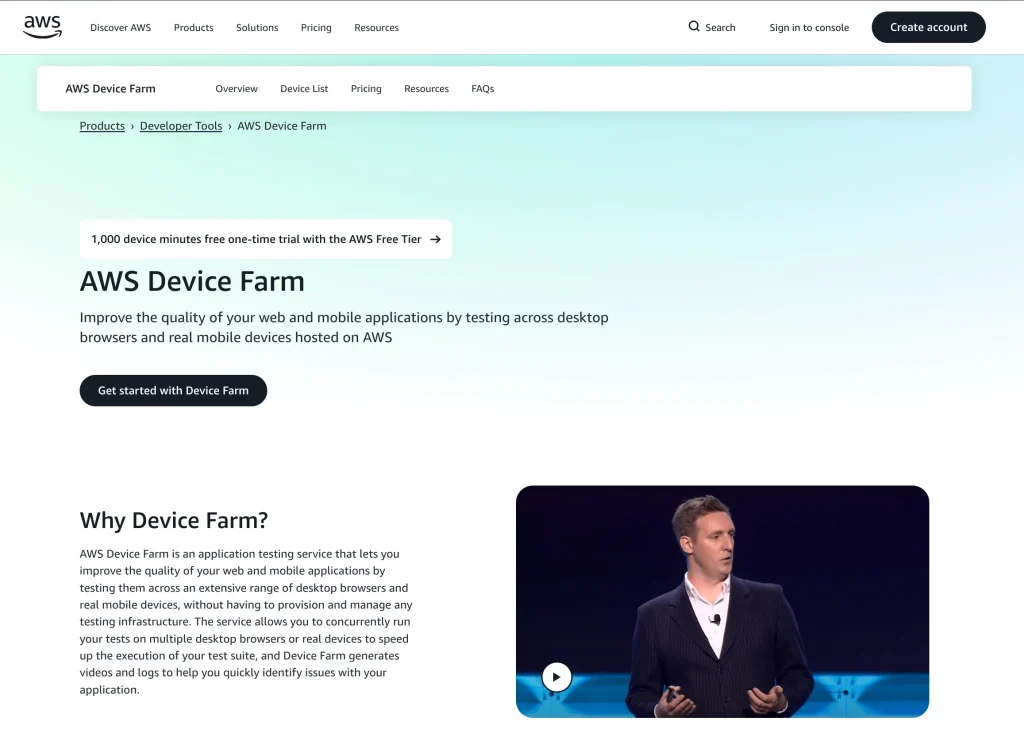
Established in 2015, the AWS Device Farm currently holds more than 2500 devices, including desktop, Android, and iOS, with 12 months of free usage. It allows the testers to accomplish automation testing with real devices, either by using built-in frameworks that do not require writing or maintaining tests or through supported frameworks directly.
Once the tests are completed, the testers get the results in the form of videos, logs, images, and other analytics for careful consideration. AWS Device Farm also allows geolocation settings and a smooth integration facility into the current development workflow for a seamless experience.
| Bottom line: AWS is a great device farm with a feasible option to get started. Since it is hosted by AWS, which also has its server farm and network hosting abilities, the testers can get a benefit out of it if they are already using AWS components in other pieces of development. |
For teams considering other platforms, check out these AWS Device Farm alternatives that provide cost-effective and flexible testing options.
Pricing
- Mobile device testing
- Pay-as-you-go: $0.17 per device minute
- Free trial: First 1,000 device minutes free
- Unmetered plan: Starts at $250 per device slot per month for unlimited testing and remote access
- Private devices: Dedicated devices start at $200 per month for exclusive access
- Desktop browser testing
- Pay-as-you-go: $0.005 per browser instance minute
3. Samsung Remote Test Lab
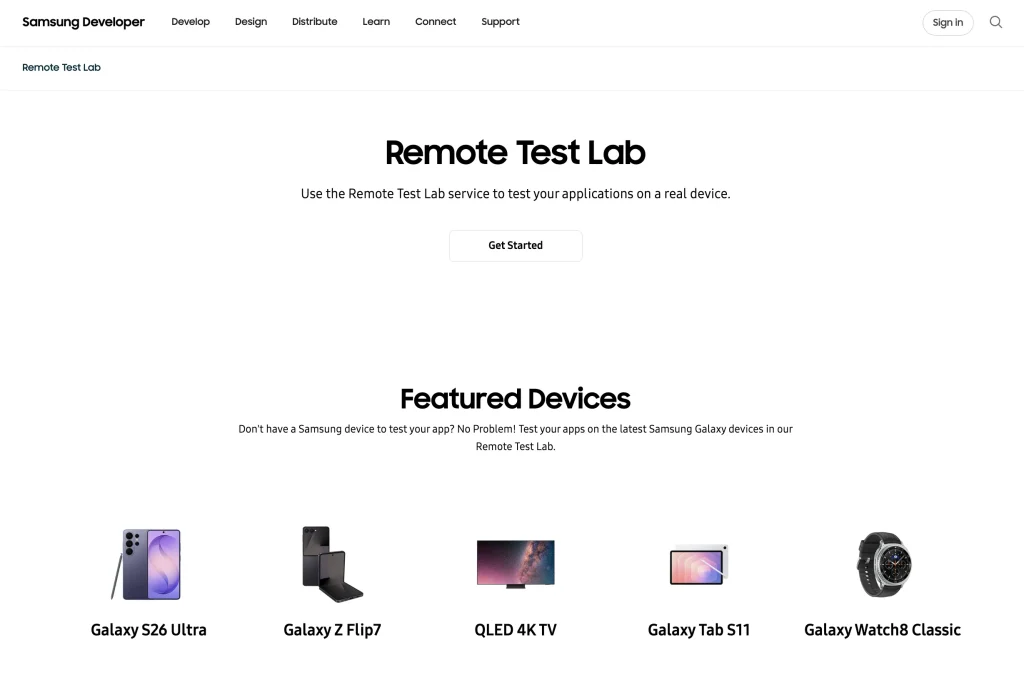
To satiate the physical device requirements and run the Android application, Samsung has its own Android farm called Samsung Remote Test Lab. This lab consists of real Samsung devices, including all the latest ones, located at 10 locations in 8 countries. Once the tester signs up for free, the nearest location is connected. However, the tester is not restricted to using just that location and can connect to other service locations as well.
Source: Samsung Remote Test Lab
Samsung Remote Test Lab has a unique way of installing the Android application using the drag-and-install feature, where the tester simply needs to drag the file from the local explorer to their dashboard to install. Once done, they get a list of features to leverage on these devices. A few of them are as follows:
- Setting alterations: Samsung Remote Test Lab provides a lot of setting options through which the testers can change the settings and test with which they are most comfortable.
- Automation testing support: The device farm by Samsung comes with support for automation testing, with a recording of integral parameters such as CPU usage and memory usage.
- Multi-touch support: The testers can test their application for multi-touch gestures, including zooming on the screen.
- Audio streaming: The device farm for Android also supports audio streaming, so the tester can listen to each sound embedded in their application.
- Bottom line: Samsung Remote Test Lab is fast, user-friendly, and efficient in testing, providing a user experience similar to a real device. However, the tester can use only Samsung devices in the lab, and since they are manufactured by Samsung, they support Android applications only.
Pricing – Free of charge for registered Samsung Developers
4. Firebase Test Lab
Google’s answer to the problem of real device procurement for testing is Firebase Test Lab. Established for Android and iOS application testing, Firebase Test Lab provisions a real device (or a virtual device as per requirement) with just a free sign-up.

Firebase Test Lab can integrate tests with Firebase console, Android Studio, and gcloud CLI due to the reason that it is made by Google. It also provides support for Robo test, through which testers can create tests without writing any code by using the Robo driver that crawls the applications and does all the necessary work. Although that does not mean test scripting is not allowed. Testers are free to choose the path they want and even integrate the CI pipeline directly through the command line into the lab. Once done, detailed reports are generated containing analytics and screenshots.
| Bottom line: Firebase Test Lab can get one onboard quickly as compared to many other alternatives. It also provides support for iOS testing, but with limited options. However, the downside is that Firebase Test Lab is not suitable for all testing domains that a tester may require. It can be used with other labs or frameworks, but not exclusively. |
Pricing
- Virtual device tests: Up to 10 tests per day with 60 minutes of free usage daily (After the free limit, pricing is $1 per device per hour)
- Physical device tests: Up to 5 tests per day with 30 minutes of free usage daily (Additional usage costs $5 per device per hour)
- Android device streaming: Includes 30 free minutes per project per month, after which usage costs $0.15 per additional minute
5. Kobiton
Another piece in the top device farms for Android and iOS testing is Kobiton. Similar to TestGrid, Kobiton also provides codeless testing capabilities; however, its device cloud only supports mobile, and that too those that are popular (with popular operating systems).
Source: Kobiton Device Lab
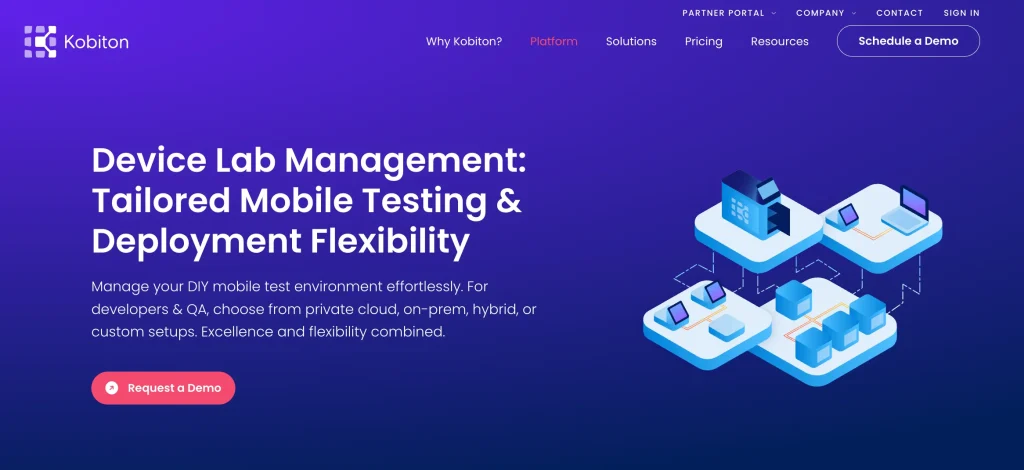
Kobiton comes with a feature of device lab management that essentially means that a tester can create a lab of their own and select the target device for their application in that lab. Since it is a personal device lab, they no longer would be required to keep track of these devices, and the lab will serve as an isolated one, yet connected to the Kobiton ecosystem. One may also find a few elements of artificial intelligence embedded in scripting to make test case writing faster. This includes self-healing as well as Appium test case generation.
| Bottom line: Kobiton device farm is an AI-supported tool with codeless support. However, considering the shortfalls of real devices, it may not be completely suitable for the organizational level of testing. |
Pricing
- Startup: Starts at $83 per month
- Accelerate: Starts at $399 per month
- Scale: Starts at $9,000 per year
- Enterprise: Custom pricing
6. Perfecto
A device farm with biometric support and network virtualization is Perfecto. Supporting both real devices and virtual devices, Perfecto allows a blend of scriptless and scripted testing for an efficient cycle.
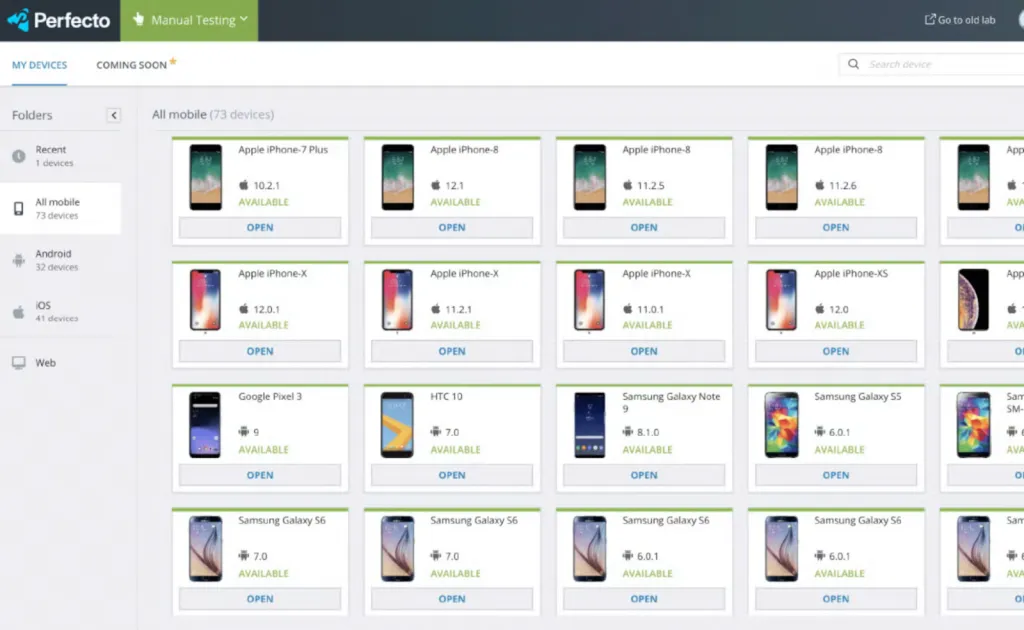
Perfecto is also capable of expanding its span beyond simple UI testing to performance testing, API testing, and user experience testing. With a certified cloud system and high-class monitoring abilities, Perfecto is easily one of the top device farms for Android and iOS testing.
| Bottom line: Perfecto is a great tool that allows most types of testing. However, the device farm lacks integrations and does not support hardware configurations like testing the camera, etc. |
Pricing
- Starter: Free
- Basic: $83 per month
- Pro: $125 per month
- Enterprise: Custom pricing
7. Sauce Labs
A device farm that can take care of all your needs from development to post-release is Sauce Labs. It provides great support for automation software and integrates third-party apps as well.
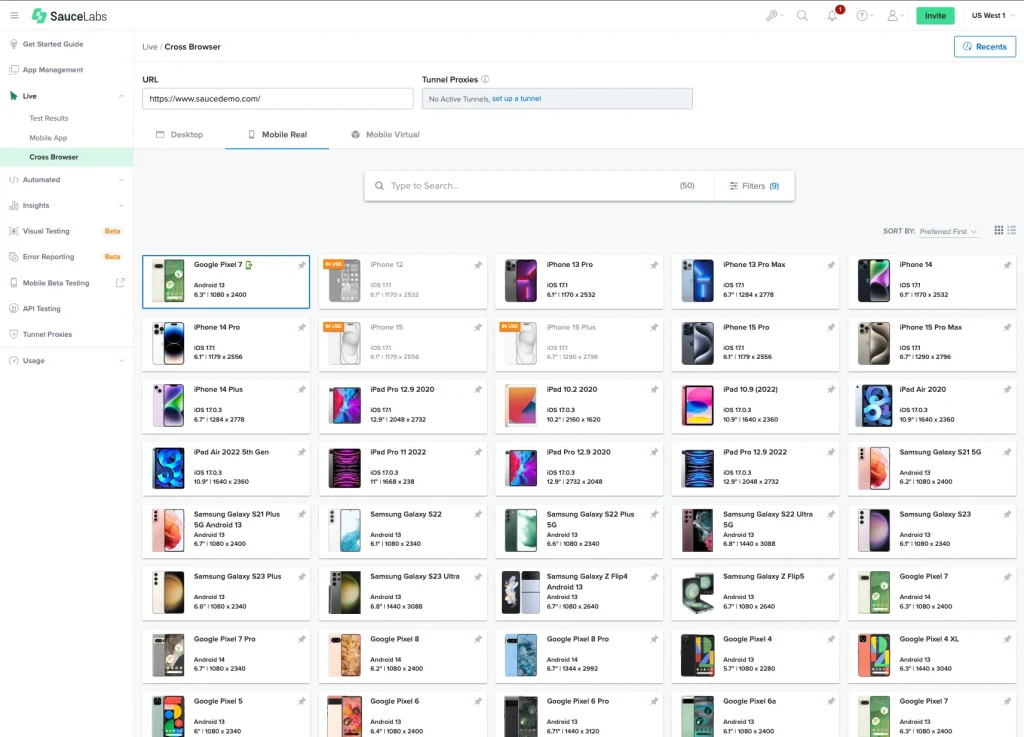
Sauce Labs has been innovative for years, providing solutions that could facilitate the testing cycles. For instance, it provides parallel testing and can open the code inspector to debug the code just as on a browser. It also provides simulators and emulators based on requirements, along with real devices that can monitor the test executions and generate an extensive report later on.
| Bottom line: Sauce Labs is a great platform that provides all the required functionalities along with CI/CD integration to the customers. However, the only downside is difficulty in accessing the hardware parameters, and it does tend to be on the pricier side as compared to its alternatives. |
Pricing
- Live Testing: $49 per month
- Virtual Cloud: $199 per month
- Real Device Cloud: $249 per month
Also Read: Selecting the Ideal Cloud Test Automation & Infrastructure Platform
8. Headspin
Promoting itself as a Global Device Infrastructure, Headspin is present at more than 90 locations whose greatest impact is seen in geolocation testing.
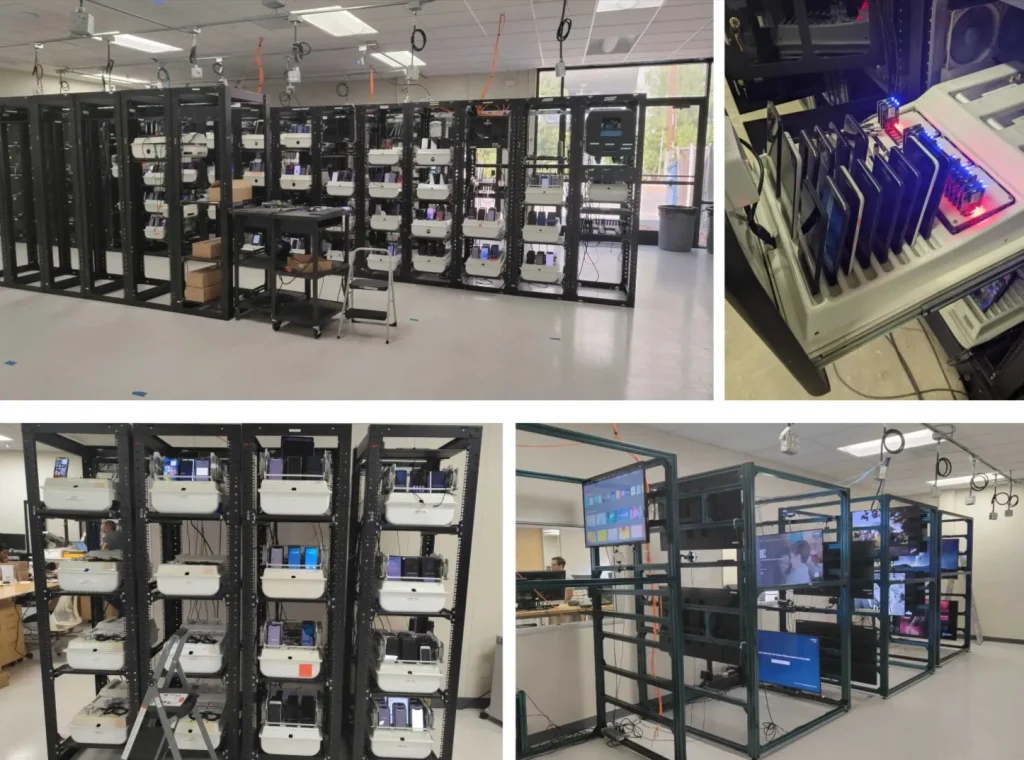
Headspin supports both manual and automation testing on real devices with a primary focus on simulating real-world conditions, no matter what type of tests are run. Its support for multiple automation frameworks makes it one of the top device farms for Android and iOS testing. Headspin also supports creating your own lab to organize the target devices in a single place.
| Bottom line: Headspin is a great choice for testers targeting geolocation testing or in any other way requiring their application to run from different locations. However, Headspin may seem to be weaker in other testing domains and does not support a few mandatory ones such as API testing. It has also been conceived as an expensive tool. |
Pricing
- Cloud Test Pro: Custom pricing
- Cloud Test Lite: $49 per month
- Cloud Test Go: $300 per month
Choosing the Right Device Farm for Mobile Testing
As mobile ecosystems expand, maintaining an in-house device lab becomes increasingly difficult. Every new device model, OS update, and hardware variation adds complexity to mobile QA workflows.
For modern engineering teams, scaling device coverage without scaling infrastructure costs is a constant challenge. As we’ve seen, this is where cloud device farms play an essential role.
However, not all tools provide the same depth of capability. Many platforms offer basic device access, but modern QA teams often need more than just remote devices. They require infrastructure that supports manual testing, automation frameworks, and CI/CD integration.
TestGrid approaches this differently by treating the device farm for mobile testing as infrastructure rather than a simple testing utility.
With TestGrid’s real-device cloud, teams can:
- Access real Android and iOS devices hosted in a managed cloud device farm
- Run both manual and automated mobile tests using frameworks like Appium and Selenium
- Perform parallel test execution across multiple devices
- Use device reservation and device locking for consistent debugging sessions
- Test biometric authentication and hardware-level behaviors on real devices
Beyond mobile testing, TestGrid also extends into cross-browser, API, performance, and automation testing within the same platform, allowing teams to consolidate multiple testing tools into a unified testing infrastructure.
Request a free trial with TestGrid to find out more.
Frequently Asked Questions (FAQs)
What is a device farm in mobile testing?
A device farm is a cloud-hosted collection of real smartphones and tablets used for testing mobile apps. It allows you to run manual or automated tests on many devices without maintaining your own physical device lab.
How do you test apps using a device farm?
You upload your application build to the platform, select devices, and execute tests manually or through automation frameworks such as Appium or XCUITest. The device farm runs tests on real devices and generates logs, videos, and performance data for analysis.
What are the benefits of using device farm tools?
Device farm tools provide large device coverage, parallel test execution, faster debugging, and reduced infrastructure maintenance. These platforms help teams validate mobile apps across real hardware environments.
What is a cloud device farm, and how does it work?
A cloud device farm hosts real mobile devices in remote data centers. You access these devices through a web interface or API. The platform installs your app, executes tests, and records execution data while you monitor results remotely.
How do you choose the right mobile device testing cloud?
When evaluating a mobile device farm, consider factors such as device availability, OS coverage, automation framework support, parallel testing capacity, debugging tools, and CI/CD integrations. Reliable infrastructure and consistent device availability also play an important role.
What are the best device farm tools for Android and iOS testing?
Common device farm tools for Android and iOS testing include TestGrid Device Cloud, AWS Device Farm, Sauce Labs Real Device Cloud, Firebase Test Lab, and BrowserStack App Live and App Automate. TestGrid differentiates itself by providing deeper device-level control, including device reservation, manual testing access, and native support for frameworks like Selenium and Appium on real-device infrastructure.
Conclusion
As time goes by, the frequency with which manufacturers release their phones also increases. Today, more than 81% of Americans own smartphones, and this percentage keeps increasing in each country. However, this serves as a problem for the developers and testers. The more devices there are, the more flexible our code needs to be to cater to all those devices. Hence, we need a solution that can provide us with devices and still be able to eliminate the overheads that come with it. This is exactly what device farms do.
Device farms are a collection of devices (mostly real) that sit at a physical location and are connected to the internet for usage. They are primarily designed to cater to the development and testing requirements, which is not a restriction, and they can be used for personal use as well. Device farms often try to differentiate themselves by providing unique features to the testers. Some, like TestGrid, can span across all testing domains, while some, like App Center Test, have restrictive capabilities. This makes the top device farms list for Android and iOS testing worth reading and understanding, which one suits our needs the best. Hope it helps in future projects, and let us know your favorite tool in the comments below!