 CoTester 2.0 is LIVE! Your Always-Available AI Teammate for Testing.
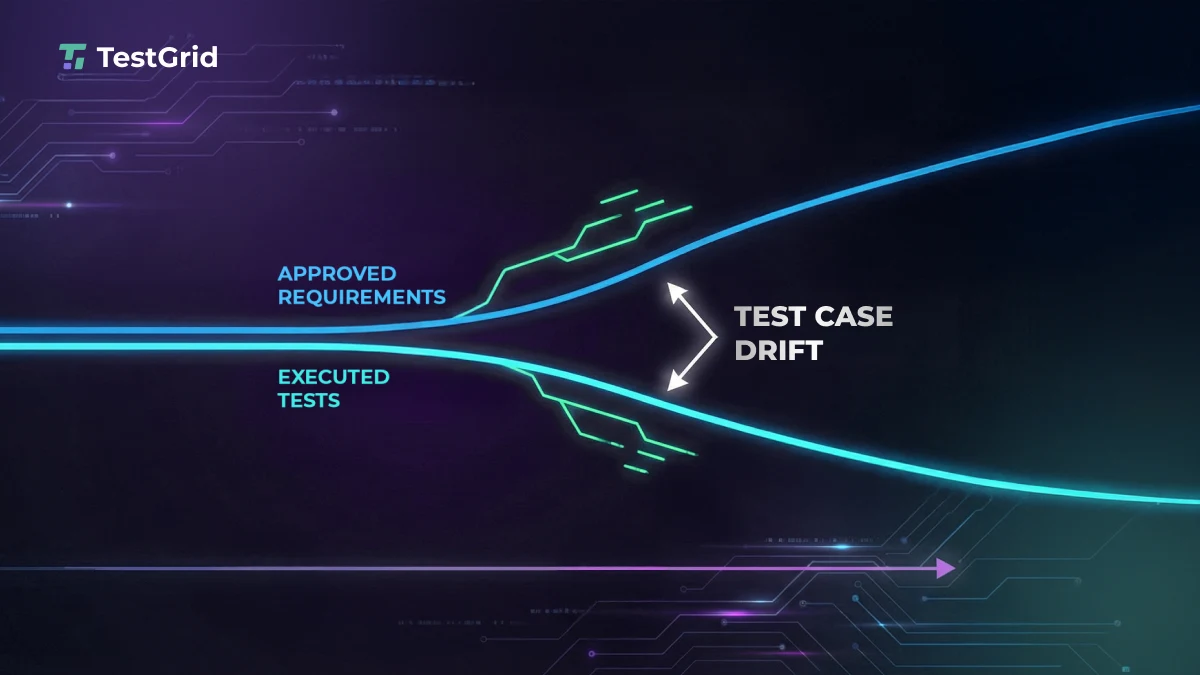
In enterprise delivery environments, tests are created to verify that implemented functionality conforms to approved requirements. Each test case is linked to a specific approved behavior, acceptance criterion, or system condition.
This linkage is what allows test execution results to be used as release evidence. However, over time, requirements change through clarifications, dependency shifts, configuration updates, or partial scope adjustments.
And these changes don’t always trigger complete or accurate impact analysis across existing test cases. As a result, they may continue to execute successfully while no longer providing reliable confirmation of requirement conformance.
This condition is known as test case drift. In this article, you’ll learn where it’s introduced in the testing lifecycle, what allows it to persist, and what must be enforced to prevent it. Explore drift prevention with CoTester.
TL;DR
- Passing test results cannot be treated as reliable release evidence unless the test’s validation logic remains aligned with the current approved requirement behavior.
- Requirement updates often preserve traceability links but do not guarantee that existing tests still validate the revised acceptance criteria or system conditions.
- Test maintenance, automation refactoring, and manual execution variability can weaken or alter validation coverage without changing the reported pass status.
- Distributed ownership across requirement tools, test management systems, and automation frameworks allows validation logic to change without enforced review or re-approval.
- Release confidence depends on enforcing version traceability and review controls that tie execution results to the exact requirement and test definition they validated.
How Test Case Drift Gets Introduced
Test case drift isn’t caused by a single event. It’s introduced at specific points where requirements, test definitions, and execution are modified without enforced realignment between approved intent and validated behavior.
The mechanisms below highlight how this alignment breaks during requirement updates, test maintenance, and automation changes:
1. Requirement intent drift
It occurs when the approved behavior of a requirement changes, but the associated test continues to validate the earlier interpretation.
Here, you update the acceptance, business rules, or configuration conditions. The requirement is re-approved with the existing test retaining its traceability link and continuing to pass, even though it no longer validates the current approved behavior.
2. Validation scope drift
It’s the reduction or alteration of what a test asserts as correct behavior to keep execution running.
You can modify the test to restore execution after UI changes, workflow updates, or data model changes. The test runs successfully again, but now it verifies fewer conditions than originally defined. The validation coverage has been reduced.
Also Read: Test Case Management [Tools & Types]
3. Automation semantic drift
It’s the change in what an automated test validates due to refactoring of automation logic rather than explicit intent review.
You consolidate assertions into shared utilities and generalize locator handling. The execution path remains similar, and the test continues to pass. The validations become indirect, and the test no longer encodes the specific requirement condition being verified.
4. Execution interpretation drift
It occurs when the manual execution of a test varies across multiple cycles.
Under time pressure or environment constraints, you apply judgment, skip optional checks, and interpret ambiguous steps differently. These decisions aren’t reflected in the test definition. But the behavior it validates varies from run to run.
5. Ownership and control drift
This is the loss of enforced alignment caused by distributing requirements, test definitions, and execution evidence across disconnected systems and roles.
That means a requirement update doesn’t force a test review. A test update doesn’t trigger requirement re-approval. Execution results are reported without confirming which version of intent they correspond to.
Learn: Test Case Design Techniques in Software Testing
Structural Characteristics of Test Case Drift
| Drift Type | Where It Enters | What Changes | What Stays the Same |
|---|---|---|---|
| Requirement Intent Drift | Requirement update and re-approval | Approved requirement behavior and acceptance criteria | Existing test case linkage and passing execution status |
| Validation Scope Drift | Test case maintenance or modification | Assertions and validation conditions enforced by the test | Test case identity, linkage, and execution success status |
| Automation Semantic Drift | Automation code refactoring or framework changes | Validation logic implemented in automation code | Test name, execution flow, and reported pass result |
| Execution Interpretation Drift | Manual test execution | Steps performed and validation interpretation | Test definition and recorded pass outcome |
| Ownership and Control Drift | Requirements, tests, and execution are managed in separate tools or systems | Artifact versions and requirement-test alignment | Reported execution status and release readiness signal |
Apply: Test Case Template – Free Examples & Formats for QA Teams
What Must Be Enforced to Prevent Test Case Drift
By now, you’ve seen how test case drift enters the lifecycle and why passing tests shouldn’t be treated as reliable validation evidence. The next plausible step is to implement enforcement control to prevent the drift.
But before that, you need to first determine whether your current system already permits drift. Use the checklist below to evaluate your workflow:
| Enforcement point | Observable today? | Enforced by the system? | Drift risk |
|---|---|---|---|
| Requirement change triggers test review | Yes / No | Yes / No | High if No |
| Test intent is separately inspectable | Yes / No | Yes / No | High if No |
| Assertion changes require approval | Yes / No | Yes / No | High if No |
| Manual and automated share definition | Yes / No | Yes / No | High if No |
| Execution tied to approved intent | Yes / No | Yes / No | High if No |
If any row is marked “No” under “Enforced by system?,” your workflow allows drift to occur without detection, and these are the steps you need to take to prevent it:
1. Conduct mandatory test reviews when requirements change
Let’s say you modify acceptance criteria, add a validation rule, or change the expected outcome of a workflow.
Before approving it, open the tests linked to it. Check whether each test still validates the updated behavior. If a test reflects the previous behavior, update it or remove it before completing approval.
| Pro tip: Edit an existing requirement and attempt to approve it. Observe whether your system requires you to review linked tests before approval completes. If approval completes without that requirement, your workflow allows tests to remain misaligned with approved requirements. |
2. Require approval when validation logic changes
If you update a test to restore execution, for example, remove an assertion, change a validation condition, or modify automation logic, think of the test as valid.
Review what behavior the test now verifies. Confirm that the current assertions still enforce the intended requirement. If validation coverage has been reduced or altered, update the test or re-approve it before relying on its execution result.
| Pro tip: Open an existing test and weaken or remove an assertion. Run the test and observe whether the system requires approval or review before accepting the new passing result. If the test immediately reports a pass and is treated as valid without review, validation logic can change without control. |
3. Ensure execution results are traceable to approved requirements and test versions
Now, if you review passing test results during release preparation, these results should determine whether the system is ready to ship.
When viewing a test result, confirm that you can see which requirement version and test definition version were executed. This information must be visible directly from the execution record.
| Pro tip: Open a test result from a recent release cycle. Check whether you can identify the exact requirement and test definition versions associated with that execution. If this information isn’t immediately visible, passing results can’t be tied to approved validation intent. |
How CoTester Prevents Test Case Drift and Preserves Test Intent
CoTester is an AI software testing agent.
It allows you to link or upload requirement artifacts such as Jira user stories, change tickets, or specification documents. CoTester generates test cases directly from these inputs.
Each test remains linked to its originating requirement, preserving a clear record of what behavior the test is intended to validate.
Before execution, you can review and finalize the generated test steps in CoTester’s editor. Refine validations, adjust checkpoints, and confirm expected outcomes. This review establishes the approved validation logic for the test.
When the app changes, CoTester adapts execution to handle UI and structural variation without silently redefining the test purpose. Execution-layer adjustments resolve locator changes, layout shifts, and interaction differences using visual and contextual matching.
The test definition, including its validation logic and requirement linkage, remains governed and versioned. If you change what the test validates, that change occurs explicitly in the test definition and remains visible for review.
Manual and automated testing operate from the same test definition.
Manual execution records observations, failures, and confirmations against the same requirement-linked test. When you extend a verified manual test into automation, CoTester uses the approved steps as the source.
Each run produces step-level outcomes, logs, and screenshots associated with the same test across execution cycles. When reviewing results during release preparation, you can see exactly which requirements and validation logic were exercised.
If you want to see how this AI agent for software testing functions in real life, book a demo with CoTester today.


