CoTester 2.0 is LIVE! Your Always-Available AI Teammate for Testing.
- What Is Conversational AI Testing?
- Why Is Conversational AI Testing Important?
- Conversational AI Test Types
- Areas to Evaluate in Conversational AI
- Conversational AI Testing Workflow: How to Perform It
- Conversational AI Testing Challenges and Ways to Overcome Them
- Test Voice Interfaces and Optimize Conversational AI Quality with TestGrid
- Frequently Asked Questions (FAQs)
Traditional software testing loves an answer key.
Click this button. Expect this screen. Send this request. Expect 200 OK.
Then conversational AI walked in and decided that five different answers could all be correct, the sixth could sound correct while being completely fabricated, and the seventh might call an API and cancel your customer’s order.
That changes how you test.
With conversational AI testing, exact-string assertions are only one tiny part of the job. You also have to evaluate meaning, context, grounding, task completion, tool use, safety, and the many paths a multi-turn conversation can take.

In this guide, you’ll learn the key conversational AI testing methods, how to structure an evaluation workflow, which metrics matter, and how to handle the problems that make AI conversations fundamentally different from deterministic software.
Test conversational AI beyond the model with TestGrid. Request free trial.
TL;DR
- Conversational AI testing evaluates chatbots, virtual assistants, and voice agents to determine whether they understand user input, retain context, generate appropriate responses, complete intended tasks, and behave safely across text and voice interactions
- Key areas include intent and entity understanding, context retention, grounded response quality, task and tool execution, safety and fallback behavior, latency, and successful conversation completion
- Types of conversational AI testing can be functional, regression, performance, security, and voice testing
- For testing conversational AI, map out test objectives, set evaluation criteria, design test cases, prepare test data, execute tests, evaluate results, monitor metrics, and analyze failures
What Is Conversational AI Testing?
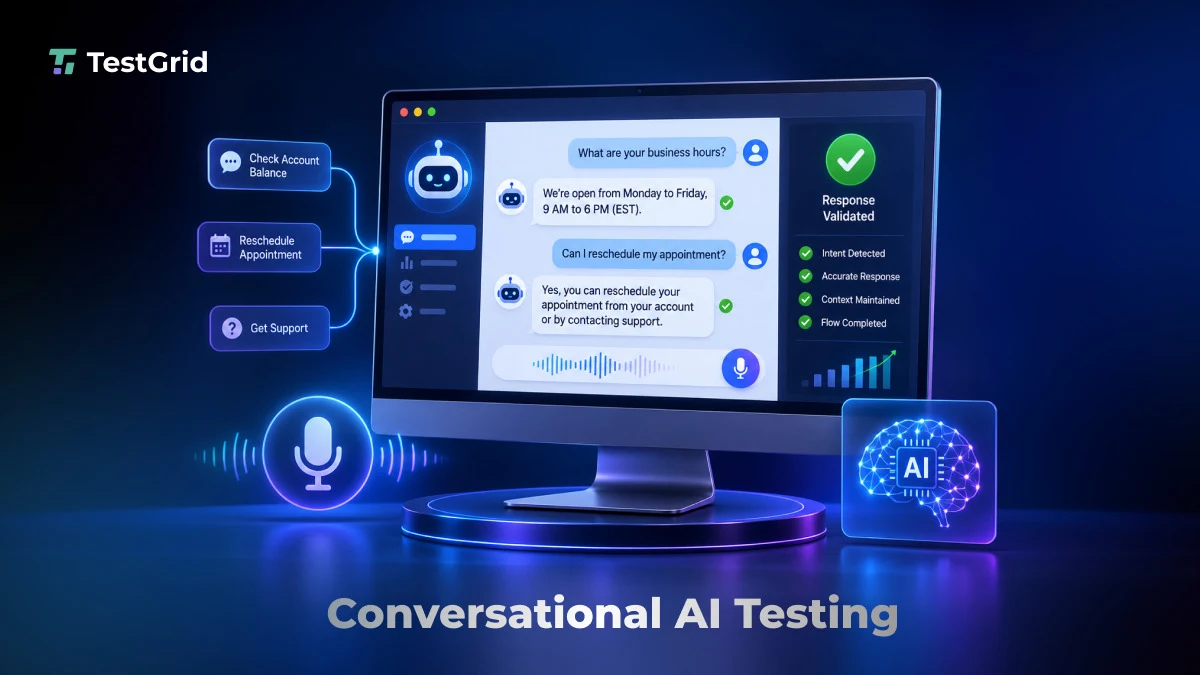
Conversational AI testing is the systematic evaluation of systems that interact with users through natural language, including chatbots, virtual assistants, and voice agents.
It examines the complete conversational stack, from language understanding and dialogue state to retrieval, tool calls, backend services, and the user-facing response.
It helps you determine if they can operate as intended across different interaction scenarios and meet your defined functional and business requirements before and after deployment.
Also Read: How to Test Audio and Video on Real Devices
Why Is Conversational AI Testing Important?
Businesses increasingly use conversational AI to answer questions, complete transactions, schedule appointments, support customers, and trigger actions across digital services.
Once an assistant can act on a user’s behalf, a fluent response is not enough; the underlying result also has to be correct.
Thorough conversational AI testing helps you:
- Ensure your users receive reliable information and avoid misinformation that can damage customer trust and business credibility
- Maintain a predictable service experience across different users, communication channels, and interaction patterns
- Confirm that AI assistants can support business operations without causing failed transactions, incorrect bookings, or incomplete service requests
- Protect organizational data, customer information, and business processes from misuse, unauthorized access, and unsafe AI behavior
- Preserve service availability and performance through high traffic conditions, infrastructure changes, and ongoing app updates
Conversational AI Test Types
Although there are several conversational AI testing methods, these are the most critical ones.
1. Functional testing
Functional testing checks whether the assistant completes the workflow it was designed for. Validate conversation initiation, authentication, data capture, retrieval, tool and API calls, backend updates, CRM actions, human handoffs, and the final application state.
Also Read: Automate Functional Testing for Media Applications
2. Regression testing
Regression testing lets you check if changes made to an AI model, system prompts, knowledge base, conversation workflows, or integrations affected any previously working functions.
Here, you generally rerun established test suites against updated versions and compare results with baseline evaluations to detect new failures, defects, or performance degradation.
Learn More: 13 Regression Testing Tools: Open-Source, AI & Enterprise
3. Performance testing
Performance testing measures how the system behaves under normal, peak, and sustained workloads.
You can track end-to-end response latency, time to first response, throughput, concurrent-session capacity, tool or API latency, and resource utilization. For voice systems, also measure delays across speech recognition, generation, and playback.
4. Security testing
Security testing inspects whether the conversational system and its connected services resist prompt injection, sensitive-data disclosure, insecure tool calls, excessive permissions, authentication weaknesses, and unauthorized downstream actions.
You can verify access controls, session isolation, and whether the assistant stays within the permissions granted to the user or workflow.
5. Voice testing
Voice testing evaluates the spoken interaction from input to response. Cover speech recognition, entity capture, text-to-speech output, pronunciation, turn detection, interruptions or barge-in, silence handling, microphone permissions, and the application state produced by each spoken request.
Areas to Evaluate in Conversational AI
1. User intent recognition
You need to check if your AI system can properly understand your user’s underlying goal. Test different phrasings, synonyms, slang, misspellings, incomplete queries, and ambiguous requests.
If your system uses predefined intents, see if it can differentiate between similar ones and extract the right entities. For generative assistants, check whether it chooses the right workflow or tool and handles unfamiliar or out-of-scope requests safely.
2. Conversation context retention
See if the AI can remember and correctly use information shared earlier in the conversation. Test whether it retains user preferences, previously given details, and conversational constraints, and whether it updates that information correctly when the user changes or corrects something later.
3. Response accuracy
The AI should generate responses that are accurate, relevant, and grounded in the available context. Check whether its answers address the user’s actual question, include the information needed to complete the task, and avoid irrelevant details or unsupported claims.
4. Hallucination and grounding behavior
Examine whether the AI fabricates information, invents facts, or presents unsupported claims as reliable answers. Check whether factual responses are supported by trusted knowledge sources, retrieved documents, or context given by the user.
Also see how the system responds when information is missing, contradictory, or outdated, instead of simply making something up.
5. Task completion ability
Your AI system should successfully guide users toward their intended outcomes. Test whether it asks the right follow-up questions, handles topic changes, and recovers from misunderstandings without derailing the conversation.
If it performs an action, also confirm that the right tool or backend process ran and produced the expected result.
6. Safety, bias, and fallback
Any AI chatbot or assistant should follow safety policies, avoid discriminatory or harmful responses, and protect sensitive user information.
When you’re testing conversational AI, assess its resistance to prompt injection, jailbreak attempts, privacy leakage, unauthorized tool use, and requests for restricted content. Also check whether it refuses, recovers, or escalates to a human when necessary.
Also Read: Audio Testing for Chatbots: A Practical QA Guide
| Testing area | What to validate |
|---|---|
| Intent recognition and understanding | Correct intent classification, entity extraction, handling of ambiguous queries, varied phrasing, and misspellings |
| Context retention and conversation memory | Conversation recall, contextual consistency, retaining updated information, and prevention of context loss |
| Response accuracy and relevance | Factual correctness, answer relevance, completeness, and alignment with the user’s query and reference information |
| Hallucination and grounding | Unsupported claims, fabricated information, faithfulness to retrieved documents, and appropriate management of missing information |
| Dialogue flow and task completion | Logical conversation progression, relevant follow-up questions, successful task execution, and recovery from misunderstandings |
| Safety, bias, and fallback behavior | Harmful or biased responses, privacy leakage, prompt injection resistance, and human escalation |
Conversational AI Testing Workflow: How to Perform It
1. State your test objectives and evaluation criteria
First, you need to understand what you want the AI system to achieve and which requirements your tests have to verify. Define evaluation thresholds, pass/fail conditions, and acceptable performance ranges so you have consistent evidence of system quality.
For example, if you have an e-commerce support chatbot, your test objectives might include resolving order-related queries, retrieving accurate product information, and completing return requests.
2. Design the scenarios and test cases
Next, develop test scenarios according to your system’s intended use cases, business workflows, and interaction patterns. Here, outline the conversation steps, preconditions, expected agent behavior, and evaluation assertions for each case.
Cover standard user journeys as well as alternative paths, user corrections, topic changes, interrupted interactions, tool failures, ambiguous requests, and situations where the assistant should refuse or escalate.
Now, based on the test scenarios, you need to design the test cases. Some examples can be:
- Verify whether the chatbot can process a product return request with a valid order ID
- Verify if the AI assistant can handle a user changing their appointment date midway through a conversation
- Verify whether the assistant correctly handles a payment failure and provides the appropriate next steps
- Verify whether the assistant can handle a request involving multiple actions in a single message
3. Prepare conversation input data
For testing, prepare diverse test data that reflects how users actually interact with your conversational AI system. Include sample utterances, conversation transcripts, user profiles, relevant context, and expected outcomes.
Add variations in language, phrasing, spelling, and input length, and for voice systems, accents or pauses where relevant. Use anonymized, masked, or synthetic data when production data could expose confidential information.
4. Execute your tests
Run your prepared tests in a controlled environment, either manually or through automation. You can test individual components such as prompts, retrieval, or APIs, and also execute complete user journeys through the application, connected tools, and backend services.
After testing, capture responses, logs, API activity, execution times, and evaluation results for analysis.
5. Evaluate results with metrics
Assess your results against the success criteria you defined earlier, then choose metrics that match what your conversational AI system is expected to do.
Common metrics include task completion rate, intent accuracy where relevant, response relevance, context retention, groundedness, tool-call success, escalation accuracy, and response latency:
- Intent recognition accuracy: How accurately your AI model can identify the user’s intended meaning and classify requests into the correct intent categories
- Response relevance: Helps you check if generated responses address the user’s questions and align with the conversation context
- Hallucination rate: Measures the frequency of the AI in generating fabricated, factually incorrect, or unsupported information
- Task completion rate: Enables you to calculate the percentage of user requests which the AI successfully completes according to predefined success conditions
- Context retention accuracy: Examines if the AI is able to recall and apply relevant information from previous conversation turns
- Response latency: The time it takes for your AI chatbot or assistant to generate a response after receiving user input
6. Analyze failures and run regression tests
Review the tests which failed and investigate the underlying causes. Failures can happen because of incorrect model behavior, prompt configuration issues, retrieval errors, or integration failures. You must document these issues, apply necessary fixes, and rerun the affected tests to confirm all existing functions work as expected.
Also Read: AI Model Testing: How to Build Trust in Intelligent Systems
Conversational AI Testing Challenges and Ways to Overcome Them
1. Non-deterministic responses
Your conversational AI systems may generate different responses to the same input because of probabilistic token sampling, model configuration, and contextual variations. This can make exact output comparisons unreliable and complicate your test reproducibility across repeated executions.
| Best practice You can reduce this problem by using semantic or rubric-based evaluation instead of relying only on exact string matching. Define what an acceptable response should contain, set factual constraints and expected behavior, and keep model parameters such as temperature consistent. For critical scenarios, run the same test more than once to account for variation. |
2. Complex multiturn interactions
If conversations involve several exchanges, changing user requests, and multiple dialogue paths, testing these variations can get tough. When the number of possible conversation sequences grows, you may find it difficult to cover every interaction and identify where a conversation goes wrong.
| Best practice Map the conversation into steps, decision points, and possible paths, then prioritize the most common and highest-risk journeys. You can use techniques such as pairwise testing for combinations of variables, while still covering critical conversation sequences, corrections, and state changes explicitly. |
3. Subjective response evaluation
Conversational AI responses can be different for one particular prompt, and yet all the responses can be correct and valid. This usually happens because of factors like tone, clarity, helpfulness, and relevance which aren’t always easy to measure with hard metrics; this can make evaluation inconsistent across testers.
| Best practice You need clear evaluation guidelines for qualities such as clarity, relevance, and helpfulness. You can combine automated evaluation using LLM-based judges with human review, but first compare the automated evaluator against a trusted set of human-rated examples so you know how reliably it scores responses. |
Also Read: LLM Testing Explained: Methods, Tools, Frameworks
4. Model and prompt differences
Different LLMs (powering conversational AI apps or systems) might interpret instructions and generate responses differently. Minor changes in system prompts, model versions, or configuration settings can affect response quality and behavior.
| Best practice Just like code, keep version control for your models, prompts, and configurations. Record the setup used for each test run, including retrieval settings, knowledge sources, tool schemas, sampling settings, and evaluators where relevant. Then validate changes against the same shared test suite before deployment. |
Test Voice Interfaces and Optimize Conversational AI Quality with TestGrid
Built by TestGrid, TestGrid ONE is the AI operating system that runs quality engineering. For conversational AI, TestGrid gives you the execution environment to test user journeys through the web or mobile application where the interaction actually happens.
For text-based assistants, you can exercise chat flows alongside the web or mobile automation your team already maintains. For voice-enabled experiences, stream live microphone audio from your local machine to a remote device or play prerecorded voice inputs directly into the application.
When the application responds with audio, TestGrid’s Audio Out capability routes that sound back to your local test environment. Your existing test logic can then check the expected transcript, intent, entity, application state, response timing, or output.
You can also:
- Repeat known text or voice conversations as regression tests
- Combine spoken requests with taps and text entry in the same user flow
- Execute voice interactions across supported real devices, browsers, operating systems, and microphone-permission configurations
- Apply controlled bandwidth, latency, packet-loss, and other network conditions to see where interactions slow down or fail
- Trigger reusable tests through CI/CD and expand coverage through parallel execution where applicable
TestGrid provides the device, browser, audio-routing, network, and execution environment. Your test framework or evaluator determines whether the conversational response itself meets your functional, semantic, grounding, or business requirements. Request a free trial to explore.
Frequently Asked Questions (FAQs)
What is the difference between chatbot testing and conversational AI testing?
Chatbot testing typically focuses on a text-based conversational interface. Conversational AI testing is broader and can cover text and voice systems, multi-turn context, retrieval, tool calls, task completion, safety, grounding, performance, and the connected application workflow.
What are conversational AI testing frameworks?
Conversational AI testing frameworks help teams define evaluation datasets, replay single- and multi-turn scenarios, capture outputs or traces, and score behavior against deterministic assertions, semantic metrics, or evaluation rubrics so results can be compared across releases.
Can conversational AI testing be automated?
Yes. Functional outcomes, tool calls, latency, regression scenarios, and other deterministic behaviors can be automated directly. Open-ended responses can use semantic or rubric-based evaluators, often combined with calibrated LLM judges and human review for subjective or high-risk cases.
Which are the most critical conversational AI testing methodologies?
Effective conversational AI testing methodologies combine functional and regression testing with performance, security and adversarial testing, multi-turn context evaluation, grounding checks, task-success validation, and voice testing where applicable. The right mix depends on what the assistant is allowed to know and do.