 CoTester 2.0 is LIVE! Your Always-Available AI Teammate for Testing.
- Why Consider TestMu AI Alternatives in 2026?
- Best TestMu AI Alternatives for AI-Powered Automated Testing
- TestMu AI Alternatives Comparison Overview
- How to Choose the Best TestMu AI Alternative for Automated Testing?
- Final Thoughts
- Frequently Asked Questions (FAQs)
- What are the best TestMu AI alternatives for AI-powered automated testing?
- What makes CoTester the best TestMu AI alternative?
- Why is CoTester considered a top alternative to TestMu AI?
- Does CoTester provide autonomous test generation and flaky test detection?
- How easy is it to migrate from TestMu AI to CoTester?
- Does CoTester integrate with GitHub, GitLab, Jira, Slack, and Jenkins?
- Is CoTester compatible with Selenium, Cypress, and Playwright frameworks?
TestMu AI has been a preferred option for development and QA teams because of its robust test automation, broad browser coverage, scalable infrastructure, and growing AI capabilities.
However, certain issues like modular pricing, which bundles multiple products into a single bill, occasional iOS simulator lags during peak hours, or real-device sessions returning ‘device not available’ have led teams to look for more flexible alternatives.
Therefore, we have tested and created a list of the top TestMu AI alternatives along with their features, use cases, and pricing to help teams evaluate platforms that better address their scalability, automation, and quality engineering needs.
Leverage enterprise-grade agentic test automation with CoTester. Request a trial.

TestMu AI Alternatives Overview
TL;DR
- CoTester by TestGrid – AI-powered testing agent focused on test creation and execution, with strong support for complex business apps, self-healing, and scalable automation
- Sauce Labs – Continuous testing cloud providing real device and browser coverage, CI/CD integrations, and scalable execution for web and mobile testing
- Testsigma – unified testing platform to automate and manage testing across web, mobile, API, SAP, and Salesforce apps
- Perfecto – cloud-based testing platform providing access to real devices and enterprise testing capabilities
- Testlio – AI-driven testing platform with a global network of expert testers, real-world devices, and centralized test management
- Virtuoso QA – AI-first test automation platform with natural language test authoring, self-healing execution, and end-to-end workflow validation
- QA Wolf – AI testing platform and managed service that autonomously creates, runs, and maintains tests
- Testim – AI-driven test automation tool for enabling fast test creation, self-healing locators, and parallel execution for modern web and mobile apps
Why Consider TestMu AI Alternatives in 2026?
Despite TestMu AI’s robust testing features like cross-browser testing, real-device testing, automated testing, AI-assisted quality workflows, parallel test execution, and cloud-based testing infrastructure, a few limitations push users to look for its alternatives.
- Occasional performance lag during test execution – users say that response times are particularly slow during live sessions and peak usage periods
- Real-device testing performance can be inconsistent – cloud-hosted devices may not always deliver the same responsiveness as actual hardware, which makes performance validations less accurate
- Local tunnel setup can be tricky – configuring and troubleshooting local testing tunnels, especially when working with complex network environments, may be challenging
- Costs might increase if test requirements scale – if you’re running large test suites or concurrent sessions, you may find costs rising as usage expands
- Advanced features can have a learning curve – some users mention that fully utilizing advanced features needs additional time and training
Best TestMu AI Alternatives for AI-Powered Automated Testing
1. CoTester by TestGrid
Best for: Autonomous AI-driven test creation, execution, and self-healing across enterprise testing workflows
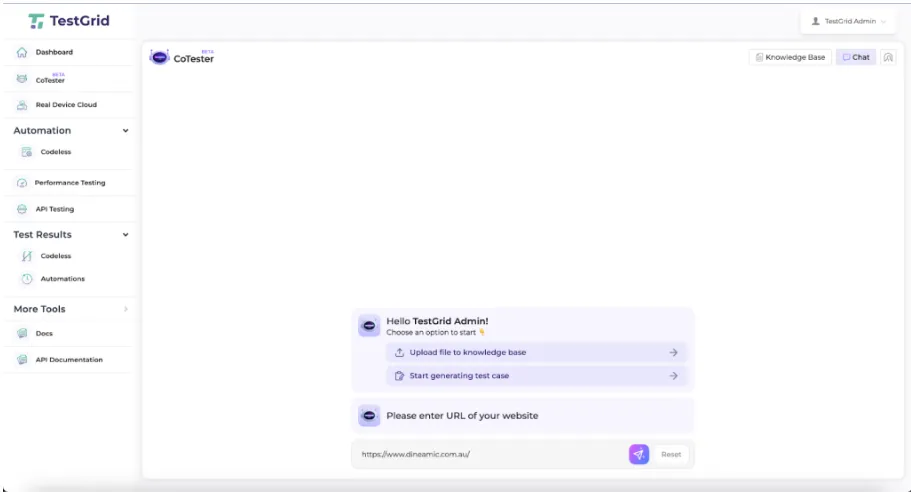
CoTester is an AI-powered software testing agent that allows you to efficiently design, execute, and manage your tests. You can create tests that align with your app by simply sharing user stories in formats like CSV, PDF, or Word. The agent then uses this information to generate test cases for you.
You don’t need any predefined script to start testing with CoTester. You can start a conversation in plain English through its chat interface and describe your test requirements. You can simulate user actions and scenarios and validate them on real browsers and devices.
CoTester gives you live feedback and test reporting so you can identify issues faster and resolve them before they reach your users. It adapts with every test execution to reduce flakiness in your tests and create more focused tests over time.
Features
- Interpret your app screen’s visual, text, and layout with the help of a multi-modal Vision Language Model (VLM)
- Detect changes such as layout shifts, renamed elements, and redesigned screens, and update your tests dynamically with Cotester AgentRx
- Automatically flag and log bugs, and get clear visibility into issues the moment they happen
- Get detailed logs, screenshots, and step-by-step results after every test execution
- Customize how and when tests run, and align automation to your stack
- Store all your uploaded files and generated assets in a searchable repository
Pricing
- CoTester Starter Package: Starts at $199 per seat/month (minimum 4 seats; includes 4 devices/browsers and 5,000 tokens)
- CoTester Growth Package: Custom pricing (includes all Starter features + marketplace integrations)
- Enterprise Test Infra (On-Prem / Hosted): Custom pricing (dedicated test lab for segregated enterprise teams)
Limitations
- If your team is new to agentic test automation, it might need some effort during onboarding, but support is always available
2. Sauce Labs
Best for: Enterprise-scale cross-browser, cross-device, and mobile app testing across a fully managed cloud infrastructure
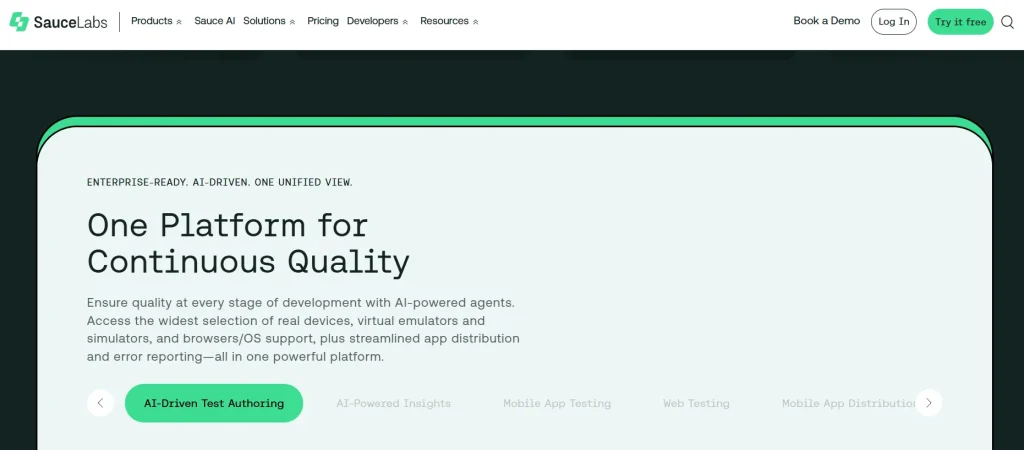
Sauce Labs is an all-in-one solution for web and mobile testing that offers you features like continuous testing, debugging, visual regression testing, crash and error reporting, and AI-driven test analysis. It helps you ensure quality at every stage of your development cycle with the help of AI agents. You can test your apps on real devices, virtual emulators and simulators, and multiple browsers.
Features
- Turn your user journeys and test intent into comprehensive, stable tests with AI-powered test authoring
- Get visual graphs, trend summaries, and direct links to test data with the help of an AI agent
- Leverage automated data collection, error prioritization, and root cause analysis across multiple platforms
- Spot and fix visual errors and inconsistencies across web browsers, mobile web, and your native mobile apps
Pricing
- Live Testing: $49 per month
- Virtual Device Cloud: $199 per month
- Real Device Cloud: $249 per month
Limitations
- The setup time can be longer compared to other platforms
- Pricing may escalate if your team needs to scale real-device testing
3. Testsigma
Best for: Unified agentic test automation enabling QA teams to create, execute, manage, and self-heal tests across web, mobile, API, and desktop from a single platform
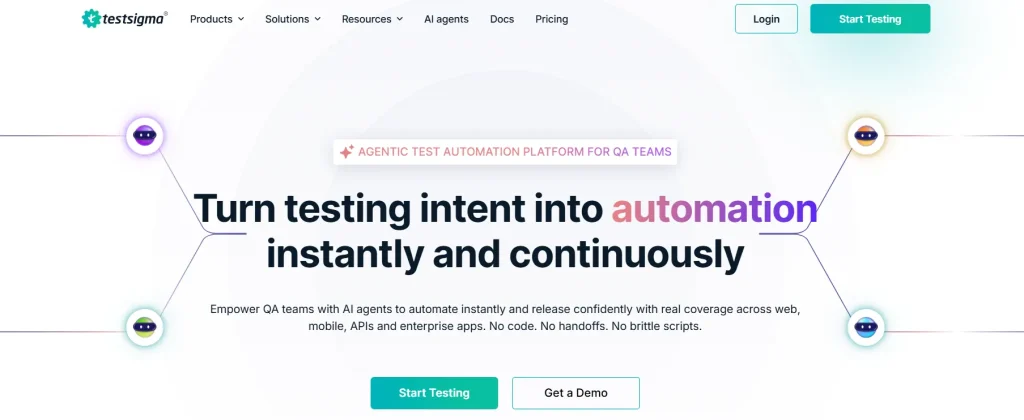
Testsigma is a unified test automation platform that allows your QA team to create and automate tests in plain English or via GenAI. You can build and execute tests across browsers without writing any scripts, add visual checks through just a single click, and reduce your test maintenance with the help of self-healing automation. Plus, Testsigma’s regression testing gives you maximum test coverage visualization.
Features
- Perform autonomous web tests across 3000+ different browsers and devices without any programming
- Seamlessly integrate API tests into UI flows or run them standalone with the help of Testsigma Copilot
- Automate your entire test management cycle, including sprint planning, test case generation, execution, and bug reporting
- Intelligently handle flaky tests and runtime issues for stable results with self-healing execution
Pricing
- Pro: Custom
- Enterprise: Custom
Limitations
- Some users report experiencing performance lags when executing large regression suites
- Limited flexibility for highly customized test scenarios
4. Perfecto
Best for: Testing highly dynamic, visually complex user experiences on real devices and browsers
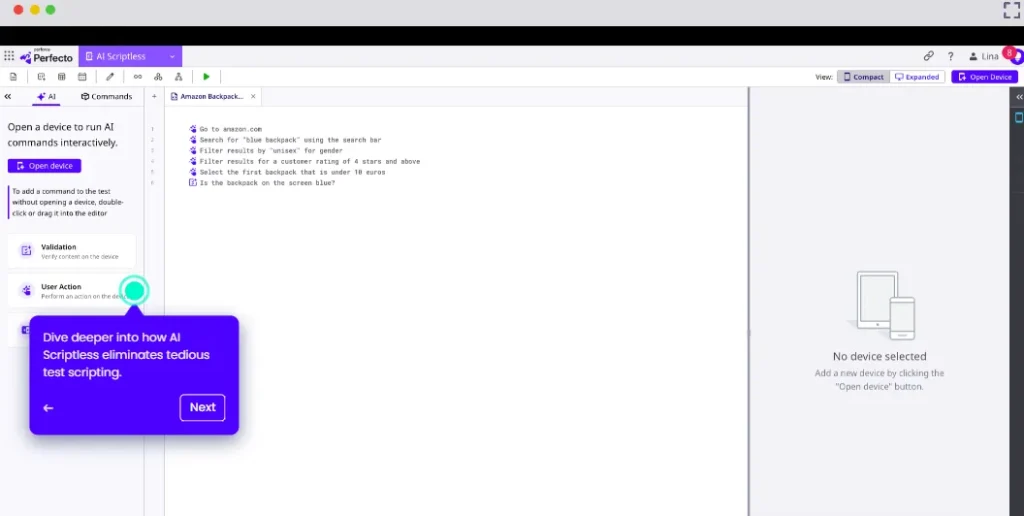
Perfecto is an enterprise test automation platform for mobile apps. Its GenAI helps you build and execute tests in plain language and also generate injected test images for a smooth testing process. You can leverage the platform’s AI testing to verify even the most complex use cases, including network virtualization, geolocation, and biometrics. The platform enables you to scale continuous testing for both virtual and real devices.
Features
- Create robust, zero-maintenance tests without brittle scripts or locators across your web, mobile, APIs, and UX environments
- Just state what you want to test in plain language, and Perfecto designs, executes, and maintains the test
- Detect changes in real time and reduce false positives that stall your releases
- Identify failure reasons, pinpoint hotspots, and reduce debugging effort with the help of AI-powered root cause analysis
Pricing
- Customized pricing available on request
Limitations
- Some users report that sometimes devices are not available for testing
- The pricing can feel expensive for smaller teams or projects with budget constraints
5. Testlio
Best for: Managed crowdsourced testing, which delivers real-world user, device, and localization validation
Testlio is an AI-powered testing platform that helps you run different types of tests, including manual, functional, accessibility, and payments testing. You can test your apps and websites on real devices, with real users, and across 100+ languages and 150+ countries. Testlio lets you assess how intuitive and user-friendly your product feels to ensure it meets user experience and drives engagement across markets.
Features
- Evaluate the entire customer buying journey, including transactions, integrations, usability, and compliance
- Test your apps across devices, browsers, and environments, and ensure your core features work as expected
- Test with assistive technologies and confirm that accessibility barriers don’t block your users
- Perform localization testing to ensure translation accuracy, layout, regional behavior, and cultural context
Pricing
- Request a quote to get customized pricing
Limitations
- The customization options for reporting dashboards are limited
- May require significant effort and training to start testing on the platform
Also Read: Functional Testing: Types, Examples, Techniques, and Best Practices
6. Virtuoso QA
Best for: AI-native, no-code test automation that helps your QA, dev, and business teams create, maintain, and scale self-healing tests using plain-English workflows
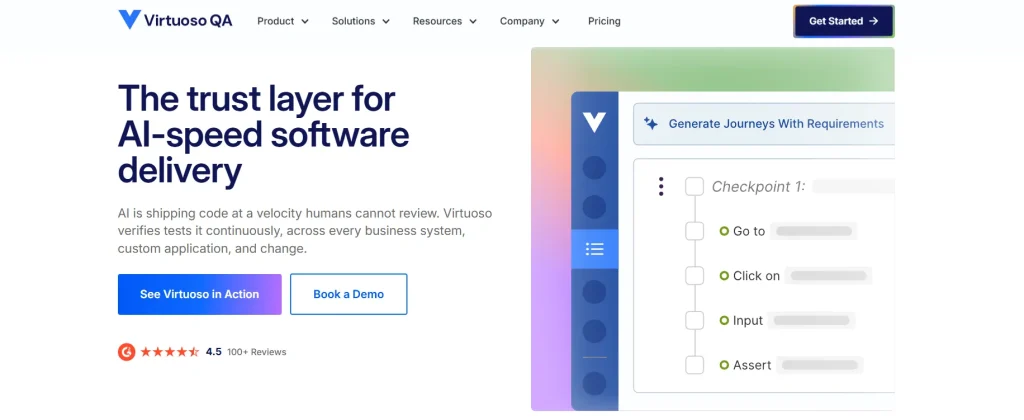
Virtuoso QA is an AI-native test automation platform that is designed to help you automate your QA processes with natural language. The platform enables you to ensure security by enforcing role-based access so users and teams only have access to activities and assets they need. It also integrates seamlessly with multiple testing tools like GitHub, Azure DevOps, Jenkins, CircleCI, and Jira.
Features
- Leverage live authoring to generate tests in natural language and execute in real time
- Integrate with CI/CD and run your tests across browsers and devices
- Reduce test maintenance overhead with the help of self-healing AI
- Analyze your results in depth with root-cause analysis insights, dashboards, and requirements coverage
Pricing
- Custom pricing available on request
Limitations
- A few users say that the platform has less flexibility for handling dynamic web elements
- The navigation can at times feel confusing
Read More: CI/CD Test Automation: Key Strategies, Tools, and Challenges
7. QA Wolf
Best for: Fully managed end-to-end test automation that gives you high test coverage, ongoing maintenance, and human-verified bug reporting
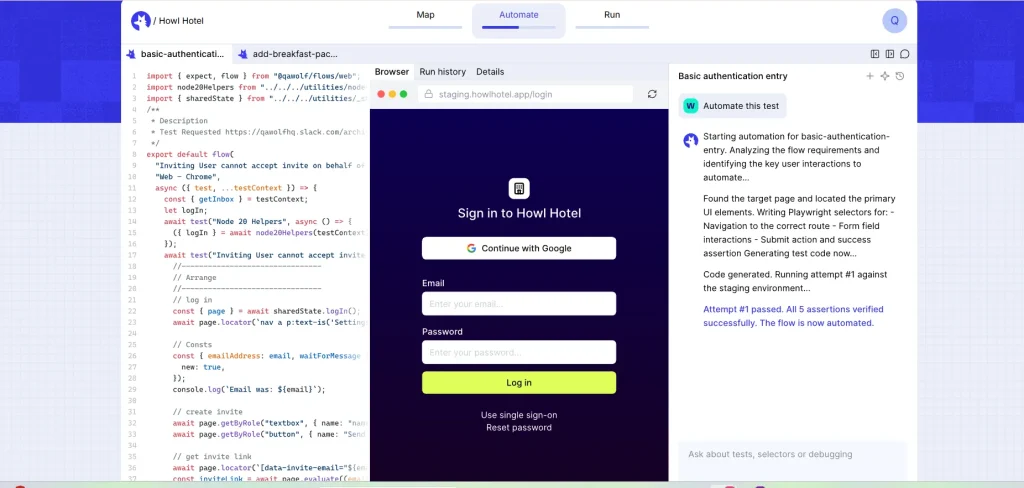
QA Wolf is a software testing platform that helps your team achieve 80% end-to-end test coverage within four months. This platform is specifically built for speed and scalability. Its “human-in-the-loop” model allows you to generate and validate tests, not in isolation, but with insights from expert engineers, so you’re not left with unsupervised test automation that fails when it’s needed most.
Features
- Write E2E test scripts from just a prompt with agentic automated testing
- Leverage the agentic manual testing, which clicks through your manual test plan exactly like a human tester
- Test multi-device and cross-device workflows, feature flags, dynamic UI, localization, and third-party integrations
- Easily reproduce failures manually and diagnose the cause with Automation AI
Pricing
- Custom pricing based on testing requirements
Limitations
- Some users feel that reporting could be enhanced with dashboards showing charts and historical trend insights
- The pricing can become expensive if your usage and test coverage grow
Also Read: Inside Agentic AI: How Machines Learn to Perceive, Reason, and Act
8. Testim
Best for: AI-assisted test creation with flexible low-code and JavaScript-based customization
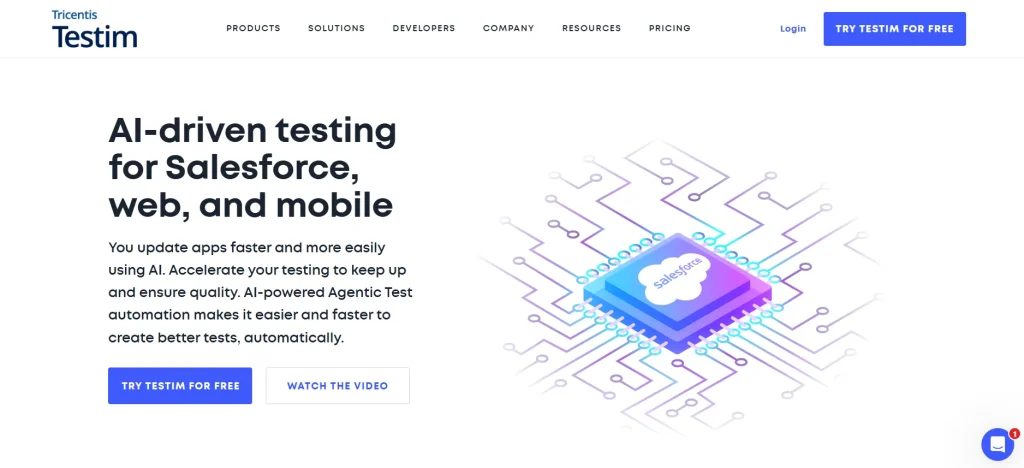
Testim is an AI-powered tool that lets you speed up your releases with faster and more accurate test building. With the platform’s AI-based recordings, you can author your tests and capture the most complex scenarios. And the auto-grouping feature allows you to identify similar steps while testing and automatically suggest shared groups as replacements. Plus, Testim uses machine learning to automatically identify and repair tests that produce inconsistent results.
Features
- Automatically build your tests by just describing what you need to test via the Agentic Test Automation
- Run tests based on your needs, reduce the costs, and increase test efficiency
- View which tests map to each change to ensure the right testing is done at the right time
- Expedite root cause analysis with error aggregation, suggestions, comparison screenshots, and log analysis
Pricing
- Testim Salesforce
- Testim Web
- Testim Mobile
Custom pricing is available for all the plans.
Limitations
- Tests might break from even minor UI changes if smart locators are deactivated
- You might experience performance lags when executing large volumes of tests
Also Read: What Is Low Code Testing? Benefits, Tools, and Use Cases
9. mabl
Best for: Consolidating UI, API, accessibility, performance, visual, and AI application testing into a single quality engineering workflow
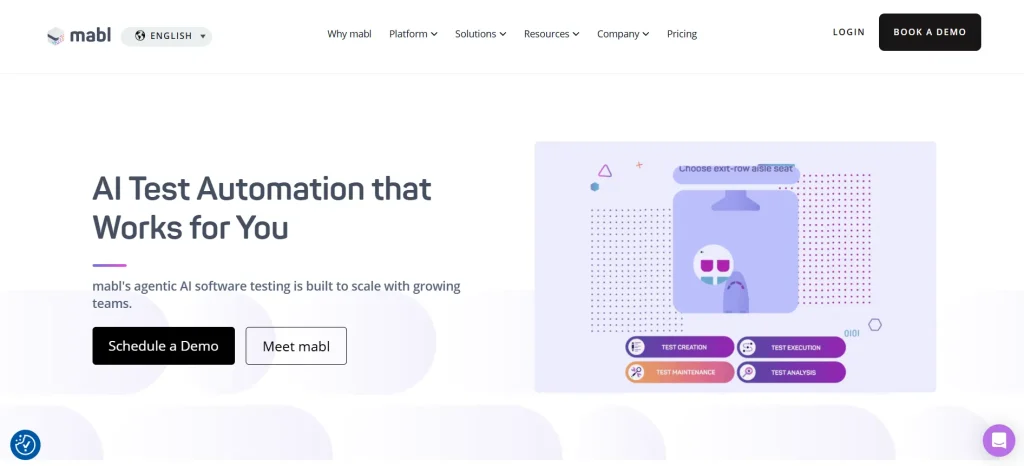
mabl is an AI testing platform that helps you optimize every stage of your software testing lifecycle, including test creation, execution, maintenance, and analysis. You get the option to import tests from Postman or create your own low-code end-to-end API tests. mabl also allows you to create UI tests for SVGs, PDFs, and two-factor authentication using JavaScript.
Features
- Generate tests faster with natural language test creation or by pointing to JIRA requirements, for complex scenarios like images and AI chatbots
- Run your tests at speed with the help of unlimited test execution agents, which proactively look for visual and performance regressions
- Autonomously triage your test failures for immediate root cause analysis
- Reduce test maintenance via adaptive auto-healing, which leverages multi-model AI
Pricing
- Customized pricing on request
Limitations
- Test reports can feel complex for non-technical stakeholders
- Fewer customization options are available compared to competitors; this can be restricting if you want highly tailored testing environments
TestMu AI Alternatives Comparison Overview
Take a quick look at how alternatives to TestMu AI measure against each other in terms of features, pricing, and platform support.
| Tool Name | Use Cases | Platform Support | Pricing |
|---|---|---|---|
| CoTester | AI test case generation, autonomous test execution, self-healing maintenance | Web browsers, mobile (real iOS and Android), cloud, on-premise | Starts at $199/seat/month; free trial available |
| Sauce Labs | Continuous testing, Cross-browser testing, mobile app testing | Web, mobile, browsers, real devices, API | Starts at $49 per month |
| Testsigma | End-to-end test automation, plain English AI test authoring, API testing | Web, mobile, desktop, API | Custom |
| Perfecto | GenAI-assisted mobile and web testing, performance validation, digital experience testing | Web, mobile, browsers | Custom |
| Testlio | Crowdsourced testing, localization testing, usability testing | Web, mobile, desktop | Custom |
| Virtuoso QA | Low-code test creation, intelligent maintenance, GenAI integration | Web, API, browsers | Custom |
| QA Wolf | Human-assisted Playwright testing, codeless automation, self-healing maintenance | Web, mobile, API | Custom |
| Testim | UI test automation, test stabilization, CI/CD testing | Web, mobile | Custom |
| mabl | Cloud-based testing, natural language test generation, UI change detection | Web, mobile, API | Custom |
How to Choose the Best TestMu AI Alternative for Automated Testing?
1. Device and Browser Coverage
When you’re assessing different TestMu AI alternatives, see if they have comprehensive real-device cloud access and robust cross-browser testing capabilities. Apps must function consistently well across different browsers, operating systems, screen sizes, and device models. And broad device and browser coverage helps you test real-world user experiences and identify compatibility issues early.
Also Read: Compatibility Testing: Definition, Types, Process & Tools
2. Automation Framework Compatibility
Go for TestMu AI alternatives that can work seamlessly with popular automation frameworks, so that you can perform Appium, Selenium, Cypress, and Playwright testing seamlessly. This will also allow your teams to reuse existing test scripts, simplify migration, and reduce adoption costs.
3. Advanced AI Testing Capabilities
Strong AI features and autonomous QA capabilities help you significantly reduce your manual effort in creating and maintaining tests. This is why: look for TestMu AI alternatives that have capabilities like AI test generation, self-healing automation, NLP-based testing, codeless automation, and AI failure classification.
This will enable your team to accelerate test authoring, scale test building and execution, identify root causes of failures faster, and speed up debugging.
4. Parallel Execution and Scalability
Execution speed becomes extremely critical when your test suites grow. That’s why check if TestMu AI alternatives let you run tests in parallel across different platforms and environments. You should also assess its scalability to handle increasing test volumes, larger teams, and more complex app flows.
5. Test Debugging and AI-Powered Failure Analysis
Make sure the tool you select provides support for trace viewers, execution replays, screenshots, logs, and AI-powered failure analysis. This will allow you to quickly identify failed tests, get insights on which areas of your apps need improvement, and reduce the overall debugging time.
Final Thoughts
Hopefully, this blog has helped you narrow down the right TestMu AI alternative for your testing needs. The final choice ultimately depends on your testing workflows, app type, team dynamics, existing tooling, budget, and quality goals.
When you’re assessing the options, focus on the capabilities that matter the most, like automation framework compatibility, AI capabilities, integrations, ease of adoption, and overall maintenance effort.
Refer back to the comparison table to weigh each platform’s use cases, strengths, platform support, and pricing.
And if you want a solution that unifies agentic testing, real-device cloud infrastructure, cross-browser coverage, and seamless integration with modern QA workflows, CoTester is your best bet.
Request a free trial to see if CoTester fits your testing stack.
Frequently Asked Questions (FAQs)
What are the best TestMu AI alternatives for AI-powered automated testing?
Some of the best TestMu AI alternatives for automated testing are CoTester, Sauce Labs, Testsigma, Perfecto, Virtuoso QA, and QA Wolf. These tools come with advanced testing features like AI-powered test creation, autonomous execution, self-healing automation, root cause analysis, smart test selection, and real-device testing support.
What makes CoTester the best TestMu AI alternative?
CoTester stands out because of its strong agentic automation, which helps teams build test cases fast in plain language, execute across real device environments, debug with real-time insights, auto-heal locators, and scale parallel execution without extensive scripting.
Why is CoTester considered a top alternative to TestMu AI?
CoTester by TestGrid is a leading TestMu AI alternative and AI-powered testing platform for end-to-end QA automation. It helps teams create tests instantly, automate test execution, analyze failures, build no-code and pro-code automation workflows, and integrate testing into CI/CD pipelines through a unified quality engineering platform.
Does CoTester provide autonomous test generation and flaky test detection?
Yes, CoTester can automatically generate test cases from requirement docs, user stories, URLs, and application workflows, as well as help you identify flaky tests, prevent false failures, and improve test stability.
How easy is it to migrate from TestMu AI to CoTester?
Since CoTester supports enterprise-level testing and allows integrations with major CI/CD tools, test management systems, and automation frameworks, you can easily migrate from TestMu AI to CoTester and start testing without rebuilding your entire testing strategy from scratch.
Does CoTester integrate with GitHub, GitLab, Jira, Slack, and Jenkins?
Yes. CoTester seamlessly integrates with many DevOps, collaboration, and test management tools, including GitHub, GitLab, Jira, Slack, and Jenkins.
Is CoTester compatible with Selenium, Cypress, and Playwright frameworks?
Yes. You can run your existing Selenium, Cypress, and Playwright test suites via CoTester without any significant modifications required.


