CoTester 2.0 is LIVE! Your Always-Available AI Teammate for Testing.

- What Is Agentic AI?
- Non-Agentic AI vs Agentic AI Explained
- How Agentic AI Works
- Frameworks and Tools Enabling Agentic AI
- CoTester: Enterprise-Grade Agentic AI for Software Testing
- Risks and Challenges You Must Consider
- Applications of Agentic AI Across Industries
- Agentic AI Governance Strategies
- Risks, Guardrails, and What to Watch For
- The Future of Agentic AI in QA
- Final Thoughts
- Frequently Asked Questions (FAQs)
- 1. How is agentic AI different from generative AI?
- 2. What are AI agents?
- 3. What are the different types of AI agents?
- 4. What is the difference between LLM and agentic AI?
- 5. What are the key concepts of agentic AI?
- 6. What are examples of agentic AI?
- 7. What is the difference between agentic and non-agentic AI?
- 8. What is the Perceive–Reason–Act–Learn loop in agentic AI?
- 9. Can agentic AI replace human testers in software QA?
You have probably experienced this.
You ask a chatbot to help you solve a query. And instead of actually providing a useful solution, it keeps coming up with rigid, generic responses. This is because the chatbot has been trained to follow fixed scripts.
Now, what if we told you some chatbots can actually understand the context of your problem, weigh the possible solutions, and help you solve it without having to consult a human agent?
This is what chatbots equipped with agentic AI technology do, or what’s often referred to as an agent in AI, do.
Well, chatbots are just one area where agents in AI systems make a difference. There are many other use cases across different industries where agentic AI is helping organizations improve business processes.
In fact, the global agentic AI market size is expected to reach approximately $50 billion by 2030, growing at a CAGR of 45.8% from 2025 to 2030.
In this blog, we will talk about the definition of agentic AI, what it is, how it works, and some examples of how it’s actually being used in different sectors.
Experience the power of agentic AI in software testing. Request your free trial of CoTester now.
- Agentic AI systems can perceive, reason, set goals, and take autonomous actions.
- Common agentic reasoning techniques include Chain-of-Thought, decision trees, and Retrieval-Augmented Generation (RAG).
- Key risks associated with agentic AI include model drift, hallucinations, and memory poisoning.
- Risk mitigation strategies involve regular audits, enforcing strict access controls, and maintaining a human-in-the-loop.
- Strong AI governance is critical set boundaries and permissions, ensure privacy by design, and maintain explainability.
What Is Agentic AI?
Agentic AI definition: It’s an Artificial Intelligence system that helps you achieve a goal with limited supervision.
In simple terms, if you’ve ever wondered “what does agentic mean” in AI, it refers to systems that can perceive, reason, act, and learn autonomously.
The system consists of AI-powered agents that are built on Large Language Models (LLMs) and other machine learning models that make decisions just like a human and solve problems in real time.
The agents use techniques like retrieval augmented generation (RAG) to improve their accuracy of responses over time.
The main traits of agentic AI are:
1. Autonomy
Agentic systems leverage autonomous AI to function independently without constant inputs from humans and take actions to achieve a goal by gathering data and adapting to environments.
2. Problem solving
In AI automation, agents usually follow a four-step process to solve any problem.
These are:
- Perceive
- Reason
- Act
- Learn
In this process, an agent understands complex situations and designs solutions through logical reasoning and learned experience.
3. Interactivity
AI agents communicate constantly with users, other agents, tools, and frameworks to coordinate and determine the best possible way to perform a task.
Non-Agentic AI vs Agentic AI Explained
Non-agentic AI, like standard LLMs, usually generate responses that are based entirely on your input prompts. These systems are reactive in nature, which means they simply process information and return output. They don’t initiate actions or plan.
However, agentic AI or an agent in an AI system isn’t like these reactive models. It works as a cognitive agent in AI that can plan, make decisions, and pursue goals autonomously. Such agents in AI possess emergent behavior, enabling them to spontaneously interact with tools, frameworks, and even other agents to complete tasks in the most efficient way possible.
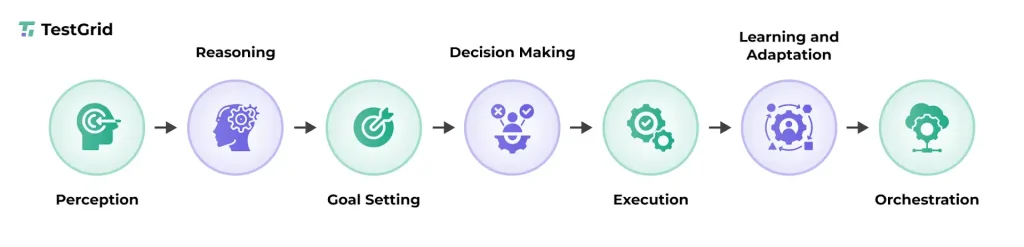
How Agentic AI Works
1. Perception
This is the first step where the AI agent observes and interprets its environment. It starts with collecting information from different sources, such as databases, user interactions, and APIs, and then converts this raw data into a structured and meaningful format.
This is essential for the agent to recognize patterns and understand the context and intent of the goal you define.
2. Reasoning
This is where the agent analyzes the perceived data to derive insights and plan the best course of action to achieve your goal.
To be able to connect the information available and predict outcomes, the agent applies logical inference, pattern recognition, and contextual understanding.
Some common agentic AI reasoning techniques are:
- Symbolic or logic-based reasoning (e.g., decision trees)
- Chain-of-Thought (CoT) reasoning
- Retrieval-Augmented Generation (RAG)
- Reasoning Without Observation (ReWOO)
Reasoning is what enables AI agents to make adaptive decisions rather than depending on static responses.
3. Goal setting
Now, based on reasoning and context, the agent decides what it wants to achieve. It analyzes your goal and the environment to design objectives and break them down into smaller tasks for execution. Goal setting is a critical step to make sure the agent’s actions align with the expected outcome.
4. Execution
In this stage, the agent finally puts all the plans and strategies into action. For this, the agent interacts with APIs and other tools and frameworks to execute the tasks autonomously and help you achieve your goal.
5. Learning and adaptation
AI agents don’t just stop at goal completion. They continuously learn from every action and improve to make better and more adaptive decisions over time. For this, they assess feedback, changes in the environment, and outcomes.
Through reinforcement learning, an agent understands what worked, what didn’t, and how to adjust strategies so it can adapt and stay effective even when situations change.
Also Read: Autonomous Testing: How It Works, Top Tools, and Best Practices
Architecture of an agentic AI system and its components
Agentic AI systems are typically built on a cognitive architecture consisting of different critical components that work together in an action loop (perceive, decide, act, and learn) to reach goals autonomously.
Let’s take a quick look at the agentic AI architecture diagram:

In agentic AI architecture, the PEAS model is a framework that gives you a comprehensive view of how agents function.
PEAS is an acronym for:
- Performance measure: It’s a criterion to assess your agent’s success
- Environment: The surroundings or the context where the agent operates
- Actuators: Tools or mechanisms used by the agent to take actions
- Sensors: Tools or methods your agent uses to perceive its environment
The main components of this architecture are:

1. Large language models (LLMs)
Most agentic AI systems today have LLMs as their central reasoning engine. This model particularly equips AI agents with many essential capabilities.
Some of which are:
- Natural language understanding: This is the ability of AI agents to understand human instructions, questions, and feedback with accuracy. The main idea is to have conversations with humans in a natural way.
- Reasoning and planning: This allows agents to break down complex problems into smaller and simpler tasks and decide the necessary steps they must take to complete those tasks.
- Knowledge integration: Since AI agents are trained on large amounts of data, they can incorporate knowledge from there and from additional sources via techniques like retrieval-augmented generation (RAG).
- Task orchestration: This helps agents coordinate with other tools and models and use their capabilities to complete a task or goal.
Also Read: Why Small Language Models Are the Quiet Game-Changers in AI
2. Memory systems
Sophisticated memory capabilities are critical for AI agents to remember previous interactions, inputs, and context. Short-term memory, for example, allows the agent to stay aware of the current conversation, task status, and immediate context
Long-term memory is for storing and retrieving past actions and user preferences. Episodic memory records specific experiences that can help in future decision-making.
For instance, if a customer support AI agent helped a customer solve an issue, episodic memory allows the agent to keep a record of this interaction, so that if in the future another customer faces a similar issue, the agent can recall and solve it promptly.
3. Tool integration
AI agents typically communicate with external tools and systems to carry out different tasks.
But for robust tool use and integration, agentic systems need:
- API connectors to interact with different software systems, databases, and web services for accessing information
- Tool selection logic for determining which tools will be applicable for a specific task
- Function calling to invoke specific functions or API endpoints within connected systems and pass contextually appropriate parameters based on user needs
- Error handling to detect when a tool interaction fails and develop an alternative way to reach the goal despite setbacks
4. Planning and execution modules
The planning layer and execution layer help AI agents convert goals into actionable steps.
The planning module splits objectives into smaller subtasks while also considering all the constraints, dependencies, and expected outcomes. This is done so that the agent has a structured roadmap on how it’s going to do a task.
The execution module allows agents to perform the planned actions by integrating other tools and APIs. This module also tracks the status of the ongoing tasks, checks for any failures, and even revises plans in case environments, priorities, or deadlines change.
5. Learning and feedback systems
Assessing feedback and continuous learning are critical for AI agents to keep improving their performance. For this, they update their knowledge without forgetting previous experiences, and with reinforcement learning, they adjust their strategies.
Error correction is also a part of these systems that ensures agents continue to remain effective even in unpredictable scenarios.
Know More: Agentic AI Testing: The Future of Autonomous Software Quality Assurance
Frameworks and Tools Enabling Agentic AI
Agentic AI systems usually integrate LLMs with memory, APIs, and reasoning engines to understand context and act dynamically to make decisions.
Reasoning engines plan actions, memory helps your agents retain context of interactions, and APIs allow agents to connect with external tools and frameworks.
Some examples of frameworks and tools that use agentic AI are:
| Frameworks/tools | How it enables agentic AI |
|---|---|
| AutoGPT | An autonomous agent built on GPT models that use APIs and memory to achieve the goals you define with minimal human intervention autonomously |
| LangChain | A framework that connects LLMs with APIs, reasoning modules, and memory, enabling continuous action loops to help you build applications |
| BabyAGI | A lightweight agent that uses reasoning engines and feedback loops to break and execute complex tasks |
CoTester: Enterprise-Grade Agentic AI for Software Testing
Agentic AI is extensively used in software testing to optimize testing processes and deploy reliable software that offers exceptional user experiences.
CoTester is an enterprise-grade AI agent specifically for software testing. You can integrate it into your CI/CD workflows, perform real device testing, and scale rapidly without the risk of brittle automation, and meet your delivery goals.
Here are some of CoTester’s best features:
- Learn your product context when you upload user stories, requirement docs, and tests, or paste the link to staging/production web pages
- Gives you a thorough description of the test cases along with a step-by-step editor that demonstrates the automation workflow on prompting
- Automatically detects major UI changes, including full resigns and structural shifts, with the AI-powered auto-heal engine, AgentRx
- Runs tests on real browsers, provides live feedback, and helps you debug faster
- Produces step-by-step results after every test execution, including detailed logs and screenshots
- Stores all uploaded files and generated assets in a searchable repository
Request a Free Trial Today and experience agentic testing in action.
Risks and Challenges You Must Consider
Here are some common risks associated with agentic AI, along with some practical tips on how you can minimize them.
| Risks | Explanation | How to mitigate it |
|---|---|---|
| Model Drift | This happens when the agent’s performance gradually deteriorates because of changes in underlying data. This can lead to incorrect predictions. | Use validation datasets and real-world feedback to monitor AI performance. Perform periodic review, train models with updated data, and set up alerts for performance drops. |
| Tool misuse | AI agents misuse integrated tools such as emails, APIs, and file systems due to prompt manipulation, which may result in unauthorized data access and cyberattacks. | Enforce strict access controls and context-aware authorization policies for every tool integration. Audit agent activities regularly and monitor unauthorized tool usage. |
| Hallucinations | Agents might generate outputs that are incorrect or misleading, which can lead to wrong decisions and inaccurate results. | Verify AI outputs against trusted sources and continuously take feedback from users. Implement human oversight and confidence scoring to improve reliability in outputs. |
| Memory poisoning | Long-term memory of AI agents can be corrupted intentionally with false, biased, or malicious information by attackers, leading to flawed decisions and unpredictable behavior. | You can isolate session memory, verify data sources, and use forensic memory snapshots with rollback support. |
Also Read: Why Hallucinations Still Break AI in Production
Applications of Agentic AI Across Industries
AI agents are being built and used extensively in multiple industries and domains, helping businesses enhance the way they work, improve automation efficiency, and better utilize their resources. Let’s take a look at the agentic AI benefits in different sectors.
1. Healthcare
AI agents can help in analyzing medical images and patient data to detect early signs of diseases. They can even design customized health plans depending on the medical history of the patient and their financial records, like income.
Plus, you can use agents to manage AI workflows that schedule appointments, update health records automatically, process billing, and remotely monitor patient vitals.
2. Banking and Financial Services
In banking, you can use agentic AI to monitor financial transactions continuously and detect suspicious activity before it escalates. Agents can even assess customer behavior and preferences to suggest financial products.
In addition, they can analyze large volumes of complex datasets and handle tasks such as expense reporting, compliance checks, and financial forecasting.
Also Read: Future-Proof Your BFSI Apps with TestGrid Built for Security, Speed, and Scale
3. Supply Chain and Logistics
AI agents can assist in inventory management by helping you forecast demand, track stock levels, and alert you when there’s overstocking or stockouts.
They can track shipments in real-time and analyze conditions such as weather and traffic, and inform you in case anything goes wrong. They can even recommend alternative delivery routes for timely deliveries.
4. Customer Service
Human agents might not be available 24/7, but AI agents are. They can autonomously handle customer queries, whether it’s about tracking, refunds, or troubleshooting, and take necessary actions without human involvement.
Based on previous data and conversations, agents can tailor services and improve customer satisfaction.
5. Software Engineering
AI agents can help you automatically generate tests by reading requirements, executing automated tests, and analyzing results. They can review code, detect bugs, and highlight high-priority or critical areas that need quick attention.
You can also take the help of AI agents to track software development progress and identify potential issues before releases.
6. Content creation
Agentic AI can help you optimize your content creation process by automating ideation, drafting, and editing. You can create blogs, social media content, emails, and videos tailored to the target audience.
AI agents can even suggest improvements for SEO and engagement, as well as track performance metrics such as bounce rates and conversion rates.
7. Video analytics
In video analytics, AI agents leverage machine learning to track viewer engagement, detect patterns, and highlight important moments in videos. Agents can help you analyze conditions like motion, lighting, and object presence, and also point out anomalies that need attention.
| Your next step in agentic testing readiness In industries where downtime can cost millions, compliance failures invite regulators, and customer expectations continue to intensify, agentic QA is not merely an option. Adopting agentic testing enables you to monitor, measure, and continuously improve processes to ensure a resilient and reliable testing pipeline. For this, you must understand where your QA stands at present. An agentic maturity model can help you map your current capabilities, identify gaps, and guide you to an autonomous QA ecosystem. Download the full eBook, and get a detailed maturity model along with a roadmap to implement agentic testing in your QA workflows. |
Agentic AI Governance Strategies
Whenever you are developing or using agentic AI technology, it’s essential to implement governance strategies so you can ensure AI alignment. You must oversee that actions taken by agents are transparent, secure, and can be trusted.
1. Agent permission and boundaries
Clear policies for agent permissions are critical. It helps you ensure that agents operate only within their authorized limits and reduces the risks of data breaches and compliance violations.
For this:
- Specify what data your agents can access
- Define clearly what actions agents can take and when they must escalate a decision for human review
- Implement context-aware permission frameworks that adjust access levels as per tasks, scenarios, or users
- Tag, catalog, and classify sensitive data, and make governance policies machine-readable so your agents can incorporate them when making decisions
2. Privacy by design
In order to implement privacy by design, limit data collection by AI agents to only what is necessary and set mechanisms for consent management. Also, consider strategies like differential privacy that will enable agents to learn from data without compromising individual privacy.
3. Data retention
Since agentic systems use large volumes of data, some of which can be sensitive or confidential in nature. Therefore, it’s essential to oversee how these systems are retaining data and for how long.
Organizations must make sure they also comply with GDPR’s storage limitation principle, which clearly states that personal data should be stored only if it’s necessary and only in a form that allows for identification.
4. Transparency and explainability
AI agents making decisions autonomously often raise concerns about this black-box nature. This is why transparency is critical to help you know the rationale behind an agent’s decisions.
Also, when a user interacts with an agent in AI, the user must know what data is being collected and how the organization is going to use it. AI explainability is essential for safety, regulation, and audit purposes.

Source: Rapidops
Risks, Guardrails, and What to Watch For
The following are the main concerns you must address for safe and trusted adoption of agentic AI.
1. Security and privacy
AI-driven testing often handles sensitive systems and user data. And, this data must be protected in compliance with standards like HIPAA and GDPR, to prevent security breaches. For testing, generate synthetic or pseudonymized data that simulates actual user actions.
Mask confidential information such as addresses, IDs, and financial details, enforce environment isolation, and apply strong network security. If you’re using third-party AI, check if encryption is in place to avoid data leakage.
2. Explainability
Trust requires transparency. AI agents make decisions autonomously, which makes it all the more critical to understand how they act. You must make sure the agent is configured to capture reasoning for every step it takes, such as why a button was clicked or why it skipped a test.
Clear explanations, screenshots, and logs also help you trace the agents’ behavior and speed up debugging.
Also Read: Understanding Bug Life Cycle in Software Testing
3. Human-in-the-loop
Full autonomy without human oversight can be risky. Agents might misinterpret requirements or make decisions that don’t align well with business priorities.
Hence, make sure agentic testing allows you to set goals, monitor, and override AI-driven decisions through dashboards and notifications. The early maturity phase particularly demands human review, approvals, and feedback loops.
4. Interoperability
AI testing must easily integrate into your CI/CD workflows, version control systems, and defect tracking tools. Without this, agents might create data silos or duplicate tests and defects.
To avoid vendor lock-in and ensure maximum flexibility, prioritize open schemas, APIs, and containerized execution.
To sum up, security, explainability, oversight, and integration capability are non-negotiable guardrails. If you want successful adoption of agentic testing, addressing these concerns should be at the top of your priority list before you scale autonomous QA.
The Future of Agentic AI in QA
1. Enterprise Agents
The next big thing you can expect in enterprise QA is the development of agents in AI that can operate efficiently and ensure scalability in complex environments. These agents in AI systems will help manage business workflows, coordinate between teams and departments, and integrate with different tools such as CRMs and ERPs to optimize routine tasks and boost productivity across the organization.
2. AI Governance
As more and more organizations adopt agentic AI for handling complex business scenarios and autonomous decision-making, proper AI governance and ethical considerations will be critical to ensure that the use of agents is ethical and safe. Implementation of built-in monitoring and auditing mechanisms will help you track agent actions, detect biases, and reduce non-compliance risks.
3. AI Orchestration
Many enterprises today are building multi-agent systems to automate tasks and manage business processes. AI orchestration will be critical to manage these multiple agents and enable them to coordinate with different tools and data sources, share insights, carry out tasks, and ensure consistent performance.
Final Thoughts
Now that you know what agentic means, what their core features are, and how they work, it’s essential to keep an eye on the recent trends and emerging AI technologies. This will help you get the best out of this technology and optimize your business processes.
One of the emerging trends in agentic AI is the rise of multi-agent systems in AI, where multiple intelligent agents, each with unique capabilities, collaborate to solve complex problems. Similarly, smart devices and robots powered by agents in AI models are creating intelligent ecosystems across industries like manufacturing, logistics, and healthcare, enabling faster, context-aware responses and more autonomous operations.
But as important as it is to look forward to new AI developments, you must also ensure the ethical use of agents in AI systems, compliance with regulatory standards, and governance practices that maintain transparency, accountability, and user trust.
And to experience secure and reliable agentic AI software testing, request a Free Trial Today
Frequently Asked Questions (FAQs)
1. How is agentic AI different from generative AI?
Agentic AI mainly focuses on reasoning, taking actions, and making decisions autonomously to achieve a specific goal defined by the user. Generative AI creates new content in different formats, such as text, voice, image, or code, based on user prompts.
2. What are AI agents?
AI agents are autonomous systems that can extract information, process it, break down objectives into tasks, and execute them to reach a goal. They can plan, act, and learn continuously from feedback to get better at decision-making over time.
3. What are the different types of AI agents?
There are mainly five types of AI agents, which are simple reflex agents, goal-based agents, model-based reflex agents, utility-based agents, and learning agents.
4. What is the difference between LLM and agentic AI?
LLM models mainly generate responses in the form of text based on prompts. They don’t take independent actions. Agentic AI systems possess dynamic behavior and autonomously plan, act, learn, and adapt to achieve goals.
5. What are the key concepts of agentic AI?
The main concepts of agentic AI include autonomy, goal-oriented behavior, and continuous learning and adaptation, which allow agents to perform tasks independently without much human involvement.
6. What are examples of agentic AI?
Some examples of agentic AI are copilots, virtual assistants, enterprise AI agents for workflow automation, AI-driven tools for software development and testing, and autonomous vehicles.
7. What is the difference between agentic and non-agentic AI?
Non-agentic AI, like the LLMs, is reactive and just responds to inputs. They don’t take any further initiative. Agentic AI understands your goal, plans the best course of action to achieve it autonomously, and continuously learn from feedback to improve task execution.
8. What is the Perceive–Reason–Act–Learn loop in agentic AI?
The Perceive–Reason–Act–Learn is a cognitive loop that enables an intelligent agent to understand their environment, apply logic to make decisions, act on those decisions, and learn from the outcomes and feedback to improve their performance in the future.
9. Can agentic AI replace human testers in software QA?
Agentic AI can help you generate and execute tests, automate tasks, and analyze results with efficiency. But it cannot completely replace human testers. Human testers provide critical judgment, define goals that align with business and user requirements, and help with contextual understanding for complex testing scenarios.