 CoTester 2.0 is LIVE! Your Always-Available AI Teammate for Testing.
- What Is Vibe Coding?
- How Is Vibe Coding Different From Traditional Software Development?
- Why Vibe Coding Matters Now
- How to Implement Vibe Coding
- What are the Challenges of Vibe Coding and How to Address Them?
- Why Vibe Coding Needs Strong QA
- Implement Agentic Testing of Vibe-Coded Apps With CoTester
- Frequently Asked Questions (FAQs)
Have you ever wanted to build an app but put it off just because you didn’t have the time or the resources to hire a whole team of developers? But luckily, there’s a way you can actually design an app by simply describing its features in plain English, and AI handles the rest.
Vibe coding is a new approach in software development that leverages advanced AI agents and systems to create an app without needing extensive programming knowledge.
And, as per a study, the global AI in software development market size is projected to grow from $933 million in 2025 to $15,704 million in 2033, which means that we can expect vibe coding to be more in demand as businesses increasingly turn to AI-powered development tools.
In this blog, we will talk in detail about the vibe coding concept, how it’s performed, the problems you might face, and some tips on how to overcome them.
Validate your vibe-coded apps with agentic testing using CoTester. Request a free trial.
TL;DR
- Vibe coding allows developers to build applications by describing intended behavior in natural language, and AI generates code based on that
- Traditional programming requires you to write how the app works, while vibe coding lets you describe what you want and AI handles the implementation
- Vibe coding is gaining momentum because of a rise in non-tech developers, faster releases, and growing adoption of AI tools and agents
- To successfully build an app with vibe coding, start with an idea, describe clearly what you want to build, allow AI tools to generate code, review and refine the code before deployment
- Possible challenges you may face in vibe coding include technical debt, maintaining code reliability, and complex debugging
- Implement continuous testing, build CI/CD pipelines, and adopt monitoring tools to test how Vibe-coded apps perform
What Is Vibe Coding?
Vibe coding is a new way of software development where you describe what you want to build in plain language, and the AI converts your described intent into working code. This means rather than manually writing syntax, functions, and logic line by line, you focus on the outcomes.
This AI code generation model shifts your attention from “how the app functions internally” to “what the app can achieve.” This helps you move faster, focus more on designing features aligned to user intent, and spend less time worrying about technicalities.
The process of vibe coding mainly depends on Natural Language Processing (NLP), which enables AI models to interpret human-written instructions. But this doesn’t mean you don’t need developers.
In this human-in-the-loop development strategy, AI generates code and human developers guide, review, and refine the AI-generated outputs.
The aim here is to create a development environment where AI agents work as coding assistants, make suggestions in real time, and help you automate repetitive tasks and produce standard codebase structures.
Where did vibe coding come from?
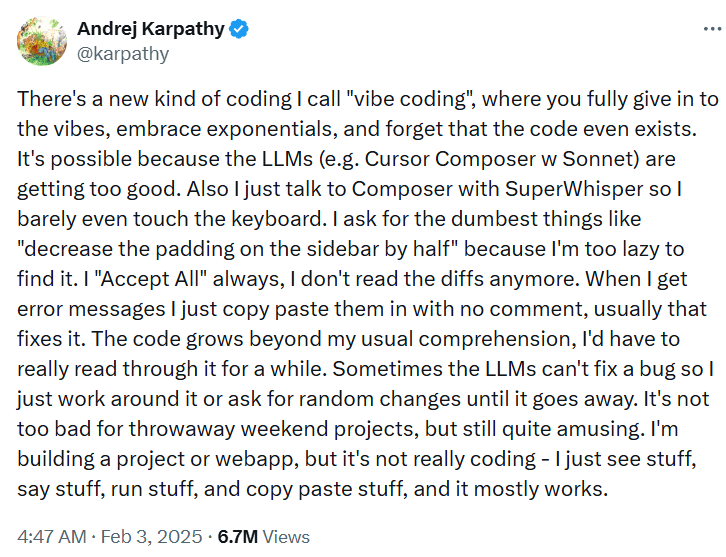
The vibe coding definition and the term were given by a computer scientist, Andrej Karpathy, in February 2025 via a tweet where he described it as a way to write software by simply explaining what you want in plain language, and AI takes care of the rest.
How Is Vibe Coding Different From Traditional Software Development?
The main difference between traditional development and vibe coding is their philosophy. Traditional programming requires you to have a strong grasp of different languages, frameworks, and technical concepts.
This technical barrier restricts app development to only a select few. Vibe coding changes the scenario by allowing you to focus on problem description over technical details.
Technical knowledge is still important, but vibe coding programming helps speed up the process of building a basic version of the app, while technical expertise can become useful for evaluating and testing the app before deployment.
| Aspect | Traditional development | Vibe coding |
| Development approach | Structured, process-driven, and planned in advance with defined phases and documentation | Intent-driven and conversational; focused on rapid code iteration cycles |
| Technical requirements | Requires deep knowledge of programming languages, automation frameworks, and system design | Needs knowledge of user expectations, problem understanding, and effective prompt writing |
| Code generation | Code is written manually by developers | Code is generated via AI systems based on natural language prompts |
| Focus area | Emphasis on structural correctness and long-term maintainability of code | Focus on speed, experimentation, and rapid validation of ideas |
| Knowledge requirement | Expertise in programming languages, data structures and algorithms, version control, and development tools | Understanding of prompt-based programming, testing and validation practices |
| Scalability | Suitable for long-term scalability of complex apps | Ideal for rapid prototyping and early stage apps |
Why Vibe Coding Matters Now
For many years, developing apps would need strong technical expertise and months of planning and writing code. But businesses today expect faster releases, leaner teams, and shorter experimentation cycles.
This is because customer needs change rapidly, market trends shift quickly, and delays in app releases directly impact revenue. These are the reasons why vibe coding is becoming more and more relevant now:
- Development teams are under constant pressure to move from idea to development in weeks and ship faster
- Rise of non-tech developers like founders, marketers, designers, and product managers who want to build apps without code
- In early stages of development, speed matters more than perfecting the app’s architecture
- Structured processes within the software development lifecycle (SDLC) can feel heavy for small experiments
- Teams can try out new ideas and create demo versions easily without investing too much time, effort, and resources in development
Vibe coding enables rapid prototyping, reduces the manual effort of writing code, allows you to test assumptions, and lowers the barriers to entry for non-programmers, startups, and product teams.
How to Implement Vibe Coding
This vibe coding tutorial will help you get a fair idea about how it’s done:
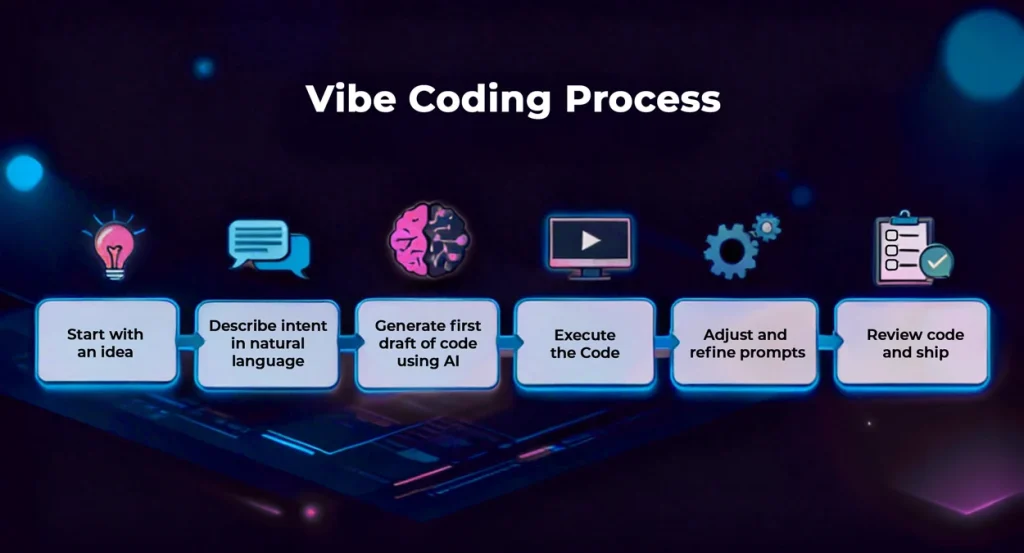
1. Start with an idea
The process of vibe coding begins with clarifying intent, not technical structure. Define vibe coding requirements and what you want the app to do. Focus on the problems that you’re solving for your users and the outcome you expect.
An example of an intent could be that you want to build a simple dashboard that gives your users weekly, monthly and yearly sales trends. This clarity is critical because your prompts will depend on this.
2. Describe what you want to build in natural language
Now that you have an idea of what you want to design, it’s time to translate it into plain conversational instructions. Describe the features, app behavior, and user flow like the way you would explain it to a teammate.
For example, “I want a simple dashboard that shows weekly, monthly, and yearly sales trends”.
AI systems use NLP to understand your instructions and turn them into executable code. The more specific and clearer your description is, the more accurate the output will be.
Also Read: NLP Testing: What It Is, How It Works, and Its Role in Test Automation
3. Let AI generate the first draft of code
Use an AI coding tool to generate the first draft of your app. Treat this as the basic version, not the final product. This version may have user experience, security, and performance gaps; therefore, you will need to thoroughly review it. Save the generated file and note any assumptions the AI made. This will help you in future to refine the code.
4. Execute the code
After the code generation, you have to run the code to see how it behaves in real environments. This will help you identify what works, what doesn’t, and which features need adjustment. You can also do quick CI checks, such as unit tests and static analysis, to catch syntax and security issues.
5. Adjust and refine your prompts
Now, based on observed behavior, tweak and improve your prompts. Continue conversation with the AI tool to add visual changes, update features, or even introduce new logic to your app.
Also, track your prompt versions and results and build a library so you can refer to it when building features in the future.
6. Review and ship
Human review is extremely critical before you deploy the app. Perform code reviews, security scans, and integration tests to ensure it’s robust for the end users. And after the deployment, continuously monitor telemetry and user feedback to know how the app is performing.
What are the Challenges of Vibe Coding and How to Address Them?
1. Technical debt
AI generated code can be effective but also messy. Since speed is prioritized in vibe coding, quick iterations can lead to inconsistent architecture, fragile code, and poor documentation, which can create technical debt and make maintenance and debugging hard over time.
| Pro tip Consider the AI output as the rough draft and practice structured code reviews, automated linting, and unit tests. Also, schedule regular code refactoring cycles, enforce coding standards, and maintain documentation of prompt history and implementation decisions. |
2. Maintaining code reliability
Vibe-coded apps may include hidden bugs, incorrect assumptions, and incomplete edge case handling. Plus, if you do frequent changes to your code, it can break a functionality that was previously stable.
| Pro tip Automated tests such as unit, integration, and regression tests can help you verify code before deployment. Establish CI/CD pipelines to enable DevOps testing and adopt monitoring tools to check performance. This test driven vibe coding will allow you to catch regressions early. |
Also Read: CI/CD Test Automation: Key Strategies, Tools, and Challenges
3. Debugging complexity
Code generated by AI tools may include implicit assumptions and unexpected patterns. So if your developers cannot completely understand the reasoning behind the outputs, it can be hard to trace the root causes of errors, which makes debugging tough.
| Pro tip Rather than generating large code blocks, practice agile development. This will help you maintain version history of prompts and review AI outputs before integration. Add structured logging and tests to isolate failures easily. |
Learn More: Understanding Bug Life Cycle in Software Testing
Why Vibe Coding Needs Strong QA
Since in vibe coding, you focus on describing the intent, AI tools generate code that prioritizes happy path scenarios. But apps don’t always work like that. Users enter unexpected or invalid inputs, integrations fail, and features may break under load.
This is why robust quality assurance is important to ensure apps are resilient and can stay stable under different conditions.
Also Read: What Is Vibe Testing in Software Testing? An AI-Driven Approach to User Experience Validation
How AI-powered testing can help validate vibe code?
Frequent prompt updates and code modifications can accelerate your development process, but it also increases the risks of regressions, hidden bugs, and unstable behavior. GenAI testing continuously monitors your code quality, adapts to changes, and ensures your app performs well in real usage conditions.
- Automation testing acts as a safety net for vibe-coded apps and helps you instantly detect failures that happen because of code changes
- Critical tests such as functional testing, regression testing, and exploratory testing verify core features, revalidate fixed issues, and uncover unexpected edge cases
- Continuous integration and shift-left testing help you test your code early, catch issues, and resolve them before it reaches users
Implement Agentic Testing of Vibe-Coded Apps With CoTester
CoTester is an AI agent specifically built for software testing that helps you design, execute, and manage vibe tests. You can simulate various user actions, load scenarios, and unexpected input conditions, and verify them by executing your vibe tests in real device and browser environments.
The best part is, you don’t need a predefined script to start using CoTester. You can use the chat interface to describe the test requirements. Also, you can share user stories in formats like PDF, CSV, or Word, and CoTester automatically uses this information to generate test cases for you. This helps you build and perform vibe testing aligned with your app’s functionality.
If you’re a founder, product manager, business analyst, or QA engineer who built an app via vibe coding, CoTester helps you easily test your app on a no-code/low-code interface. You can also switch between scriptless or record and play mode for nuanced test case generation.
- AgentRx, an auto-heal engine, updates your tests dynamically so they don’t break when your prompts change your app’s UI or elements
- You get live feedback so you can easily detect issues and resolve them faster
- You can customize how and when your tests run and align automation to your stack
- CoTester learns continuously from every test execution and feedback to adapt and improve its understanding of how your vibe-coded apps should work from an end user’s perspective
Request a free trial, and start testing your apps with CoTester.
Frequently Asked Questions (FAQs)
1. What is vibe coding, and how is it different from traditional software development?
In traditional development, you manually design the app architecture and write code line by line.
Whereas vibe coding is an AI-driven method of building software by describing intent and behavior in plain language as prompts, which an AI model interprets to automatically generate code.
2. How is vibe coding different from traditional programming and automation-driven development?
Vibe coding depends on natural language instructions to generate and refine code for building an app with the help of an AI tool or agent. Traditional programming involves developers who manually design features and write structured code, and automation-driven development uses predefined scripts and test automation pipelines to speed up the development process.
3. What role does AI play in vibe coding workflows and code generation?
AI acts as a real-time coding collaborator for vibe coding workflows. Large language models understand developer intent and help you generate initial drafts of code, suggest improvements, and refactor logic. They can also assist in refining code, debugging, and documentation.
4. How does vibe coding affect software QA workflows and quality assurance processes?
As vibe coding generates code that focuses on intent rather than functional correctness, it can lead to security gaps and missed edge case scenarios. This is why thorough quality assurance and vibe coding test are critical to ensure the app works as expected. QA teams must verify that the generated code meets performance, compliance, and reliability standards.
5. Why does vibe coding change how teams approach functional and regression testing?
Vibe coding may often involve frequent changes to code structures, which is why functional and regression testing become essential. A small prompt adjustment can affect multiple components of the app. Teams should use automated test suites and CI pipelines to continuously validate every change.
6. How do self-healing and predictive testing techniques support vibe-coded applications?
These techniques help you keep apps stable as frequent changes in code may affect UI elements and functionalities. Self-healing tests adapt to changes and reduce false failures. Predictive test execution analyzes past results and code changes to prioritize high-risk areas.
7. Can AI-generated tests reliably validate applications built using Vibe coding?
Yes, AI-generated vibe tests can validate common workflows, edge cases, and regression scenarios. You can improve the reliability of apps even more by combining tests with human review, well-defined acceptance criteria, and automated CI pipelines for continuous testing.
8. Is vibe coding compatible with no-code AI-powered testing and agentic testing systems?
Yes. Since vibe code is generated using AI systems, you can easily test this code using AI testing tools and agentic systems without having to manually script the tests. AI agents can autonomously explore your app and generate and execute tests.


