CoTester 2.0 is LIVE! Your Always-Available AI Teammate for Testing.
- Why Is Ensuring Quality No Longer Enough
- What Is Vibe Testing in Modern Software Testing?
- Core Principles of Vibe Testing
- How Vibe Testing Differs from Traditional Approaches
- What Is Vibe Coding? AI-Assisted Development and Its Impact on Testing
- Why Is There a Growing Need for Vibe Testing in QA Teams?
- The Role of Agentic AI in Vibe Testing
- How Tools Like CoTester Enable and Scale Vibe Testing
- Looking Ahead
- Frequently Asked Questions (FAQs)
- What is vibe testing, and how does it relate to vibe coding?
- Who should use vibe testing: developers, QA engineers, or vibe coders?
- What types of bugs does vibe testing catch best in AI-built applications?
- Does vibe testing replace manual or automation testing?
- How do you incorporate vibe testing into existing QA workflows?
- Can vibe testing be integrated into CI/CD pipelines?
- Which AI testing tools support vibe testing for vibe coders?
- Is vibe testing useful for no-code or accessibility testing scenarios?
Before you launch your app, you make sure every single function and feature works smoothly. And yes, it’s critical because unexpected downtime or service disruptions are the last things you want your users to face.
But do you check if your app actually resonates with the users? Does it feel intuitive, easy to navigate, and keep users engaged? Maybe there are UX gaps you missed because traditional functional checks can’t detect them.
An emerging concept in quality assurance, vibe testing, helps you tackle exactly these concerns. What is vibe testing, and how can you perform it? We will discuss that in this blog.
Experience vibe testing with CoTester. Request a free trial today.
TL;DR
- Vibe testing is an AI-assisted testing approach that validates user intent, experience flow, and interaction quality
- This testing focuses on how users actually explore apps, including hesitation, mistakes, and non-linear journeys that scripted tests may not be able to cover
- Agentic AI enables vibe testing through adaptive learning, predictive intelligence, smart test prioritization, and automated bug detection
- It can easily be integrated with existing CI/CD pipelines, which allows teams to continuously assess changes
- Vibe testing leverages NLP, helping product and business teams easily contribute to testing and verify if apps meet user expectations
Why Is Ensuring Quality No Longer Enough
If you look at the software development space today, you would realize that just verifying all features of your app and catching defects before a release doesn’t suffice anymore. User experience is now a core quality signal.
Even if your functional checks pass, your users might still feel slowed down or frustrated while using the app. Why? Because you didn’t consider these major quality gaps:
- Interactions feel unintuitive or force users to pause and think too often
- User journeys include unnecessary steps, interruptions, or detours
- Visual elements make the screen look cluttered
- Error messages confuse users instead of clearly guiding them toward recovery
Vibe testing helps you address these issues.
What Is Vibe Testing in Modern Software Testing?
It is a modern quality assurance approach that focuses not just on whether an app works as expected, but on how the app feels to real users. Rather than checking if the features of the app work correctly, vibe testing focuses on the intangibles:
- Are the pages, buttons, or menu easy to use?
- Are there any unnecessary interruptions like popups or reloads?
- Does the app create a positive emotional experience for the users?
In vibe testing, you mainly use natural language prompts to describe intended user behavior or experience, and AI interprets the prompts to help you generate and execute test cases.
Also Read: NLP Testing: What It Is, How It Works, and Its Role in Test Automation
Core Principles of Vibe Testing
1. Exploratory Testing
Testers explore the app just like a real user. They try different variations of user inputs or navigation paths, make mistakes, and deviate from the happy path to uncover friction, confusing flows, and UX gaps that scripted automation might miss.
2. Intent-first
The whole idea of vibe testing is to determine how well the app supports what the user is trying to achieve. So tests are framed around goals like completing a task or finding information, which helps you assess if the experience actually fulfills user intent.
3. Continuous refinement
In vibe testing, you treat app quality as an ongoing loop. You can use AI systems to continuously observe how users are interacting with different features and incorporate feedback to refine future tests.
How Vibe Testing Differs from Traditional Approaches
The table below will help you distinguish exactly how traditional tests like unit, integration, system, and functional testing are different from vibe testing.
| Aspect | Traditional testing | Vibe testing |
|---|---|---|
| Approach | Predefined test cases and step-by-step scripts derived from requirements; repeatable and deterministic | Tests generated via natural language inputs that closely reflect actual user behavior |
| Primary focus | Evaluates functional correctness and requirement coverage; main emphasis is on specification compliance | Assesses the ‘feel’ of the app; uncovers UX issues |
| Test creation | Manually authored test cases | Automatic test creation from natural language prompts using AI testing tools or agents |
| Execution style | Scripted, reusable test runs suited for CI pipelines and regression suites | Exploratory; adaptive test runs where inputs, timing, and path vary |
| Adaptability | Usually brittle to UI changes unless maintained using locator strategies | AI adapts tests as apps evolve using ML-based understanding; maintenance via self-healing locators |
| Test description | Tests are described using structured steps, assertions, and programming language | Tests are described in plain language around user intent and expected experience |
| Technologies used | Automation frameworks, test runners, execution engines, and assertion libraries | GenAI-powered testing, large language models, agentic automation |
What Is Vibe Coding? AI-Assisted Development and Its Impact on Testing
Vibe coding is an AI-driven development process where you describe your app requirements to an AI tool or agent, and it automatically generates executable code for you. It mainly leverages techniques like natural language processing, which helps developers build apps by simply expressing intent.
Vibe coding testing shifts the focus from verifying hard-coded steps to evaluating if the app behaves as users expect it to and delivers the right experience.
Why Is There a Growing Need for Vibe Testing in QA Teams?
With rapid UI iterations, AI-assisted development, and shorter release cycles, QA teams can no longer rely solely on scripted or regression-heavy testing. Vibe testing addresses this gap by aligning quality validation with real user behavior and experience rather than static test cases.
1. Traditional tests validate behavior, not experience
Unit, integration, UI, and regression testing primarily check if your app behaves as specified in the requirements. They verify API responses, UI element state, and navigation flows. And this is important. But even if these tests pass, issues like confusing copy, unclear feedback, or unexpected redirects can affect the experience.
These issues can typically be uncovered through usability research or exploratory methods like vibe testing.
2. Test scripts can’t always keep up with constant UI changes
Scripts are dependent on specific locators and step sequences. When designers frequently update layouts, rename labels, or restructure buttons, these scripts often fail and need extensive maintenance.
Vibe testing AI focuses on intent and outcome, and self-heal tests dynamically with the changes. So, for example, if your app’s login button text gets modified from “Login” to “Sign in”, AI can still recognize the underlying goal and complete the login flow.
Learn More: Self-Healing Test Automation: A Key Enabler for Agile and DevOps Teams
3. Tests reflect how users actually explore apps
AI helps testers simulate real interactions such as retries, pauses, varying inputs, and navigation choices. This allows you to observe how your app responds to this unpredictability, find out the experience gaps, and build interfaces that are more intuitive and resilient to actual usage conditions.
4. Allows non-tech members to make active contributions to testing
Since vibe testing helps you define test requirements in plain English, even product managers, UX designers, and business analysts can express user intent, expected behavior, and experience concerns directly as prompts in the testing tool, rather than relying on QA engineers to translate them into scripts.
With this collaborative approach, you can better align quality checks with product outcomes and business goals.
Also Read: Codeless Test Automation: A Comprehensive Guide
The Role of Agentic AI in Vibe Testing
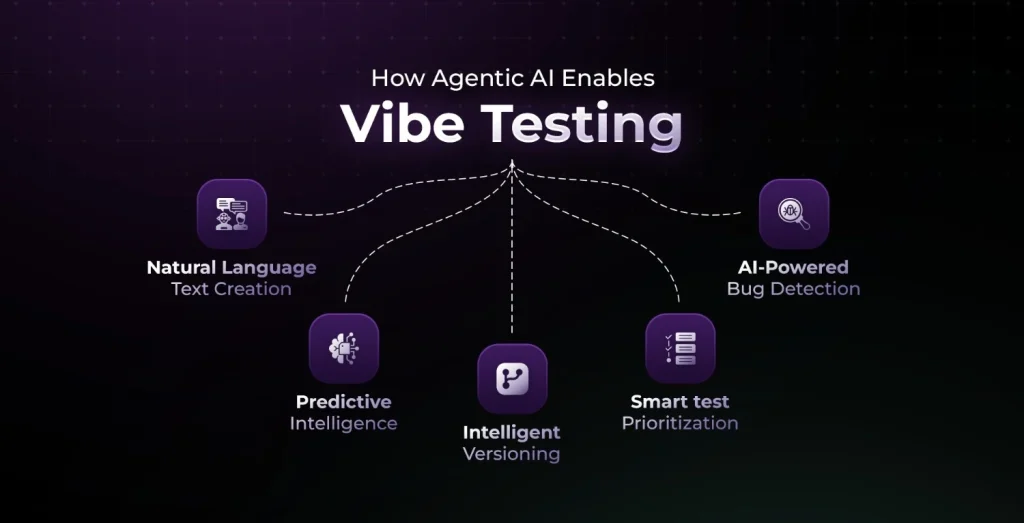
1. Contextual AI-generated test data
AI agents use schemas and past telemetry to autonomously generate realistic test data and edge case scenarios for vibe tests. They can understand different user personas and error conditions, and continuously provision data for efficient testing. This helps you cover more user scenarios and reduce the manual effort of gathering authentic test data.
Learn More: AI Test Case Generation: A Complete Guide for QA Teams
2. Predictive test execution
Predictive intelligence helps you anticipate where your users are likely to face issues while using the app. AI agents analyze historical test results, code commits, and analytics to predict high-risk areas and potential drop-off points. And you can use this data to generate tests that cover the critical user journeys based on impact.
3. Intelligent versioning support
AI agents don’t just record what changed. They also analyze why the change happened and what it affected by tracking commits, UI diffs, test results linked to previous versions, and configuration changes. And based on these signals, they can help you adjust tests and ensure vibe assessments stay aligned with your current product context.
4. Smart test prioritization
With the help of agentic AI, you can identify which user flows matter the most. Agents can assess code changes, past defects, UI updates, and flaky test patterns to pinpoint the tests that are most critical to business and have a high effect on UX.
5. AI-powered bug detection and triage
AI agents can significantly help reduce your manual effort of investigating bugs and enable efficient defect management. They continuously analyze execution traces, logs, screenshots, and UI states to detect issues and even suggest likely root causes and improvements.
Also Read: Agentic AI vs Generative AI: Head-to-Head Comparison
How Tools Like CoTester Enable and Scale Vibe Testing
CoTester is an AI agent for software testing with advanced features that help modern QA teams efficiently build, execute, and manage vibe tests.
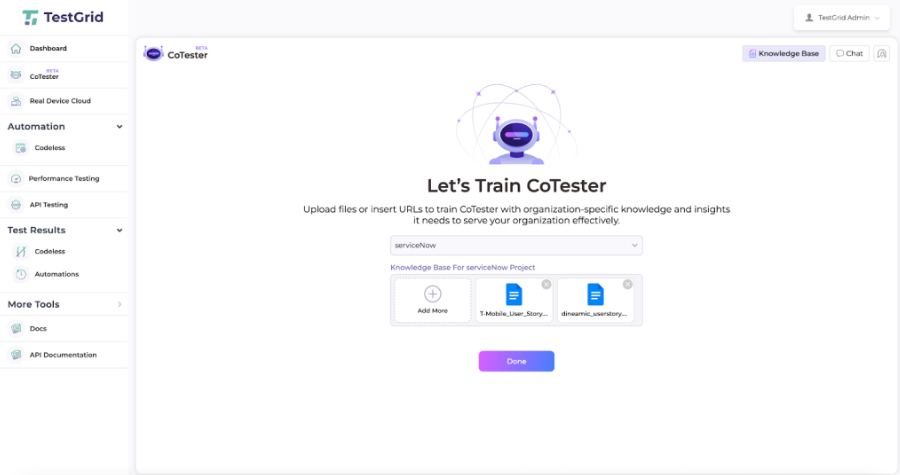
Here are some of CoTester’s key capabilities:
1. Creating Tests Using Natural Language and User Intent
You don’t need a predefined script to use CoTester. You can start a conversation with it in the chat interface and describe your test requirements. To create tests that align with your app, you can share user stories or test plans in formats like CSV, PDF, or Word. The agent uses this information to generate test cases for you.
2. Adapting Test Coverage Across Continuous UI Changes
AgentRx, an auto-heal engine, can detect changes such as renamed elements, layout shifts, and redesigned screens and update your tests dynamically. This ensures your vibe tests continue to validate user intent even as interfaces evolve.
3. Simulating Real-World Usage Scenarios With AI Exploration
With agentic testing, you can simulate real user actions and verify them by executing your vibe tests in real browsers and device environments. CoTester provides you with live feedback so you can identify potential issues faster and resolve them before they hit users.
4. Continuous Learning Through Feedback-Driven Test Optimization
This agent learns from every test execution and feedback to adapt, reduce test flakiness, and improve its understanding of how apps should behave and feel from a user’s perspective. This helps you ensure your vibe tests are better aligned with real-world usage.
Looking Ahead
Vibe testing is a fairly new concept. Using it smartly alongside usual functional and non-functional tests will help you build apps that are both reliable and deliver meaningful experiences.
In the future, we can expect vibe testing to be integrated into the complete software QA lifecycle as a continuous testing process rather than a last-stage quality check. And instead of writing extensive code for every test, quality engineers and developers will be able to function as strategists to design features that meet user expectations.
Test the vibe of your app with CoTester — request a free trial today.
Frequently Asked Questions (FAQs)
What is vibe testing, and how does it relate to vibe coding?
Vibe testing is a no-code AI-powered testing method to assess the overall sentiment, consistency, and quality of an app from the user’s perspective. Vibe coding follows a similar philosophy where developers describe intent in plain English and let AI generate code.
Who should use vibe testing: developers, QA engineers, or vibe coders?
Vibe testing can be done collaboratively. Developers can validate AI-generated code before it reaches the testing stage, QA engineers use it to explore different user flows and detect experience gaps, and vibe coders can check if app behavior matches the intent they described via natural language prompts.
What types of bugs does vibe testing catch best in AI-built applications?
It can effectively catch issues such as misleading copy, poor error handling, usability issues, and tone inconsistencies. These issues may not be caught during regular functional checks.
Does vibe testing replace manual or automation testing?
No. It doesn’t replace manual or test automation; rather, it complements them. Automated and manual tests are essential for verifying regressions and functional issues. Vibe testing adds an intent-focused layer that helps testers check if apps feel intuitive during real use.
How do you incorporate vibe testing into existing QA workflows?
You can select AI-powered vibe testing tools or agents that support integration with automated testing pipelines. You can then use it after every code commit alongside functional tests to continuously catch UX gaps or usability issues without affecting the existing testing workflow.
Can vibe testing be integrated into CI/CD pipelines?
Yes. You can incorporate vibe testing into your CI/CD pipeline through AI testing tools for vibe coding apps. This can help you run tests after every build and catch issues early in the development cycle.
Which AI testing tools support vibe testing for vibe coders?
CoTester is an AI-agent for software testing. You can think of it as one of the AI testing tools for vibe coders that allows them to generate tests in plain language in the no-code interface and edit test steps as needed easily in an editor or via a chat interface.
Is vibe testing useful for no-code or accessibility testing scenarios?
Yes, vibe testing is suited well for both no-code and accessibility testing. Because these tests are written in natural language, non-tech teams can verify app behavior without writing code. Accessibility issues like unclear focus order, confusing labels, or poor feedback can be detected using vibe testing.