CoTester 2.0 is LIVE! Your Always-Available AI Teammate for Testing.

- What are Software Testing Strategies?
- Main Components of a Software Testing Strategy
- Types of Software Testing Strategies
- How Would You Design Your Testing Strategy?
- Software Testing Trends in 2026
- Implement Your Software Testing Strategies with TestGrid
- Frequently Asked Questions (FAQs)
- Who prepares the software testing strategies?
- How often should you update your software testing strategies?
- How do teams decide between manual and automated software test strategies?
- What challenges can teams face when preparing software testing strategies?
- What are some of the best practices of software testing strategies?
Your payment and checkout flow might need frequent regression checks before every release, while your APIs that connect to external services might require continuous validation. If you operate in highly regulated industries, you will need stronger compliance and security tests; if you have an e-commerce app, performance and load tests must be your priority.
You see, different systems have different quality risks and hence need different testing strategies. This is where software testing strategies help by aligning testing efforts with your application’s architecture, development process, and quality goals.
In this blog, we’ll learn what software testing strategies are, why they’re necessary, the types that teams use today, and the steps for implementation.
Build modern software testing strategies and enhance quality engineering with TestGrid. Request a free trial.
TL;DR
- Software testing strategies are different methods to design, prioritize, and execute testing activities based on app risks, system architecture, development workflows, and quality goals
- Software test strategies help you structure testing activities, align testing with business goals, spot defects early, and minimize rework post-production
- The main components of a software testing strategy are testing scope, environment strategy, defect management, testing methods, reporting, and test data management
- The different types of testing strategies in software engineering are static, structural, behavioral, exploratory, risk-based, and model-based testing
- To formulate your software testing strategy, you need to define objectives, understand the application architecture, select the right tools, automate tests, and establish feedback mechanisms
- Some software testing trends to watch in 2026 are autonomous testing, AI-powered automation, QAOps, and observability-driven testing
What are Software Testing Strategies?
A software testing strategy is a structured approach that defines what to test, how to test it, and when to test it to ensure software quality throughout the development lifecycle.
It’s a blueprint where you outline the different testing methods, environment, testing tools, risk assessments, reporting processes, and team responsibilities that you’ll be following throughout your testing journey.
There are different software test strategies, or testing approaches, under this broad framework, which help you decide what you need to test, when, and how.
Why are Software Testing Strategies Important?
A structured testing process is extremely critical, particularly if you’re testing apps that connect with multiple APIs, third-party tools, cloud platforms, databases, and external integrations, and must work reliably across different browsers, devices, and operating systems.
This helps you:
- Spot defects early so they don’t impact production environments
- Get visibility into risks across your development and staging pipelines
- Avoid exhausting resources and testing efforts on low-value workflows
- Balance software quality, release speed, and operational costs effectively
In a recent podcast, Michael Bolton and James Bach talk about how software testing is more than just finding bugs. They highlight that it’s a process to help teams improve product quality, assess compliance with regulations, and deliver a product that meets or exceeds user expectations.
This shows us why testing strategies in software testing matter so much. It’s not enough to just fix functional defects today. You need to implement the right strategies that’ll help you gain user trust and minimize risks.
Main Components of a Software Testing Strategy
Now that you know what testing strategies are, have a look at the components.
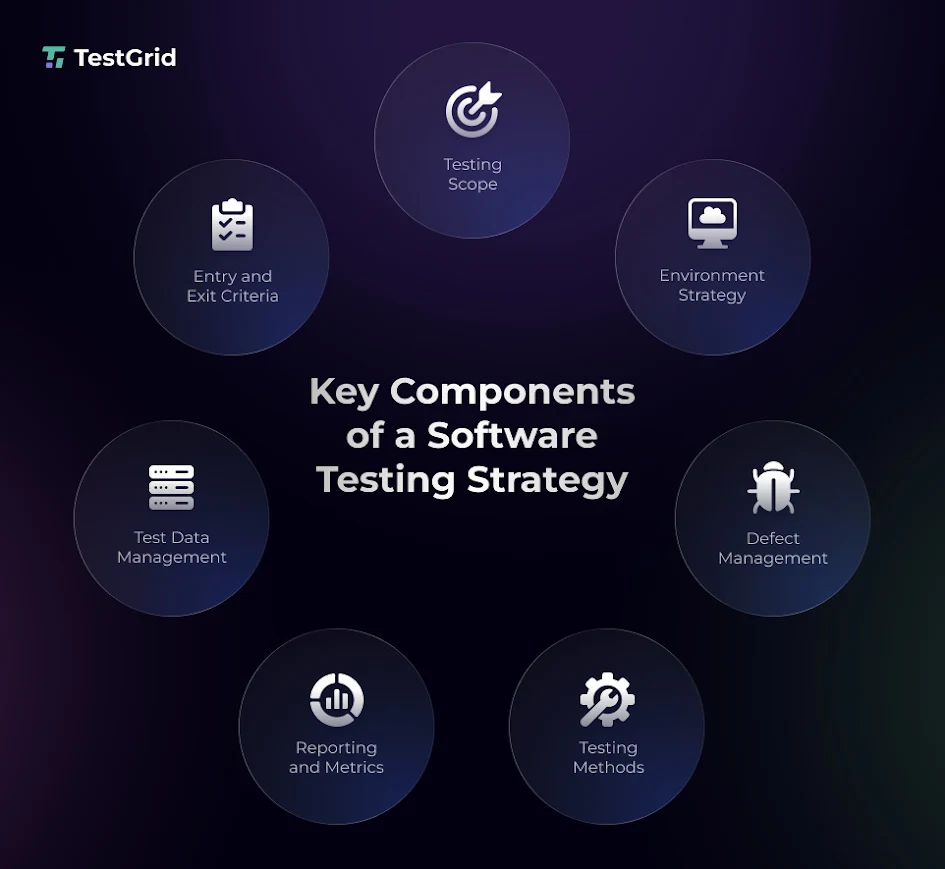
1. Testing Scope
Your test scope is probably one of the most essential parts of your software test strategy because here’s where you identify and jot down the core features, user paths, modules, and integrations that you need to test.
You also mention the out-of-scope areas (e.g., features not included in your current release), as well as the testing types, third-party dependencies, and the browsers or devices your app will support.
A test scope helps you better allocate your test resources and align with project goals, timelines, and business requirements.
2. Environment Strategy
If you want to ensure your app performs reliably when it reaches users, you need to make sure your test environment resembles the production conditions closely. And that’s why proper environment management is vital.
Your environment strategy should include all the details about how your team will plan, set up, and maintain the hardware, operating systems, browsers, devices, databases, and network configurations throughout the testing process.
3. Defect Management
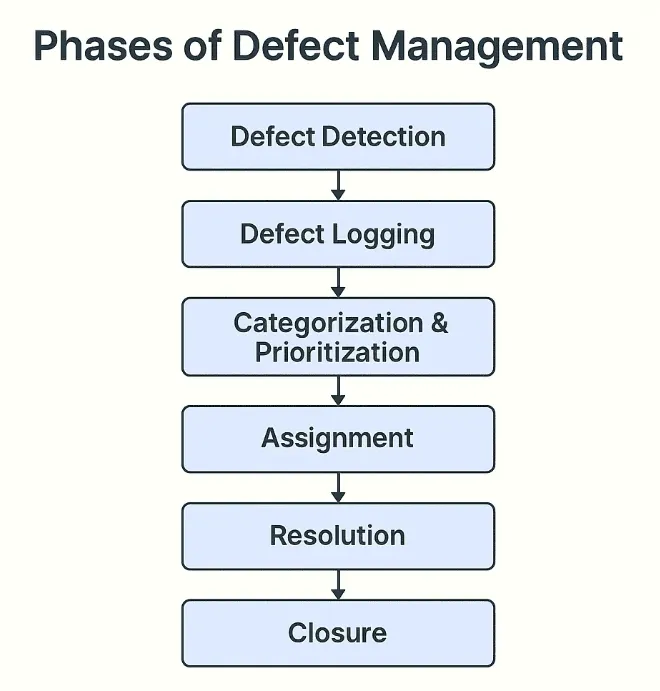
For detecting and resolving defects promptly, you need to develop a robust process where you mention how to identify, document, track, prioritize, and fix the defects.
In an effective defect management strategy, the process of bug reporting, severity classification, root cause analysis, retesting, and closure is established.
source: keploy.io
Other than this, you also map out the communication channels so your testers, developers, and stakeholders can accurately report issues, share updates, assign ownership, and track the resolution process.
4. Testing Methods
A test strategy normally details all the critical tests that you need to perform to ensure all components of your app are thoroughly checked and improve quality engineering. So, before you decide on the test types, you need to know which ones are essential for your app.
E.g., if you have a banking app, then functional, performance, and security tests are a must.
Usually, these are some of the most important tests you should run to achieve maximum coverage:
- Functional testing – this will help you ensure that your app works as specified in the requirements docs
- Regression testing – it allows you to check if recent code changes or updates affected any existing functions of your app
- Integration testing – here you verify all the modules, API, services, and workflows of your app seamlessly communicate with each other
- Security testing – this test enables you to find vulnerabilities, authentication flaws, and insecure API endpoints, which can be exploited by attackers
- User acceptance testing – it’s usually the final validation stage, where real users access the app to see if it meets real-world business expectations before launch
5. Reporting and Metrics
Accurate reporting and monitoring the right metrics help you detect issues in your app early, as well as highlight any gaps in your testing process.
Say, your tests failed, and you want to find the root cause. Reports that have detailed logs, screenshots, and videos will let you understand if the failure was because of an issue with your app or caused by a flaky test.
In your software test strategies, mention metrics such as defect density, test coverage, pass/fail rates, mean time to resolution, and test execution progress so your team can measure the quality of the app and work on improvements.
Also Read: Software Testing Metrics: How to Track the Right Data Without Losing Focus
6. Test Data Management
How accurate your test results are can depend largely on the test data, which is why you should organize and maintain it securely.
Define what test data management tools you would be using to generate data, mask and anonymize sensitive information (PII, login credentials), and version control.
A strong test data management strategy is important to ensure that your testers always have access to relevant and realistic datasets so that they can check how your app behaves under actual usage scenarios.
7. Entry and Exit Criteria
Entry and exit criteria are basically predefined conditions that help you determine when you should start testing and when to complete the process.
So, in your entry criteria, you might write down aspects like detailed requirements, stable test environments, and access to relevant test data. Your testing can start only when you meet these conditions.
And for exit criteria, you can list benchmarks like successful test execution, acceptable defect levels, target coverage, and all defects resolved before you end the testing process.
Learn More: How to Write a Software Requirement Specification Document (SRS)
Types of Software Testing Strategies
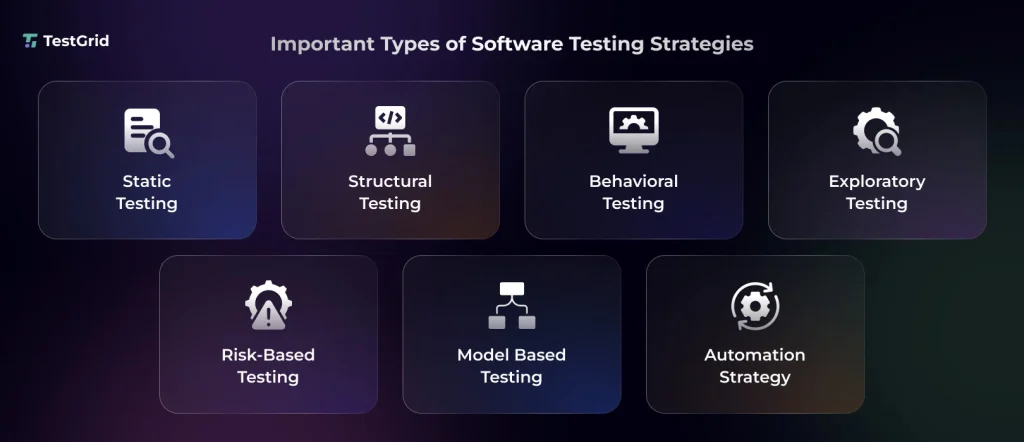
Static Testing
With static testing, you examine your source code, design documents, requirements, and test cases without actually executing your software or app. This testing generally includes techniques like peer reviews, walkthroughs, inspections, and static code analysis to spot coding standard or style violations, security gaps, and dead code.
Static testing helps you find these problems early in the development cycle and improves code quality.
Structural Testing
Structural testing, or white-box testing, lets you check the internal structure and code flow of your app. You analyze control flow, decision points, loops, paths, and code branches to see if execution paths function as expected under different input and runtime conditions.
Some common methods of structural testing are statement coverage, branch coverage, path coverage, and condition coverage. These can allow you to find localized errors, unreachable code paths, and incorrect branching.
Behavioral Testing
Also often called black-box testing, this lets you evaluate your app from the perspective of your end users. Here, you don’t examine the app’s internal code or architecture. You check if it gives you the expected outputs as per the business requirements, functional specifications, and user workflows.
Functional, usability, acceptance, regression, and end-to-end testing are some of the important types of behavioral testing. The main focus of this test is to assess system responses, error handling, and overall user experience.
Exploratory Testing
Exploratory testing is a method where testers manually interact with the app in order to investigate unexpected behaviors, edge cases, and usability issues. This testing doesn’t normally involve fixed scripts.
Testers depend on their domain knowledge, intuition, and experience to spot problems like confusing user flows, accessibility issues, and unintuitive navigation, which structured or functional testing might not be able to catch.
Risk-Based Testing
In risk-based testing, rather than checking every feature of your app with equal importance, you focus on testing the high-risk areas like critical business functions, payment flows, external integrations, and modules that are more sensitive to security threats.
Here’s usually how the process goes:
- You first identify the risk factors that can potentially lead to failures, such as feature complexity, change frequency, and user impact
- Then you assess the features and workflows in your app against these factors. E.g., you highlight the functions that have the most impact on your users
- After this, you assign risk scores and allocate test resources
This strategy can help you minimize major production failures and can be particularly beneficial if you have limited time and resources.
Model-Based Testing
Model-based testing, or MBT, is a method where you automatically generate test cases from abstract models that depict the expected behavior, states, and functionality of your app. You don’t need to write hundreds of test scripts manually.
What you do instead is design state diagrams, flowcharts, decision tables, or UML (unified modeling language) layouts of how your app should ideally work, and then testing tools create structured tests based on these.
Automation strategy
An automation strategy is a test plan that you design for creating, executing, and maintaining your tests across your software development life cycle (SDLC).
In this strategy, you generally include how you’ll be using automation frameworks, environment provisioning, test data management, CI/CD, self-healing, and analytics tools to automate every stage of your testing workflow, improve test coverage, speed up releases, and minimize manual work as much as possible.
How Would You Design Your Testing Strategy?
The first thing that you must do before you start building your software testing strategies in software engineering is to align them with the development methodology that you follow.
So, for agile methodology and extreme programming, you might focus more on continuous testing and rapid feedback, whereas for the spiral model, you should prioritize iterative risk analysis and incremental testing.
And if you implement the Waterfall model or the V-Model, your test strategies should reflect sequential and structured testing phases.
These considerations help you ensure that your quality assurance (QA) activities and automation strategy align well with the development process.
Here are the steps you can follow to create your testing strategies in software engineering:
- Define objectives – understand what you want to achieve, whether it’s faster releases, better test stability, or minimized production defects. Clear objectives will allow your team to match test efforts with business goals
- Assess your app architecture – study your app’s dependencies, APIs, infrastructure, integrations, and deployment model before designing your strategy. Monolithic systems, microservices, and cloud apps all need different testing approaches
- Select the tests you want to automate – automate the repetitive and critical test suites first. These could be related to paths or features users access the most, as well as the ones that have a direct impact on your revenue
- Pick the right tools – analyze what you need in your testing tools. Ideally, you should be looking for scalability, CI/CD integration support, reporting features, cross-platform coverage, scripting flexibility, easy maintenance, and strong community support
- Set proper reporting and feedback processes – make sure you have robust reporting workflows that give you instant insights into your test execution, results, and failure trends. This will enable your developers to debug and resolve issues quickly
Also Read: Test Strategy vs Test Plan: Differences and Importance
Software Testing Trends in 2026
You must know about the upcoming trends and changes in software testing, because the different testing strategies you develop will depend on that.
AI-Powered Testing
This is a method of software testing where you leverage artificial intelligence and machine learning models to optimize processes and minimize manual efforts. The global market for AI testing is steadily growing, and reports show that it’s expected to hit $4.64 billion by 2034 from $1.21 billion in 2026.
There are specialized AI testing tools that allow you to generate test cases in plain language, manage flaky tests via self-healing mechanisms, enable risk-based test selection, and implement intelligent test orchestration.
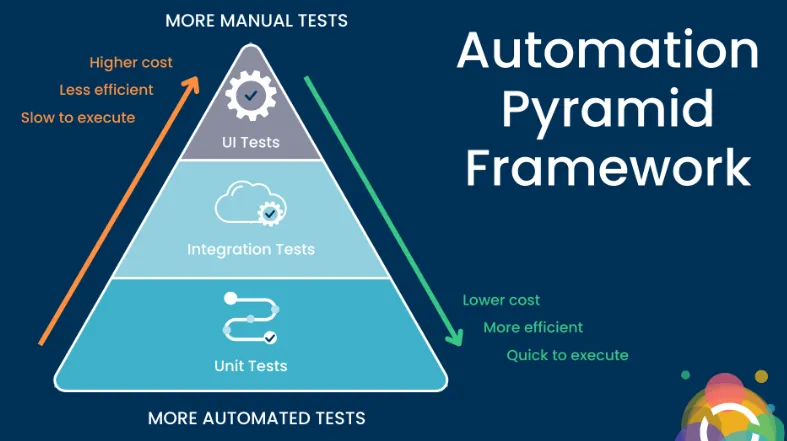
Test Automation Pyramid
The test automation pyramid is a framework that helps your QA teams to balance the automated tests across different testing layers. There are actually three layers in this pyramid. The first one is unit tests (base), the second is integration tests (middle), and the third is end-to-end UI tests (top).
The pyramid recommends that you run a large number of unit tests frequently, preferably every time your developers make code changes. This layer gives you the fastest feedback.
Followed by this, you should run integration tests to verify if all app modules, APIs, and services work together correctly. And lastly, you run a smaller number of E2E UI tests (because these require more manual efforts and costs) to check complete user flows.
source: converged.propelsoftware.com
Autonomous Testing
This is even more advanced than AI-powered testing, where intelligent agents autonomously execute tasks based on specific goals with very little human intervention.
E.g., you might ask the agent to test your app’s login flow via a natural language interface. The agent will understand this goal, determine the steps for testing, generate relevant tests, execute them, and show you the results.
Autonomous testing can help you attain faster testing cycles, better test coverage, optimal use of resources, improved productivity, minimal human error, and quantifiable ROI.
Here’s something interesting: Just like we talked about the test automation pyramid, Angie Jones, a renowned name in the software development space, has designed a test pyramid specifically for AI agents, which talks about managing uncertainty and reconfiguring complex agent behaviors. You can check the details here.
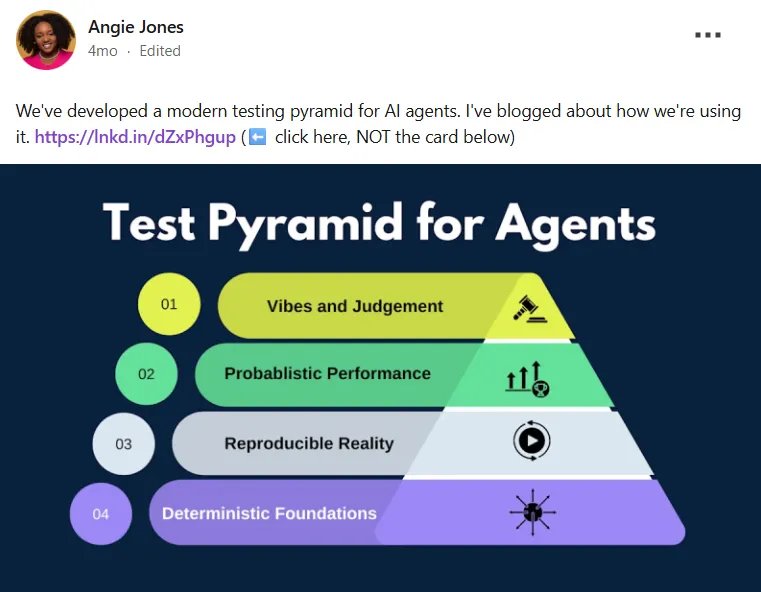
Source: LinkedIn post by Angie Jones
QAOps
QAOps is a relatively newer concept in software testing that integrates quality assurance activities into your DevOps workflows. The main aim of this approach is to make testing a continuous part of your development process, rather than waiting for the app to be completely developed before starting testing.
A recent report shows that around 51.9% of organizations now involve their testers right from the requirements and design phase. This helps them create better tests, share feedback quicker, and reduce costly rework in the late stages of the SDLC.
Observability-Driven Testing
This modern strategy of software testing encourages QA teams to leverage telemetry data logs, metrics, traces, events, and runtime insights to create more comprehensive and targeted tests. Here you use data from your staging and production environments to detect failures, analyze root causes, and improve test reliability.
Implement Your Software Testing Strategies with TestGrid
To bring your software testing strategies into action, you need a platform that allows you to perform different types of tests, automate your testing workflows, offer you a robust test environment, and help you get insights into every step of your execution process.
TestGrid is an AI-powered software testing platform where you can:
- Test your user journeys end-to-end across different devices and browser combinations
- Enhance your automation strategy by integrating with CI/CD pipelines and running continuous tests
- Check the high-risk flows like login, authentication, and payment processing before release
- Reduce test maintenance with the help of self-healing automation
- Speed up your releases via parallel test execution in a scalable cloud-based test infrastructure
- Improve debugging with centralized reporting, execution visibility, and failure analysis insights
- Run exploratory tests across multiple environments to find usability gaps and edge case failures
Your testing strategy can become a lot more effective when you have a testing tool that supports your quality assurance requirements.
TestGrid gives your team the flexibility it needs to scale test operations, adapt to dynamic apps, and meet quality benchmarks, every single time. Request a free trial today.
Frequently Asked Questions (FAQs)
Who prepares the software testing strategies?
Software test strategies are normally prepared collaboratively by QA leads, test managers, software architects, developers, DevOps engineers, and product stakeholders in modern enterprise setups. However, in smaller teams, you may see senior QA engineers or test managers take ownership.
How often should you update your software testing strategies?
It actually depends on how often your app goes through changes. You should ideally update your software testing strategies whenever you make major modifications in your app’s code, architecture, release process, compliance requirements, or development methodology. At the same time, connect with business teams to update strategies as user behavior and requirements evolve.
How do teams decide between manual and automated software test strategies?
Most teams assess factors like test frequency, app complexity, test stability, release speed, and business impact to decide which tests should be manual and which ones to automate. Normally, you perform tests like exploratory, usability, and accessibility manually, and automate regression, functional, and performance checks.
What challenges can teams face when preparing software testing strategies?
Challenges you might encounter when building your software testing strategies include unclear requirements, frequently changing app features, unavailability of diverse test data, and tight release timelines. However, you can overcome these by improving cross-functional collaboration, assessing your team and testing needs, and setting achievable project goals.
What are some of the best practices of software testing strategies?
Some of the best practices you can follow to optimize the process of designing your software test strategies are aligning your testing process with business risks, including the app flows, planning for test data and test environment in advance, tracking the right metrics, and reviewing the strategy quarterly or after major releases.