CoTester 2.0 is LIVE! Your Always-Available AI Teammate for Testing.
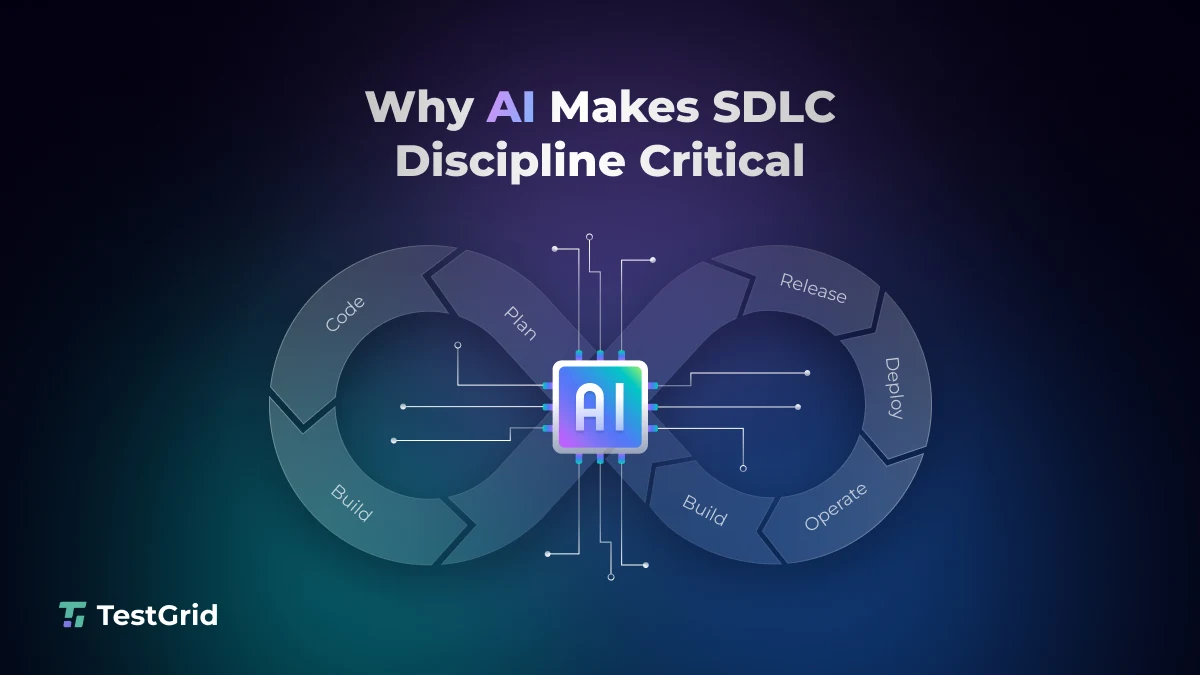
When AI enters your delivery process, the first wins are obvious. Your engineers draft code faster, your QA team gets test ideas sooner, and release notes stop taking half a day.
But what takes longer to notice is that your review queues are getting heavier, your test suites are growing without proving risk coverage, and your summaries are closing out decisions that were never fully resolved.
You see, AI output can look complete while the assumptions behind it remain unvalidated, and if your requirements are vague, your architecture rules are undocumented, and your release process is dependent on what your senior engineers happen to remember, AI will carry those gaps downstream faster than your team can catch them.
This article explains how to give AI the structured inputs and controls it needs to strengthen your delivery process rather than expose its weaknesses at higher speed.
Request a free CoTester trial to assess how AI testing performs under real enterprise delivery conditions.
TL;DR
- AI can speed up code, testing, and documentation, but weak SDLC practices create downstream review, QA, security, and release pressure.
- The quality of AI output depends on the quality of your requirements, acceptance criteria, architecture rules, and traceability standards.
- AI-generated code needs the same review, security checks, architecture validation, and human accountability as any other code.
- Test success should be measured by risk coverage, not the number of AI-generated test cases.
- The most useful AI metrics show where work moves across the SDLC, including PR corrections, QA failures, security exceptions, and release-review churn.
- AI strengthens mature delivery processes and exposes immature ones faster.
Treat SDLC Maturity as an Executive Control
When you introduce AI into delivery, the informal practices your team has relied on stop being manageable. If your tickets depend on verbal clarification, AI has no way to fill that gap.
If your architecture standards live in someone’s head, AI has no reason to follow them. If your release process runs on institutional memory, your reviewers end up approving polished artifacts without the evidence to support those decisions.
None of this is new, but AI makes it a faster, higher-volume problem.
| Next steps Start by auditing where your process currently depends on conversation rather than documentation. Those are the points where AI-assisted work will create the most downstream pressure. The point is, if you cannot show what changed, who accepted it, what evidence supports it, and which risks remain open, then moving faster has limited value. Your requirements, traceability rules, security controls, test strategy, and release approvals need to function as operating standards before AI can meaningfully improve your delivery outcomes. |
Requirements: Determine the Quality of AI Output
The quality of what AI produces is directly bound by the quality of what you give it.
A requirement like “Add payment support” gives AI room to make its own assumptions about user state, failure behavior, logging, and edge cases, and you won’t always know which assumptions it made until something breaks.
A requirement like “Allow a verified user to pay an unpaid invoice with a saved card, block payment after three failed attempts, log the attempt, prevent duplicate submission, and show a retry message when authorization fails” gives AI actual constraints to work with.
It also gives your product, engineering, QA, and security teams a shared standard for review, which cuts down on the downstream debate about what the feature was supposed to do.
The same applies to identity, compliance, data handling, or any other domain where the rules matter. For instance, “Let users reset MFA” is a good place to begin.
Similarly, “Allow a signed-in user to reset MFA only after reauthentication, block reset from untrusted devices, notify the account owner, log the change, and require support approval for recovery-code fallback” is something your team can build and test against.
When the rule is explicit, AI can draft better implementation options, suggest stronger tests, flag missing paths, and produce documentation that reflects what the feature does.
| Next steps So, if your team isn’t writing requirements at that level of specificity today, that’s the first thing to fix. Pick your highest-risk workflows and work backward. Your inputs should include acceptance criteria, architecture boundaries, non-functional requirements, compliance constraints, known defect patterns, and traceability rules, with every AI-assisted artifact connected back to a requirement, ticket, commit, test result, reviewer, approval, and release decision. |
AI-Generated Code Requires the Same Review as Any Other
Better requirements reduce ambiguity going in, but they don’t replace the need for controls during development.
Your AI-generated code should follow the same naming rules, branching policy, dependency standards, logging patterns, error-handling rules, data-access boundaries, and API contracts as anything else your team produces.
Enterprise-grade CoTester AI helps you apply the same discipline to AI-assisted testing workflows.
Tests generated from Jira stories, specifications, or recorded user flows remain connected to the originating requirement, execution history, screenshots, logs, approvals, and defect records throughout the release cycle.
You can review and edit generated test steps before execution instead of allowing AI-generated automation to run unchecked.
To reduce brittle automation maintenance, AgentRx, CoTester’s execution-layer self-healing engine, adapts to UI shifts, changed labels, moved fields, and layout changes during runtime using visual and structural context in addition to static selectors.
The engineer who accepts the result owns it, and that accountability matters because AI can generate plausible code that misses business context in ways that don’t show up in a local test.
It may put logic in the wrong layer, reuse a pattern your team deprecated, skip a security constraint, or pull in a dependency you already decided against. Your static analysis, unit tests, code review, architecture checks, software composition analysis, and secrets detection all apply.
| Next steps For higher-risk systems, track whether code was AI-assisted and record who accepted it. If you don’t have a way to answer “who reviewed this and what did they verify” for an AI-assisted change touching identity, payments, healthcare data, financial records, customer permissions, or production infrastructure, that’s a gap worth closing before you scale AI adoption further. |
Make Risk Coverage the Test Standard
The same logic applies to testing. AI can generate tests quickly.
But if your testing prompt is weak, you’ll get a large set of shallow happy-path cases that don’t prove much. A useful prompt includes the requirement, acceptance criteria, user roles, data rules, integrations, failure paths, permissions, production incidents, and known defect patterns.
With that context, AI can surface edge cases your team might otherwise miss, including invalid state transitions, partial failures, duplicate submissions, expired sessions, and permission conflicts.
Here’s an example: for a healthcare workflow, your test value comes from coverage across privacy rules, role-based access, escalation triggers, audit events, incomplete records, notification failures, and sensitive data moving across systems.
More cases around “update patient status” do not add value unless they address the risks that matter for that workflow.
| Next steps Ask your QA leaders to report which risks are covered, which remain open, and which generated tests were accepted, modified, or rejected as redundant. If they’re leading with test counts, redirect the conversation toward risk coverage. On the security side, AI can summarize scan results, draft threat-model questions, and explain dependency findings, but none of that substitutes for a clean scan result, a resolved critical vulnerability, or a completed exception approval. Think of your security evidence as the source of truth, not the summary. |
Evidence Latency Is Worth Tracking Too
You also need to check how long it takes for an AI-assisted change to move from generated output to verified proof.
For any given change, you should be able to see who requested it, who accepted it, who approved it, which tests passed, which risks are still open, and which release decision it was part of.
If you can’t answer those questions consistently, your governance model hasn’t kept pace with your adoption.
Stop Measuring Output. Start Measuring Evidence.
The organizations that build delivery discipline now will end up with more than just a faster pipeline. They’ll have a system that can show what changed, who approved it, and what evidence supported each decision, at a pace that was not achievable before.
As we’ve seen, CoTester operates within defined review, approval, and execution boundaries instead of generating automation without accountability.
The question worth asking is whether your delivery system is capable of making AI’s speed trustworthy. If you invest in answering that seriously, you’ll find that AI compounds the value of a good process rather than exposing the absence of one.
Request a free trial with CoTester to see how AI-assisted testing fits into your release and approval workflows.