CoTester 2.0 is LIVE! Your Always-Available AI Teammate for Testing.
A large insurance enterprise operating across policy administration, claims processing, and customer servicing applications was struggling to keep testing aligned with the delivery pace.
Each release introduced changes to regulated workflows involving multiple roles, approvals, and downstream systems. While development velocity increased, test creation remained heavily manual and increasingly disconnected from sprint timelines.
Quality leaders were under pressure to move faster without compromising traceability, execution evidence, or compliance readiness.
The Challenge
Key issues included:
- Slow test authoring for complex workflows: Policy and claims scenarios required detailed, step-by-step validation across roles and systems. Creating tests often took days per story for the insurance enterprise.
- Automation limited to specialists: Only a small automation group could convert requirements into executable scripts, creating queues and sprint spillovers.
- Manual tests stuck in documents: Many tests were stored in spreadsheets or PDFs, isolated from execution results, defect tracking, and regression history.
- Audit pressure without end-to-end traceability: Teams needed clear lineage from requirement to test to execution evidence, but maintaining that manually was error-prone.
The result was delayed releases, incomplete coverage, and growing risk as changes accumulated faster than tests could be authored and validated.
Why Existing Approaches Fell Short
Traditional test automation tools required early scripting decisions and ongoing maintenance, which did not fit document-heavy insurance workflows. Manual testing tools captured steps but failed to convert them into durable, reusable assets.
In both cases, test creation remained slow, siloed, and difficult to govern at scale.
The CoTester Approach
The insurance enterprise introduced CoTester to remove test creation friction without changing ownership or governance models. Here’s what the AI software testing agent helped with:
Requirement-driven test generation
Teams imported policy documents, acceptance criteria, and Jira stories directly into CoTester. The platform interpreted business intent and user flows to generate structured, step-by-step manual test cases.
Test depth and coverage could be adjusted per requirement, and every generated step remained editable. This allowed QA teams to move from specification to executable tests within minutes instead of days.
Human review before execution
Before any test was run, QA teams reviewed and refined the generated steps in CoTester’s editor. Validation points were added where failures carried business or compliance risk. Execution only proceeded after explicit approval, ensuring every test aligned with regulated workflows and internal controls.
Manual and automated testing, linked
Approved manual tests could be executed as-is or extended into automation when repeatability was required. Automation was generated directly from validated steps, eliminating the need to rebuild scripts separately.
Both manual and automated executions stayed linked to the same requirement and test definition, preventing drift and duplicate artifacts.
Built-in traceability and evidence
Each execution produced step-level outcomes, screenshots, and detailed logs. Defects were captured with full context and remained tied to the originating requirement and test flow. This ensured end-to-end traceability across test cycles and provided audit-ready evidence without additional tooling or manual reconciliation.
The Impact
Within the first few months of adoption, the insurance enterprise reported measurable improvements:
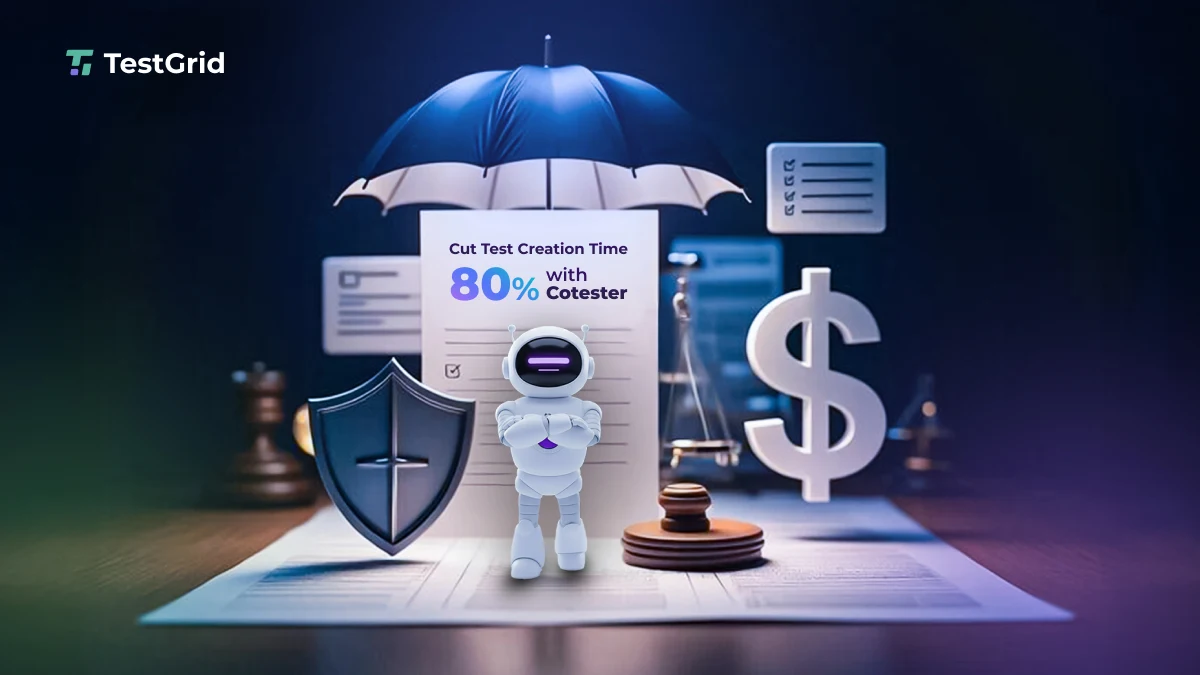
- 80% reduction in test creation time: Tests that previously took days to design were generated and validated in minutes.
- Faster sprint completion with fewer rollovers: Test authoring no longer lagged development, allowing QA to stay aligned with delivery cadence.
- Broader tester participation without loss of control: Manual testers contributed directly to executable tests without writing code.
- Audit-ready traceability by default: Requirement-to-execution lineage was preserved automatically, reducing manual reconciliation.
What Changed for Delivery Teams Because of CoTester
For this insurance enterprise, speed without control was not an option. By removing test creation as a bottleneck, CoTester allowed teams to move faster while preserving the approvals, evidence, and governance required in regulated environments.
Releases became more predictable. Coverage improved incrementally with every sprint. Risk surfaced earlier, when changes were still inexpensive to fix.
What the Client Had to Say
“We didn’t change how ownership or accountability works. What changed was the friction. Requirements now turn into executable tests quickly, reviews happen in context, and every execution leaves behind evidence we can trust. That’s what allowed us to move faster without introducing risk.” — Director of QA and Compliance, Insurance Enterprise
See How CoTester Works for Insurance Teams
If test creation is slowing down your releases or increasing audit pressure, CoTester helps you turn real insurance requirements into executable, traceable tests without disrupting your existing QA model.
Request a free trial to experience how CoTester enables enterprise-scale policy and claims testing.