CoTester 2.0 is LIVE! Your Always-Available AI Teammate for Testing.

- What Is Artificial Intelligence (AI) in Software Testing?
- The Role of Machine Learning (ML) in Software Testing AI
- Benefits of AI in Software Testing
- Types of AI in Software Testing
- AI Software Testing vs. Manual Testing: Key Differences
- Challenges and Considerations for AI in Software Testing
- Top 5 AI Tools for Software Testing
- The Future of AI in Software Testing
- The Bottom Line on AI in Software Testing
- Frequently Asked Questions (FAQs)
- Will AI take over QA jobs?
- Will ChatGPT replace QA?
- How to use AI in software testing?
- How will AI change software testing?
- What is the future of AI in quality assurance?
- Which tools and frameworks support AI software testing?
- How to become an AI/QA tester in software testing?
- What is the role of AI in software engineering and testing?
As Artificial Intelligence (AI) accelerates and expands operations in all industries, software testing hasn’t been left behind. Capgemini reports that 77% of organizations are investing in AI solutions to bolster their quality engineering, proving that AI in software testing is no longer a futuristic concept but a present-day necessity.
As you are aware, teams are under immense pressure to release software more quickly, achieve broader test coverage, and detect defects earlier in the development cycle. With AI, they can streamline repetitive tasks, minimize human error, and respond to shifting customer expectations with agility.
Moreover, unlike traditional test automation, Artificial Intelligence in software testing introduces a layer of “intelligence” that can learn from past data, adapt to changes in application behavior, and even predict where future defects may occur. This marks a pivotal transition from manual testing to AI-powered testing.
Curious to learn more? This article explores everything you need to know about software testing AI, including its benefits, challenges, and best practices. By the end, you’ll have the right tips to change how you fundamentally approach quality engineering as a discipline.
What Is Artificial Intelligence (AI) in Software Testing?
AI enables computers to “think” and “learn.” In the realm of testing and quality assurance, it contributes to higher efficacy and reliability, from creating tests and integrating them into CI/CD pipelines, to recording in-progress tests and analyzing results, and generating reports.
Much like test automation tools used so far, AI can automate mundane and repetitive testing tasks and do so far more efficiently. For example, instead of manually writing test scripts, the AI engine can create test code if you provide it with the basic variables, conditions, and acceptance criteria.
AI software testing can move beyond creating and running tests. With the proper training and adaptations, it can also review test results, adjust to recent code changes, manipulate code coverage, and even decide which tests are best suited for a certain project, module, environment, or test run.
Related read: What Is Artificial Intelligence (AI)Testing?
The Role of Machine Learning (ML) in Software Testing AI
So, where does ML come into the picture here?
It enhances the capabilities of AI by providing algorithms that the latter can use to learn.
As AI absorbs more data, it can adapt to changes in the testing landscape, company priorities, and team needs. ML research is focused on studying information and making decisions based on previous data.
The AI engine absorbs data consistently to make calculated and rational decisions. Over time, the engine fine-tunes its decisions in line with the specifics of the organization using it.
AI for testing leverages ML to recommend practices for better code coverage, including advanced approaches like AI Code Coverage, conduct better static analysis, evaluate test results, and use other metrics to find gaps in efficiency.
It can also be trained to respond specifically to the skills of team members, the quality of your tech stack, code repo, and larger infrastructure.
Benefits of AI in Software Testing
- Serious cost savings
AI-enabled testing can significantly reduce costs by automating most mundane tasks. Tests are built faster with less human input, so teams have to hire only a few testers to get the job done.
Additionally, AI can automate much of the test maintenance, helping to achieve wider test coverage. All this translates to lower needs for human resources, except for foundational and innovative tasks.
That’s one thing off your security team’s list. You can function with a lean team without compromising data integrity and privacy.
Related read: Guide on Codeless Test Automation
- Better software quality
Using AI for software testing has one primary purpose: to deliver better software. Every function is designed to do exactly that. AI detects patterns in code, finds bugs and vulnerabilities, and highlights performance issues.
It helps you write better test cases quickly, which leads to more comprehensive testing. AI even enhances the quality and outcomes of manual testing. Building test cases and execution pipelines based on historical and expert data directly produces better software.
AI lets you test more features, run more tests in each sprint, and adjust for code changes with minimal effort. It augments every stage of the QA funnel and refines the application codebase on every parameter.
- Improved team collaboration
Thanks to AI-based testing, team members with no technical training can create and run test cases. This provides the entire team with a deeper understanding of the product under development.
Hands-on knowledge of the actual software puts every team member, tester or otherwise, on the same page. You’ll have a more connected team with a ready understanding of what they are building. At the end of the Software Development Life Cycle (SDLC), expect improved collaboration, innovative solutions, and a more comprehensive product.
- Increases test coverage and speed
As mentioned above, AI tools inspect requirements, user stories, and code. The data helps it build test cases automatically, including certain edge cases that manual testers can overlook.
It identifies application features that are not adequately tested (such as rare code paths) and quickly builds tests to verify their functions, even if these functions are complex and layered.
Additionally, testers with no coding experience can create tests with natural language. They can refer to documents or conversations to create simple, understandable instructions and get complete test cases within seconds.
Needless to say, this increases test coverage with practically no increase in QA effort. Finally, since AI is literally a thinking machine, it will execute all functions, especially test creation and running, at a speed humans cannot match.
Related read: Essential Non-Technical and Technical Skills Required for Software Testers
- Ability to make data-based decisions
AI can never replace human perception, but it can automate certain decisions that count as “grunt work” for humans. For instance, if you’re not using Artificial Intelligence in software testing, your team might be building test cases from scratch.
After all, current automation tools are simply unable to automate this function. Testing with AI solves this gap via ML capabilities. It can learn from previous projects and adapt to create structured test cases from natural language instructions.
This ability can be expanded to verify an app’s usability, accessibility, and reliability. The right AI engines can create and optimize workflows, patterns, and tasks based on testing data, user behavior, and previous interactions with the system.
These are tasks that humans must do, but they don’t utilize the full potential of our cognitive abilities. By automating them, human testers can focus on driving core business value through technical improvements.
Related read: What is Decision Table Testing?
- Simplifies and accelerates test maintenance
Artificial Intelligence in software testing reduces the heavy lift of maintaining test suites by enabling self-healing scripts that automatically adapt to UI or DOM changes.
Instead of manually updating locators or rewriting tests, AI can prioritize cases by risk, identify obsolete or duplicate scripts, and adapt regression tests when new features are added.
Combined with smarter element detection and automated root-cause analysis, this makes test suites far more resilient, allowing QA teams to focus on strategy rather than constant script upkeep.
Types of AI in Software Testing
- AI-driven test case generation
AI analyzes requirements, user stories, and historical defects to generate relevant test cases automatically. Using ML, it identifies high-risk areas and creates structured tests, including edge cases that manual testers may overlook. This reduces dependency on human input while expanding test coverage.
- Self-healing test automation
Traditional test automation breaks whenever an element changes in the UI or DOM. AI solves this with self-healing scripts that dynamically adapt by detecting attributes such as hierarchy, text, or context. The result is robust, long-lasting automation with minimal maintenance.
Related read: AI in test automation
- Visual testing with AI
AI-powered visual testing compares screenshots, layouts, and UI changes to identify discrepancies beyond code-level checks. Instead of pixel-by-pixel comparison, it applies image recognition and pattern matching to detect misalignments, broken layouts, or inconsistent branding.
- AI-powered test data generation
High-quality test data is essential but often complex to create. AI uses pattern recognition and synthetic data generation to simulate real-world scenarios while protecting sensitive information. It can also balance datasets to reflect diverse usage conditions.
- AI-enhanced performance testing
Performance testing requires modeling user load and stress conditions. AI refines this by analyzing historical performance logs, predicting bottlenecks, and simulating realistic user behavior under varying conditions. It continuously learns from system responses to optimize scenarios.
- NLP-based test automation
Natural Language Processing (NLP) allows testers to write test cases in plain English. AI interprets these instructions, converts them into executable scripts, and integrates them with existing frameworks. This lowers the barrier for non-technical team members.
- AI-driven flaky test management
Flaky tests produce inconsistent results, undermining confidence in automation. AI analyzes execution patterns, logs, and environment data to identify the causes of flakiness and recommend fixes or quarantines. It learns from test history to reduce recurrence.
- AI in security testing
AI-powered testing tools detect vulnerabilities by scanning code, analyzing patterns, and simulating potential attacks to identify weaknesses. Unlike static security scans, AI adapts to new threats and predicts exploit scenarios based on historical breach data.
- AI-assisted test reporting
Reporting often produces overwhelming dashboards. AI enhances this by summarizing results, highlighting key risks, and recommending corrective actions. It can even translate technical findings into business-impact insights for stakeholders.
- Bias and fairness testing
Applications powered by AI/ML need fairness checks. AI in software testing frameworks analyzes models for biased outputs, ensuring equitable treatment across demographics and use cases. It evaluates datasets, decision logic, and outcomes for potential discrimination.
AI Software Testing vs. Manual Testing: Key Differences
| Testing Aspect | Manual Testing | AI Software Testing |
|---|---|---|
| Accuracy | Dependent on human judgment; prone to oversight and inconsistencies | AI in software testing detects patterns and defects with higher consistency and precision |
| Cost Efficiency | More testers needed as scope grows; high overhead for regression tests | AI tools for software testing cut costs by automating repetitive tasks and reducing maintenance |
| Reliability | Results can vary by tester skill and environment; scripts break easily | Software testing with AI enables self-healing scripts and stable, adaptive pipelines |
| Test Coverage | Limited by human bandwidth; often misses edge cases | Software testing AI expands coverage with automated test case generation and deeper analysis |
| Scalability | Difficult to scale with rapid releases; requires added effort each sprint | AI in software test automation scales dynamically, adapting to code changes in real time |
| Speed | Slower setup and execution; re-testing takes time | Artificial intelligence in software testing accelerates execution and shortens release cycles |
| Adaptability | Scripts must be manually updated after changes | AI updates regression suites automatically, managing flaky tests with ease |
Challenges and Considerations for AI in Software Testing
- Not enough quality data
AI models must be trained on massive volumes of high-quality data that is properly tagged and labeled. If the data is unavailable or not adequately organized, your AI tool will generate inaccurate predictions and make imbalanced decisions. It will not be able to predict or recognize edge cases.
- Issues around transparency
Advanced AI models, such as those for deep learning, generally aren’t too transparent about the inner mechanisms that drive their functioning. They are essentially “black boxes.”
Consequently, testers may not understand exactly why the AI engine is highlighting a bug, predicting an outcome, prioritizing a test case, or recommending a certain course of action.
This can lower trust in the AI engine’s decision-making capabilities and make a team unwilling to move forward with AI software testing tools.
- Integration bottlenecks
Depending on an organization’s existing tools and workflows, AI tools for software testing might face issues integrating properly into essential processes. This is especially true for DevOps pipelines, CI/CD workflows, and manual testing protocols.
It’s not uncommon that exhaustive customization is needed to incorporate AI-powered capabilities into legacy test management frameworks.
- Skill gaps
Any team seeking to work with AI software testing requires a baseline knowledge of AI, data analysis and interpretation, and ML.
Not every QA professional will possess the requisite knowledge, which can pose difficulties in utilizing the AI engine. There may be issues with configuring, refining, and interpreting AI models and their predictions.
Companies may need to invest in training their teams to use AI and ML in software testing. The challenge lies in bridging the gap between traditional software testing skills and expertise around AI.
- Significant initial costs
It can be expensive to implement, at least initially. Expect some budgetary pressures for purchasing tools, training employees, and customizing system integrations. This can create issues for smaller teams and companies, especially if setup and implementation will take a while to generate adequate ROI.
Related read: Guide for QA and Engineering Leaders on Test Automation ROI
- Adapting to evolving applications
Certain AI tools may struggle to adapt to and operate with apps that are quickly expanding with new features and functions. This is especially true if the changes add new app behaviors and user scenarios.
Considering that Agile development mandates frequent changes, your chosen AI testing tools should adapt quickly to evolving requirements or environments without requiring too many retraining funnels.
- Questions around regulation and compliance
Stringent regulations bind specific industries, such as finance, healthcare, and aviation. These rules can sometimes restrict the scope of automated testing, particularly when it comes to transparency and accountability.
Once again, the question is of training. To leverage the best of AI-enabled testing, teams need to configure AI tools to comply with industry-specific regulations.
- Issues with scalability
Not every AI tool will scale at the same rate as the complexity and size of the software being tested. In some cases, AI-based testing can degrade as the app grows in size and implements increasingly complex functions.
If your AI tool is trained on a small codebase, you will almost inevitably face these problems. The tool will struggle with performance and accuracy while accomplishing tasks or making predictions.
- Ethical questions
If training is inaccurate or insufficient, AI engines can push biases into the algorithms and training data. For instance, it may prioritize specific test cases due to organizational problems in the historical data.
It can miss critical scenarios and derail entire test pipelines, hampering the fairness and reliability of decisions.
Top 5 AI Tools for Software Testing
1. CoTester by TestGrid

Cotester by TestGrid is the first enterprise-grade AI agent for software testing, designed as an always-available teammate for QA teams. It combines Vision-Language Intelligence, adaptive learning, and robotic execution to create, run, and maintain tests at scale.

Unlike brittle test tools, CoTester adapts to your product context, evolves with your workflows, and ensures reliability with enterprise-ready security, integrations, and complete code ownership.
It also has a strong backing from Fortune 100 companies and industry leaders in BFSI, eCommerce, healthcare, and telecom
Key Features
- Schedule test execution aligned to nightly builds, regressions, or release cycles
- Deploy in private cloud or on-prem with secure data handling and API hooks
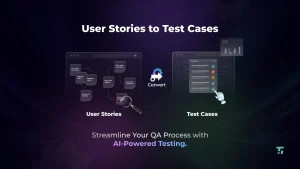
- Generate test cases instantly from JIRA stories, specs, or plain descriptions
- Switch between no-code, low-code, and pro-code modes for full flexibility
- Log bugs automatically with execution data, screenshots, and traceability
- Auto-heal scripts with AgentRx to handle structural shifts and redesigns
Pros
- Users of all skill levels (non-coders, semi-technical, pro coders) can use CoTester
- Incorporates guardrails and pauses at critical checkpoints to validate alignment with your team
- Supports diverse roles – QA engineers, product owners, business analysts — without retraining teams
- No vendor lock-in
Cons
- Some features (like extended mobile support or deeper integrations) are currently in development
You can learn more about CoTester by TestGrid: A Detailed Look at your AI Testing Buddy
2. Katalon Studio

Katalon Studio is a unified automation platform that brings the power of AI in software testing to web, mobile, API, and desktop applications. It accelerates test creation, reduces maintenance with self-healing scripts, and scales seamlessly across CI/CD environments.
Key Features
- Integrate seamlessly with CI/CD and DevOps pipelines
- Generate test cases from natural language with StudioAssist
- Detect and fix broken locators through self-healing automation
- Run tests in the cloud or on-premise with flexible execution options
Pros
- Easy to adopt for new testers while offering depth for advanced teams
- Supports a wide range of AI platforms in one environment
Cons
- Can feel heavy for small projects
- Advanced features may require enterprise licensing
3. Tricentis Tosca

Tricentis Tosca is an enterprise-grade platform that brings AI in software testing to large-scale environments. Its model-based, codeless automation and built-in Agentic AI help teams generate, adapt, and analyze tests with natural language.
Key Features
- Generate autonomous test cases with Agentic AI and natural language prompts
- Adapt test suites dynamically with Vision AI for UI recognition
- Support end-to-end processes across 160+ technologies
- Optimize testing scope using risk-based prioritization
Pros
- Strong fit for enterprises with complex, multi-technology ecosystems
- Reduces manual authoring effort significantly with agentic automation
Cons
- High licensing and setup costs for smaller teams
- Learning curve for model-based testing can be steep
4. Functionize

Functionize brings AI in software testing to modern end-to-end (E2E) scenarios by combining cloud-based test automation with intelligent validation of UIs, APIs, databases, and third-party content. It enables teams to test complex workflows like MFA, file exports, and dynamic embedded plugins directly in the cloud.
Key Features
- Explore and validate APIs through a built-in API Explorer
- Connect directly to databases to query and validate data integrity
- Verify downloaded files, such as PDFs, HTML, or Excel, during test runs
- Automate multi-factor authentication flows with dynamic email/SMS handling
Pros
- Covers modern E2E scenarios that many traditional frameworks miss
- Cloud-native platform reduces infrastructure overhead
Cons
- It may be excessive for teams with only simple UI testing needs
- Requires time to configure advanced workflows for maximum value
5. Sauce Labs

Sauce Labs provides a platform for automated testing and error monitoring across web and mobile applications. With AI at its core, Sauce Labs not only enables cross-device and cross-browser validation but also utilizes predictive analytics to identify flaky tests, highlight trends, and surface high-impact issues before they affect users.
Key Features
- Detect flaky tests and root causes with Sauce AI analytics
- Ask natural language queries for instant test data insights
- Gain a unified, real-time view of application health and performance
- Run automated tests across thousands of real browsers, devices, and OS combinations
Pros
- Exceptional breadth of device/browser coverage for cross-platform testing
- Predictive AI significantly reduces the time spent on debugging and triage
Cons
- Requires integration effort for teams not already using major frameworks
- Advanced analytics features are best suited for enterprise-scale projects
The Future of AI in Software Testing
- From test execution to predictive quality engineering
The future of AI in software testing won’t just be about running tests faster. It will involve predicting where failures are most likely to occur before tests even begin. By analyzing code commits, developer behavior, and historical bug data, AI will help teams anticipate weak spots.
QA professionals will shift from reactive “bug finders” to proactive quality strategists, guiding development priorities with AI-driven risk forecasts.
- Hyper-personalized testing with context awareness
As systems become more user-centric, software testing AI will evolve toward context-aware validation. Instead of one-size-fits-all regression, AI will tailor test cases to user personas, environments, and even cultural differences.
Testers will act as user advocates, interpreting AI insights to ensure software is fair, accessible, and inclusive across diverse real-world contexts.
- AI as a co-pilot, not a replacement
The long-term vision of AI in software testing is a co-pilot model where AI handles data-heavy, repetitive tasks while humans focus on exploratory, ethical, and creative testing.
Much like developers now rely on AI coding assistants, testers will supervise, train, and validate AI tools, ensuring automation aligns with business values and compliance requirements.
Related Read: Software Testing Trends: Shaping 2026 and Beyond
The Bottom Line on AI in Software Testing
For teams under pressure to ship faster and smarter, AI in software testing is the competitive edge that separates leaders from laggards.
Beyond cutting costs and automating routine work, AI is pushing QA into a new era of predictive quality, adaptive test suites, and data-driven decision-making.
The fundamental shift isn’t about replacing testers but elevating them. By working alongside AI, QA professionals become strategists and innovators, shaping test priorities, ensuring fairness, and aligning automation with business goals.
Frequently Asked Questions (FAQs)
Will AI take over QA jobs?
AI is not a substitute for human testers but a complement. The more realistic outcome is that routine QA tasks will shrink, while opportunities grow for professionals who can design strategies, validate complex scenarios, and supervise automation. Careers in testing are likely to evolve, not disappear.
Will ChatGPT replace QA?
No. As helpful as AI tools may be, there are specific attributes they can’t replicate: human judgment and critical thinking, creating innovative test cases, understanding business context, nuances of particular software, and user preferences, and collaborating and mediating between teams.
How to use AI in software testing?
AI in software testing helps predict high-risk code areas, auto-update test scripts when the UI or code changes, generate test cases from natural language or requirements, analyze logs and code to detect root causes of defects, and prioritize the most critical tests based on past failures and impact.
How will AI change software testing?
AI will transform software testing by automating complex scenarios, applying sentiment analysis to user feedback, improving test coverage with data-driven recommendations, creating stronger test cases from historical datasets, and speeding up root-cause detection of bugs.
What is the future of AI in quality assurance?
The future of AI in quality assurance is predictive and context-aware. Instead of only detecting issues, AI will anticipate risks, recommend preventive measures, and simulate real user behavior across personas, geographies, and devices for more accurate testing.
Which tools and frameworks support AI software testing?
Several tools support AI in testing, including CoTester by TestGrid, Katalon Studio, Tricentis Tosca, Functionize, SauceLabs, Applitools, Testim, and Mabl, all of which enhance automated testing within the software development lifecycle.
How to become an AI/QA tester in software testing?
To become an AI/QA tester, professionals should master traditional QA practices, programming, and DevOps workflows while also gaining skills in data analysis, machine learning concepts, NLP frameworks, and AI-enabled QA tools.
What is the role of AI in software engineering and testing?
The role of AI in software engineering and testing is to accelerate quality by streamlining test design, adapting to UI changes, analyzing results at scale, highlighting risk areas, optimizing environments, and uncovering hidden patterns in data.