CoTester 2.0 is LIVE! Your Always-Available AI Teammate for Testing.
- What Are Generative AI Testing Tools?
- How We Evaluated These Generative AI Testing Tools
- Generative AI Testing Tools at a Glance
- Best Generative AI Testing Tools in 2026
- How to Choose the Right Generative AI Testing Tool
- Frequently Asked Questions
- What are the best generative AI software testing tools in 2026?
- How does generative AI generate automated test cases?
- What features should you look for in a generative AI testing platform?
- How do AI-powered testing tools reduce test maintenance?
- Which generative AI testing tool is best for enterprise test automation?
QA teams across industries are moving from experimentation to actually putting generative AI to work. The global genAI in testing market size, which stood at $59.96 million in 2025, is predicted to increase to $439.81 million by 2035.
And Capgemini’s World Quality Report shows that around 30% of organizations are already using GenAI routinely across multiple quality engineering projects.
The concern is not whether GenAI testing is effective. It’s deciding which testing tools can help you get meaningful value beyond basic AI-driven test generation.
In this blog, we have evaluated the leading generative AI testing tools against key criteria and identified the ones worth considering. Keep reading to find out.
Optimize your QA processes with CoTester’s agentic automation. Request a free trial.

TL;DR
- CoTester: AI testing agent that generates, executes, self-heals, and adapts tests using product context and test intent
- Tricentis Tosca: Generative AI-powered testing for creating test cases, exploring test assets, and analyzing results using natural language
- ACCELQ: AI-native codeless testing for generating, automating, and maintaining tests across web, API, mobile, and enterprise apps
- Functionize: AI-powered testing with testGPT for turning natural-language requirements into automated tests and simplifying test creation
- Katalon: AI-assisted testing that creates test cases, executes tests, analyzes failures, and supports project-aware automation through specialized AI agents
- Testim: AI-driven test automation that uses natural-language test generation and smart locators to create stable, low-maintenance tests
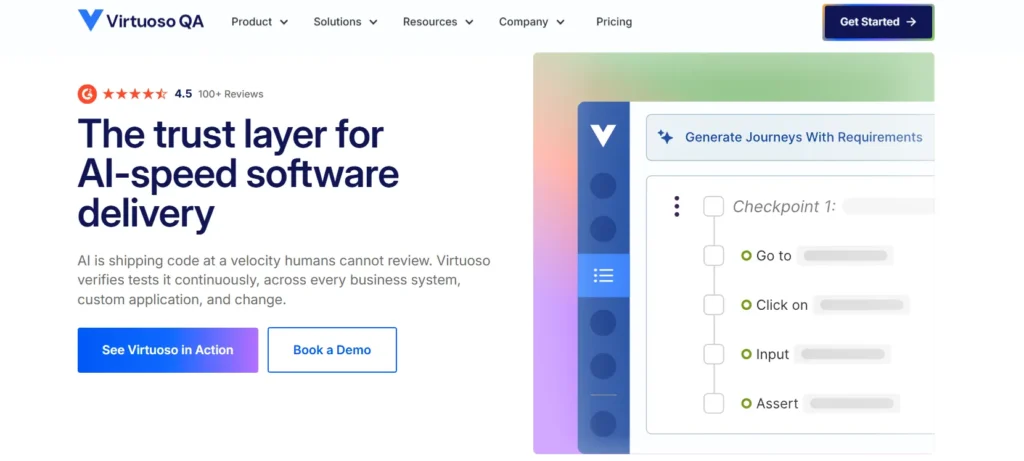
- Virtuoso QA: Generative AI testing that lets teams build and maintain end-to-end tests using natural language without traditional scripting
- UiPath Autopilot: AI testing agent that helps generate, optimize, execute, and maintain test scripts across the testing lifecycle
- Applitools Autonomous: AI-powered no-code platform which designs end-to-end functional and visual tests using plain-language instructions
What Are Generative AI Testing Tools?
Generative AI testing tools mainly use LLMs (large language models), natural language processing (NLP), machine learning (ML), computer vision, and AI agents to understand app behavior and create, execute, and maintain tests.
These tools can automatically build tests from requirements, user stories, wireframes, Figma designs, or test scenarios and also generate test data, assertions, and other testing assets.
GenAI testing tools also help testers with test prioritization, risk-based test selection, identifying redundant or obsolete tests, generating test documentation, improving defect triage, and optimizing test coverage.
Generative AI vs traditional testing tools
Traditional testing tools generally depend on predefined rules, scripts, and test cases for testing. Generative AI testing tools can understand natural-language intent and generate or adapt testing workflows.
The table below shows you the detailed comparison between the two.
| Aspect | Traditional testing tools | Generative AI testing tools |
|---|---|---|
| Test creation | Requires manual test design and scripting | Generates tests from prompts, requirements, or user stories |
| Test maintenance | Scripts often need constant updates after code changes | Can adapt to app changes |
| Test data generation | Relies on manually prepared test data | Can generate synthetic or contextual data |
| Failure analysis | Relies more on logs and manual analysis | Leverages AI to recognize patterns and likely causes |
| Test coverage | Coverage depends mostly on manually defined tests | Identifies gaps and suggests additional scenarios for better coverage |
| User interaction | Tool-specific syntax or code | Natural-language prompts |
| Human effort | Requires more manual intervention | Reduces repetitive test-authoring and maintenance work |
How We Evaluated These Generative AI Testing Tools
We thoroughly researched the top generative AI testing tools available in the market today before we finalized the top options for you. And we didn’t just look at the feature lists or marketing claims.
In fact, we tested their capabilities across several factors like test generation, maintenance, test management, reporting, and integrations.
First, we assessed the depth of AI functionality. This included how well each tool understands requirements, generates tests, analyzes failures, assists in AI root cause analysis, and adapts to ongoing app changes.
Test quality and coverage were another important area. We looked at whether AI-generated tests are covering meaningful user flows, edge cases, and assertions rather than simply producing basic happy-path scenarios.
We also examined the different tests these tools allow testers to perform, such as functional, non-functional, exploratory, and accessibility testing.
Next, we examined self-healing and test maintenance. A tool should be able to identify UI changes and recover tests without masking genuine defects.
Lastly, we considered TestOps capabilities, ease of use, no-code support, CI/CD and framework integrations, cross-platform coverage, deployment flexibility, and documentation for quick onboarding.
This process helped us differentiate generative AI tools for software testing that offer measurable value from those that primarily use AI as a feature label.
Also Read: Top 25+ AI Testing Tools and Platforms
Generative AI Testing Tools at a Glance
Every tool approaches testing differently. The table below comprises the gen AI testing tools list and compares their primary use cases, key AI capabilities, no-code support, deployment options, and pricing to help you quickly identify the right fit.
| Tool | Best For | AI Capabilities | No-Code Support | Deployment | Integrations | Pricing |
|---|---|---|---|---|---|---|
| CoTester | Agentic test automation and robust self-healing | Codeless test creation, AI-assisted debugging, adaptive learning | Yes | Cloud, on-prem, private cloud | Jenkins, GitHub Actions, Azure DevOps, Slack, Teams | Starts at $199 per seat per month; free trial available |
| Tricentis Tosca | Model-based testing of complex enterprise apps | Natural-language test generation, AI-assisted troubleshooting | Yes | Cloud, on-prem, hybrid | Jenkins, Selenium, Cucumber, Jira | Custom |
| ACCELQ | Business process automation across web, mobile, desktop | AI test data generation, workflow discovery | Yes | Cloud, on-prem, hybrid | Jenkins, TeamCity, Bamboo, Azure Pipeline, CircleCI | Custom |
| Functionize | Test generation from real user behavior | AI failure diagnosis, self-healing automation | Yes | Private cloud, on-prem | Jira, XRay, TestRail | Starts at $20 per month |
| Katalon | Unified web, mobile, API, and desktop test automation | Test recording, AI-assisted failure analysis | Yes | Cloud, on-prem, private SaaS | Jira, Azure DevOps, GitHub Actions, CircleCI, GitLab | Starts at $50 per seat per month |
| Testim | Strong automated testing for dynamic web and Salesforce apps | Smart element detection, GenAI code generation | Yes | Private cloud, public cloud | GitHub, Bitbucket, Sealights, Bamboo, Azure Pipelines | Custom |
| Virtuoso QA | AI-powered test generation and legacy test migration | Context-aware step generation, synthetic test data management | Yes | Cloud | GitHub, Microsoft Azure, Jenkins, CircleCI, XRay | Custom |
| UiPath Autopilot | AI assistance across test design, automation, and test management | Requirement analysis, Intelligent test optimization | Yes | Private cloud, on-prem | Jenkins, Azure DevOps, AWS | Starts at $25 per month |
| Applitools Autonomous | Autonomous functional and visual testing | Visual AI, automated test maintenance | Yes | Dedicated cloud, on-prem | GitHub, Bitbucket, GitLab, Azure DevOps | Custom |
Best Generative AI Testing Tools in 2026
1. CoTester
Best for: QA teams looking for agentic automation for test generation and execution, and to automatically self-heal tests when major UI changes occur
Overview
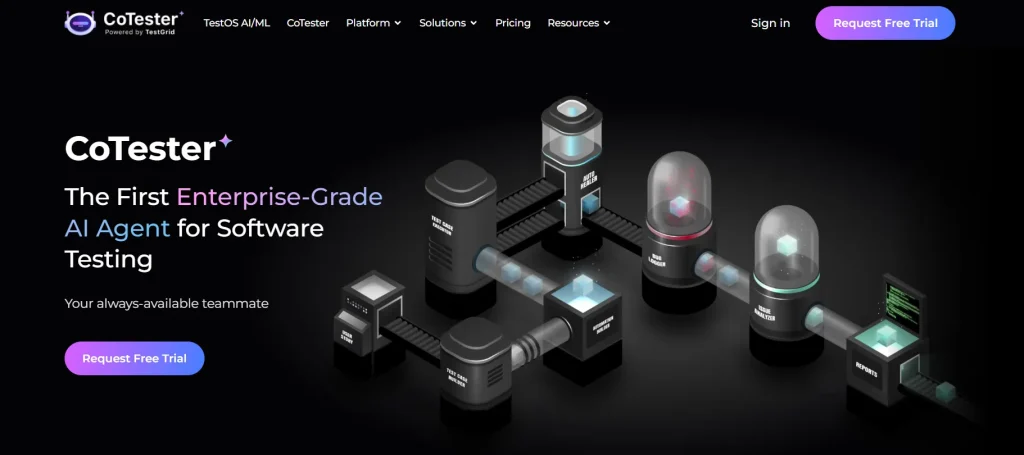
CoTester by TestGrid is an enterprise-grade AI software testing agent that integrates seamlessly into your development workflows and enables you to generate, execute, and maintain automated tests efficiently.
This agent learns your app’s context, adapts to your QA processes, and handles testing just like an experienced human software tester. You can just upload docs, paste a URL, or describe what you want to test, and the agent figures out how to design tests and execute them.
Your testers stay in complete control of the process. You can switch between scriptless, record and play, or code mode, edit your tests, and schedule execution to align with your release timelines.
Features
- Turn your specs into structured tests by uploading or linking your Jira stories
- Detect, flag, and log bugs during test execution; your team gets visibility into issues the moment they happen
- Leverage the self-healing engine, AgentRx, to update locators automatically when you change UI elements or redesign layouts
- Interpret your app screen’s visual, text, and layout with the help of a multi-modal Vision Language Model (VLM)
- Get detailed logs, screenshots, and step-by-step results after every test execution
- Store all your uploaded files and generated assets in a searchable repository
Limitations
- Teams new to using AI agents for software testing might require some training effort; however, documentation and support are always available
Pricing
- CoTester Starter Package: Starts at $199 per seat/month (minimum 4 seats; includes 4 devices/browsers and 5,000 tokens)
- CoTester Growth Package: Custom pricing (includes all Starter features + marketplace integrations)
- Enterprise Test Infra (On-Prem / Hosted): Custom pricing (dedicated test lab for segregated enterprise teams)
2. Tricentis Tosca
Best for: Enterprise QA teams who need GenAI assistance to understand large test portfolios and generate test cases from natural language prompts
Overview
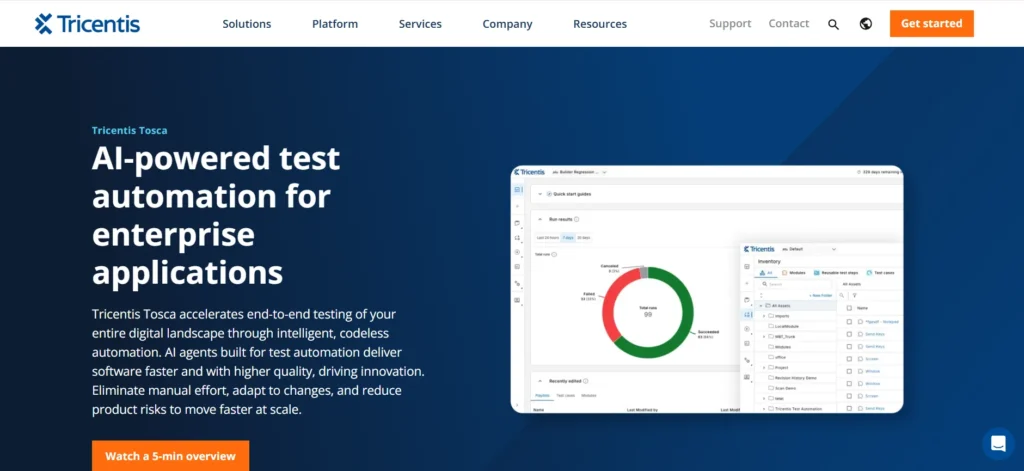
Tricentis Tosca is an AI-powered automation testing platform that allows you to create, adapt, and analyze tests without the need for scripting or heavy setup.
Tosca Copilot, its GenAI-powered assistant, helps you find, study, and optimize test assets through a chat interface. The platform supports Agile, DevOps, and waterfall workflows and keeps your QA and development in sync for your mobile, web, cloud, and custom-built apps.
Features
- Build end-to-end tests automatically for business-critical flows across technologies with custom agents
- Leverage AI agents to analyze existing tests and intelligently merge new tests with existing modules
- Build your test cases using Tosca’s AI-driven, model-based approach with modern, cloud-native test automation
- Share a live dashboard and results with your stakeholders to get complete visibility into software quality
Limitations
- Some users mention that the licensing costs are expensive compared to other tools
- The platform isn’t compatible with Mac or Linux devices
- Cross-environment testing may be difficult
Pricing
- Request a quote for custom pricing
3. ACCELQ
Best for: Teams looking for AI automation of complex end-to-end business processes spanning web, mobile, API, desktop, and backend systems
Overview
ACCELQ is a codeless testing tool which lets you automate testing for API, microservices, SSH, backend, and ESB. It also comes with pre-built business process-modeled test assets for automating your cloud and enterprise apps, including Salesforce, Oracle, SAP, and ServiceNow. The platform supports test scenario generation using visual application models to speed up test creation. It allows integration with tools like Jira, Jenkins, Bamboo, and TFS.
Features
- Automatically identify and map out end-to-end test scenarios within your app’s context
- Express complex business rules in plain English and generate comprehensive automation that integrates front-end, back-end, APIs, and middleware
- Adapt your tests dynamically with app changes using core semantic and functional attributes of UI elements
- Get rich insights with AI that analyzes tests, suggests optimizations, and highlights improvements for reliability
Limitations
- Limited community-driven tutorials, guides, and real-world implementation examples
- Some users say that advanced customization and reporting capabilities should have greater flexibility
- Learning curve can be steep if you have no prior exposure to automation frameworks
Pricing
- Customized pricing available on request
Also Read: Enterprise Application Testing: Types, Methodology, and Best Practices
4. Functionize
Best for: Teams wanting Gen AI testing tools to generate test scenarios from real user journeys, diagnose failures, and autonomously maintain tests
Overview
Functionize offers you a collection of Gen AI tools for testing with which you can test even the most complex apps and scenarios seamlessly. It uses machine learning to make automation mimic human-like behavior.
You can evaluate apps, databases, APIs, .pdf files, Excel sheets, and other digital assets at scale. Plus, with Functionize’s testGPT, you can perform autonomous testing, create tests, diagnose failures in real time, and get intelligent recommendations for potential fixes.
Features
- Leverage large-scale AI models and cloud-scale to improve autonomous testing
- Use testAGENTS to perform important testing actions based on your app “awareness”
- Find issues and resolve them easily with Functionize’s Adaptive Event Analysis
- Increase productivity by 10x, accelerate time to market by 6x, and reduce costs by 70%
Limitations
- Test case execution might occasionally be slow
- Some users report a steeper learning curve for AI and NLP test creation
- Some dynamic elements in the UI can be difficult to automate
Pricing
- Free: $0
- Pro: $20 per month
- Max: $100 per month
Learn More: How to Test Generative AI Applications for Modern QA Teams
5. Katalon
Best for: Testing teams searching for AI assistance to generate, explain, and refine automation scripts
Overview
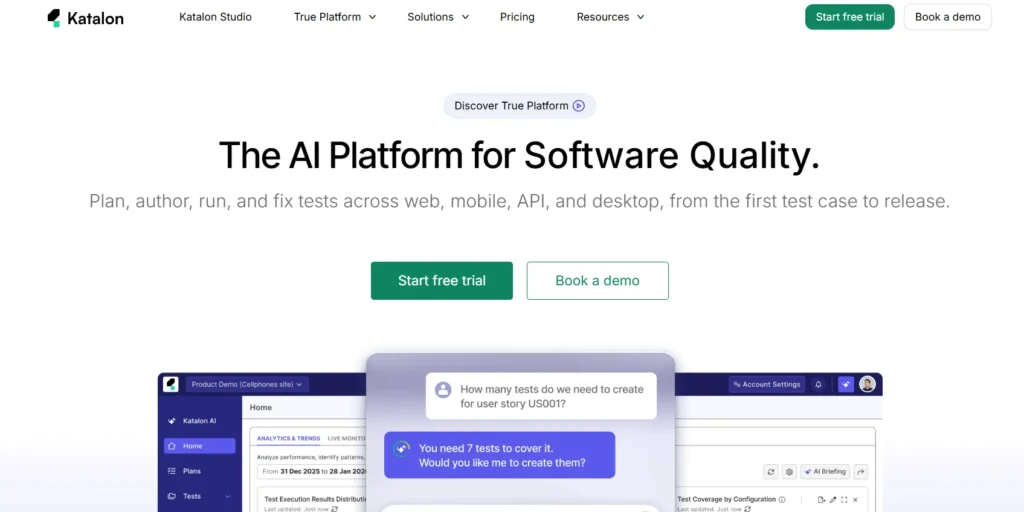
Katalon is an AI-powered testing platform that helps you build tests efficiently through no-code, low-code, or full-code interfaces.
You can execute your tests in parallel across different devices and browsers and set up dashboards for real-time visibility into testing progress and coverage gaps. The platform enables your testers to cut test time, expand coverage, and match quality assurance processes with your release cycles.
Features
- Generate, explain, and refine test automation scripts easily with natural language prompts, with native support for BDD (behavior-driven development) testing
- Reduce the flakiness of your tests with Katalon’s built-in AI which auto-generates resilient XPaths and adapts to UI changes
- Create test cases, objects, and test data automatically by connecting AI agents to built-in and custom MCP servers
- Import your tests from Swagger, Postman, and WSDL and save the effort of repeatedly rebuilding tests
Limitations
- A few users mention adding video attachments to better understand why a test case failed
- Most of the advanced features are under the premium pricing plans
- The self-healing feature may sometimes fail to handle elements accurately
Pricing
- True Platform: $50 per seat per month
- Katalon Studio Enterprise: $150 per seat per month
- True Automation: $167 per seat per month
6. Testim
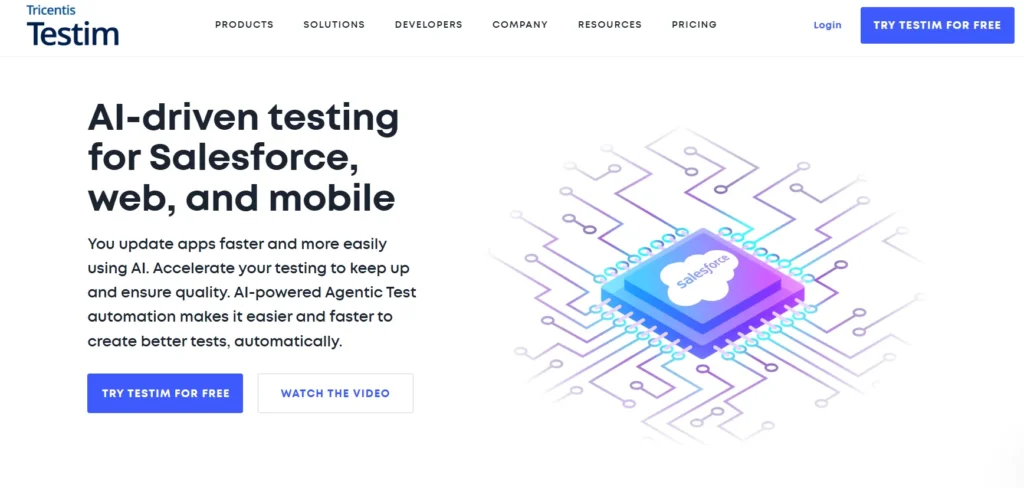
Best for: Agile QA teams testing dynamic web, mobile, and Salesforce apps and need GenAI to create custom test code and smart locators to stabilize tests
Overview
Testim is an AI-powered testing platform that enables you to design tests faster using natural language and execute them across multiple virtual devices hosted in the cloud.
It also offers AI-based recordings so you can capture even the most complex scenarios smoothly. Plus, you get nearly unlimited customization features, with the option to insert JavaScript wherever needed to perform server-side or front-end actions.
Features
- Enable all your team members to participate in the testing process via low-code, NLP-based test authoring
- Automatically lock in elements without human intervention with the help of Proprietary Smart Locators
- Generate tests autonomously with natural language test authoring; just describe what you need to test and custom agent workers will build tests for you
- Benefit from AI throughout test creation, execution, maintenance, and test management
Limitations
- Advanced test customization may sometimes need coding knowledge
- The UI may lag when test suites grow
- Initial setup and organizing large test suites can take some time
Pricing
- Customized pricing available on request
Also Read: Agentic AI vs Generative AI
7. Virtuoso QA
Best for: Teams who want to generate E2E tests, synthetic test data, and custom JavaScript extensions using AI
Overview
Virtuoso QA is an AI-native testing platform built to automate testing with the help of natural language. The platform’s test generation engine, GENerator, helps you create tests 87% faster.
With the help of plain language prompts, Virtuoso’s bots can identify page elements even when their selectors change. Plus, you get detailed insights into the DOM, page console logs, and network performance to understand where tests have failed and how to fix them.
Features
- Author your tests in natural language, see them execute in real time, and get instant feedback, including screenshots, logs, and evidence
- Adapt your tests with ML-powered self-healing and accept self-heals with a click of a button
- Detect and correct typos in real time, simplify syntax for complex commands, and get step suggestions based on your journey with StepIQ
- Generate names, dates, addresses, emails, phone numbers, and any other type of data you need for precise testing
Limitations
- May lack flexibility in handling highly dynamic web elements
- Navigation can be confusing, particularly when managing multiple tasks
- Some users mention the automation features are limited
Learn More: Machine Learning in Test Automation
Pricing
- Request a quote to get a customized pricing plan
8. UiPath Autopilot
Best for: Enterprise testing teams looking for AI to build manual and automated tests and analyze test results across the testing lifecycle
Overview
UiPath Autopilot is one of the popular gen AI tools for software testing that helps you build resilient automation and deliver high-quality software faster. It allows you to leverage AI to generate, optimize, and manage test scripts with speed and efficiency.
And you can streamline test design, execution, and management with reduced manual effort and increased test coverage.
Features
- Evaluate your requirements for quality aspects and automatically generate tests from the requirements
- Proactively identify tests that need updates and detect obsolete tests easily
- Seamlessly create coded UI and API automation, create synthetic test data, run fuzzy verifications, and fix validation errors with agentic test automation
- Generate comprehensive test insights reports and automatically create recurrent test reports
Limitations
- May involve a learning curve when moving from traditional RPA to agent-based automation
- Debugging can at times be challenging because of the dynamic nature of AI responses
- A few users feel the monitoring and reporting can be more detailed
Pricing
- Basic: Starting at $25 per month
- Standard: Custom
- Enterprise: Custom
9. Applitools Autonomous
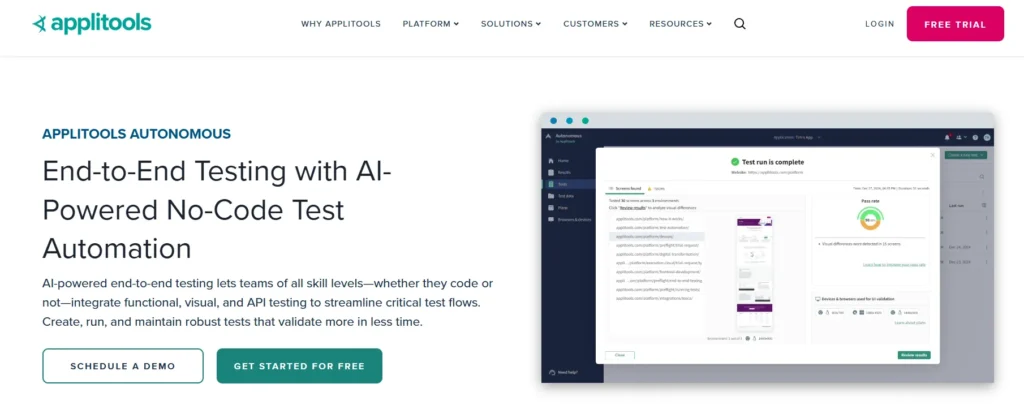
Best for: Teams who need Visual AI to validate functional and visual behavior of apps and websites across dynamic web pages, browsers, and devices
Overview
Applitools Autonomous is a no-code test automation platform that lets you create tests in natural language, record and debug in real time, test dynamic content, and achieve more coverage with less work.
You can perform functional, visual, and API testing for critical flows and integrate with CI/CD tools to run tests during each pull request. The platform also helps you automatically group changes or bugs that are discovered and update them with a single action.
Features
- Enter a URL and Autonomous will crawl the sitemap and automatically create a test suite
- Use plain English to describe your test intent, and an auto-correcting LLM simplifies complex flows into steps
- Easily edit or debug your tests by recording user flows in an interactive browser
- Schedule tests to run on a set schedule and catch errors or changes that come from third-party apps and user-generated content
Limitations
- The dashboards may not provide a granular view of usage metrics
- Users report the pricing is a bit on the higher side compared to competitors
- The API key setup and understanding how to structure multi-team account isolation may take some trial and error to get right
Pricing
- Starter: Custom
- Public Cloud: Custom
- Dedicated Cloud: Custom
How to Choose the Right Generative AI Testing Tool
When you’re assessing the different generative AI testing tools, look for the capabilities that matter for your team and test requirements.
One of the main factors that most teams look for is how easily a tool helps them build tests. For that, consider features like autonomous test generation, requirement-to-test generation, and edge case generation.
Tools that come with context-aware test generation and continuous learning are important for producing tests that reflect your app and improve over time. Test maintenance is another important area to evaluate; therefore, prioritize tools that can detect changes, diagnose failures, and update automation with minimal human intervention.
To make sure the generative AI testing tools can seamlessly fit with your testing processes, check support for your existing testing frameworks, browsers, mobile devices, APIs, and CI/CD pipelines.
Lastly, whether you’re a startup or an enterprise team, consider deployment flexibility, security controls, ease of adoption, and total cost of ownership. A strong tool should reduce your repetitive QA work and improve overall coverage.
CoTester brings all these capabilities together in one unified platform. Request a free trial today to experience AI-powered testing firsthand.
Frequently Asked Questions
What are the best generative AI software testing tools in 2026?
CoTester, Tricentis Tosca, Functionize, and Applitools Autonomous stand out for their breadth of GenAI capabilities. These gen AI automation testing tools focus strongly on natural language test generation, autonomous execution, AI-driven failure diagnosis, test result analysis, root-cause analysis, and self-healing test automation.
How does generative AI generate automated test cases?
Generative AI analyzes your test requirements, user stories, prompts, app behavior, or existing test assets to generate structured automated test cases. Gen AI tools for automation testing can identify test scenarios, create steps, AI-powered assertions, and test data, then convert them into executable tests. Some GenAI tools can also refine tests based on execution results.
What features should you look for in a generative AI testing platform?
The features you should ideally be looking for in a generative AI testing tools are codeless test authoring, natural-language interaction, synthetic test-data generation, self-healing, failure analysis, visual validation, test maintenance, CI/CD integrations, cross-platform support, and robust security and governance controls.
How do AI-powered testing tools reduce test maintenance?
AI-powered testing tools use self-healing mechanisms to reduce your maintenance effort. They can detect app changes, spot broken elements, update test steps or locators, and analyze failures automatically so you don’t need to manually update scripts after every code change.
Which generative AI testing tool is best for enterprise test automation?
Although tools like Tricentis Tosca, ACCELQ, Functionize, and UiPath Autopilot have strong enterprise testing capabilities, CoTester may be a better fit for teams who are looking for scalable AI-driven automation, cross-platform testing, self-healing, automated test scheduling, enterprise deployment options, AI guardrails, and human-in-the-loop controls.