CoTester 2.0 is LIVE! Your Always-Available AI Teammate for Testing.
Your users aren’t the only ones who are interacting with the APIs today. APIs are now also accessed by AI-powered tools, copilots, chatbots, and autonomous agents to retrieve data, perform actions, and communicate with other apps.
This is creating a surge in the API requests, which in turn is increasing pressure on QA teams to keep them reliable, secure, and resilient. AI is helping teams meet these demands and test APIs more effectively across complex environments.
In this blog, we’ll learn why using AI is critical for modern API testing, the challenges it helps you solve, and how you, too, can leverage it to improve the quality of your APIs.
Simplify AI-powered API testing with CoTester. Request a free trial.

TL;DR
- Traditional API test automation can lead to high maintenance overhead, difficulty managing schema drift, and challenges validating dynamic response data
- AI in API testing helps you improve the process by automating complex testing workflows, enhancing coverage, and adapting to evolving API ecosystems
- API testing using AI can enhance areas including API test generation, root cause analysis, anomaly detection, and risk prediction
- The different API tests which you can optimize with AI are functional, contract, security, performance, regression, and E2E testing
- The best AI-powered API automation testing tools in 2026 are CoTester, Postman, Swagger, REST Assured, and Apigee
What is AI in API Testing?
AI in API testing basically refers to how different artificial intelligence technologies like Machine Learning (ML), generative AI, large language models (LLMs), and AI agents are applied to enhance the testing, validation, and monitoring of APIs.
These technologies help API testing systems interpret information, recognize patterns, and make data-driven decisions.
AI, ML, and LLM in API testing enable you to:
- Improve your test coverage by including scenarios and API interaction paths which are overlooked in manual test designs
- Perform risk-aware testing by highlighting APIs that have a higher chance of getting affected by recent changes
- Get earlier visibility into quality issues via correlating signals across test executions, environments, and dependent services
- Maintain large-scale test suites, environments, and data efficiently
Challenges of Traditional API Testing
Traditional API automation testing methods were developed for environments that had slower release cycles. But modern apps have constantly changing APIs, microservices, and third-party integrations. And this can lead to the problems below.
- High test maintenance overhead: PI updates, endpoint modifications, and changing business rules may need frequent test script revisions
- Managing schema drift: Changes in request structures, response payloads, or API contracts can break your existing tests and create gaps in test coverage
- Verifying dynamic response data: APIs generally return variable values like timestamps, session IDs, tokens, and personalized content, which can make assertions more difficult to maintain
- Testing rate limiting policies: You may have to build complex test scenarios that simulate high request volumes, traffic spikes, and quota restrictions to assess rate limiting
AI in API automation testing can help you tackle these issues by incorporating adaptability and intelligence into your testing processes.
AI models and API testing agents learn API behavior patterns, uncover hidden test scenarios, link signals across multiple systems, and give you actionable insights with which you can make better-quality decisions.
Also Read: AI in Test Automation: A Detailed Overview
How AI Learns and Adapts to API Behavior
For making accurate predictions, your AI model first needs to understand exactly how your APIs communicate, exchange data, and support business workflows.
The model doesn’t rely on predefined rules. It rather learns patterns from API interactions, structures, and execution histories. This is a typical workflow of how AI evaluates your API when making testing decisions:
- Analyze communication patterns across REST APIs, SOAP APIs, and GraphQL services
- Learn how different HTTP methods such as GET, POST, PUT, PATCH, and DELETE are used to retrieve, create, update, and remove data
- Interpret JSON and XML structures to understand data relationships and dependencies
- Map connections between endpoints and downstream services
- Identify behavioral patterns from your historical test executions and usage trends
- Continuously learn and adapt as the APIs update using the runtime context and execution history
Also Read: AI Model Testing: Methods, Challenges, and How to Test AI Models
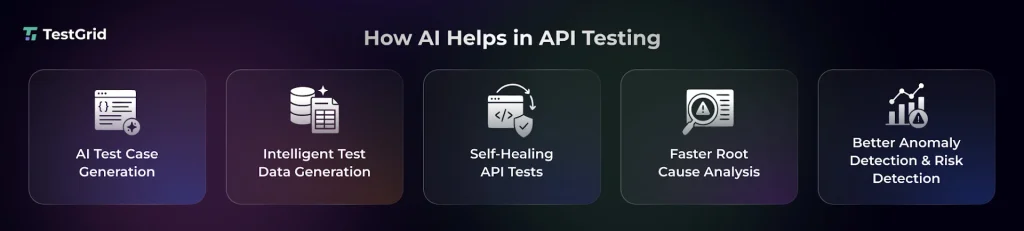
Where AI Help in API Testing?
1. AI-Powered Test Case Generation
ML, LLMs, and generative AI in API testing can help you automatically create API test scenarios, including edge cases and invalid input combinations for negative testing and boundary testing, from sources like requirements, user stories, API documentation, OpenAPI specifications, and historical test assets.
Also Read: AI Test Case Generation with CoTester
2. Intelligent Test Data Generation
AI models can analyze your API schemas, data relationships, and business rules, and then generate valid inputs, edge-case values, and synthetic data at scale. This way, your team can create realistic and diverse datasets with lower manual data preparation efforts.
3. Self-Healing API Tests
Self-healing tests can automatically adapt to your API changes without much need for manual updates. When your API endpoints, parameters, response structures, or validation rules change, AI models can assess these changes, identify the affected tests, and recommend updates so you can maintain your test stability.
4. Root Cause Analysis
Your team can leverage AI to examine the test results, logs, response payloads, infrastructure metrics, and service dependencies and then pinpoint the likely causes like code defects, configuration issues, environment instability, or downstream service failures. This allows you to troubleshoot faster and with precision.
5. Anomaly Detection and Risk Prediction
AI helps you spot when your API behavior deviates from established patterns, such as unexpected response times, error spikes, or abnormal payload structures. And for doing this, AI models mainly use historical execution data and runtime signals.
With AI, you can notice the high-risk APIs, support test impact analysis, improve test prioritization, and address issues before they affect production systems.
Learn More: Machine Learning in Test Automation
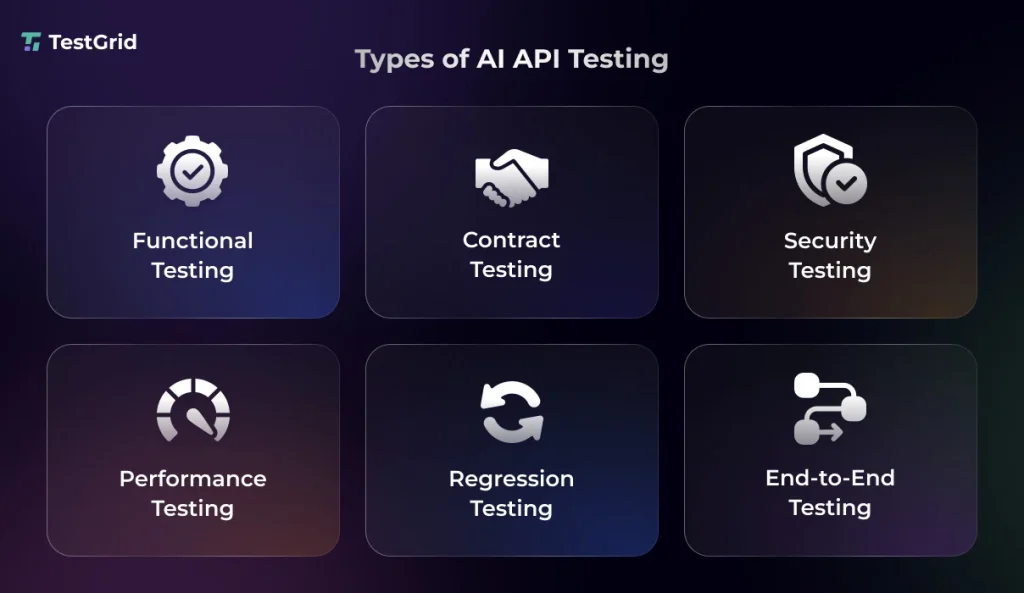
Types of API Tests Optimized by AI
1. Functional Testing
API functional testing helps you check how your APIs behave when they receive valid and invalid requests, including response and schema validation.
You mainly assess endpoints, request handling, response accuracy, and HTTP status codes. Here you can leverage AI to generate test cases from API specs and identify the missing scenarios.
2. Contract Testing
Contract testing is done to verify that your APIs adhere to the agreed structure, data types, and communication rules as defined in the API contract. AI helps you continuously compare API behavior against OpenAPI definitions, detect schema drift, highlight undocumented changes, and spot contract violations.
3. Security Testing
It’s critical to check if your APIs properly protect sensitive data and restrict access to authorized users. API security testing lets you examine security controls such as authentication, authorization, token validation, and access permissions.
With AI, you can improve testing of OAuth flows, JWT tokens, and privilege escalation scenarios to find security gaps that might go unnoticed in manual reviews.
4. Performance Testing
API performance testing allows you to check how your APIs respond under different levels of request traffic, workload, and concurrency. Your goal here is to measure the response times, throughput, scalability, and system stability, and detect performance lags that could affect user experience.
You can use AI-powered testing tools for APIs to generate realistic traffic patterns, predict high-risk workloads, and analyze large volumes of performance data to evaluate latency spikes, error patterns, or resource consumption.
5. Regression Testing
API regression testing is important after new code changes, bug fixes, or feature updates because it lets you verify whether these modifications affected any existing API functionality.
AI enables you to inspect which APIs are most likely to be affected by recent changes, prioritize high-risk test cases, and reduce unnecessary test executions through smart test selection.
6. End-to-end Testing
End-to-end AI API testing helps you assess the sequence of API interactions, from the initial request to the outcome. You test complete business workflows which cover multiple APIs, services, databases, and third-party integrations, and verify that data flows correctly between all these components.
Here, AI can:
- Automatically create multi-step test journeys from requirements
- Identify dependencies between APIs, databases, and third-party services
- Prioritize critical user journeys based on usage patterns and business impact
Also Read: End-to-End Testing: Importance, Process, Best Practices and Frameworks
Top AI-Powered API Testing Tools in 2026
1. CoTester – AI Testing agent
CoTester is an AI-powered testing agent that helps your team create, manage, execute, and refine API tests efficiently. Share your testing requirements, specifications, and user stories, and CoTester can turn them into structured, executable test cases.
It also supports API, UI, and non-UI testing, provides detailed execution logs and screenshots for faster debugging, and keeps your team in control through approval checkpoints throughout the testing lifecycle.
For UI testing, the Cotester AgentRx feature can automatically adapt tests when locators, layouts, or interface elements change.
2. Postman
Postman is an AI-driven API testing platform which lets you design, build, test, and collaborate on APIs. You can seamlessly test your API’s behavior, performance, and reliability with the help of a JavaScript-based library of code snippets. The platform also helps you store values in variables within dedicated testing environments and use them in any request’s headers, body, or URL.
3. Swagger UI
Swagger UI is an automated API testing tool which enables you to describe the structure of your APIs and then automatically build interactive API documentation. With the platform, you can design, govern, and test across the full AI-enabled API lifecycle and ensure quality at every step. The Swagger Editor helps you create your APIs directly in your browser with syntax auto-completion and real-time feedback.
4. REST Assured
REST Assured is basically a Java library with which you can test and validate REST APIs. It also offers a DSL that makes it easy for you to create readable and maintainable test cases. The platform supports HTTP requests like POST, GET, PUT, DELETE, PATCH, and HEAD, and lets you test response status code, body, message, and headers using the Rest Assured library.
5. Apigee
Apigee is a cloud native API management tool that is developed by Google. The platform helps you design, secure, deploy, monitor, and scale your API tests. You can generate OpenAPI specifications in natural language in Cloud Code and Gemini chat, and also automate tedious tasks like API documentation and SDK creation.
Final Thoughts
APIs connect your app with databases, payment systems, and third-party platforms. So, when APIs fail, it can result in users being unable to complete transactions, access critical services, or retrieve important information.
API failures can also expose your app to risks like service outages, security vulnerabilities, data corruption, and degraded customer experiences.
This is why implementing API performance evaluations early in the development process is necessary, so you can fix the issues before your users encounter these problems.
CoTester helps teams incorporate API testing into CI/CD workflows through integrations with Jenkins, GitHub Actions, and Azure DevOps, enabling tests to run automatically as part of builds and releases and providing faster feedback when issues arise.
You can schedule test executions, review results and detailed execution logs, identify and record defects with context, and maintain visibility, control, and traceability throughout your testing workflows.
These capabilities help teams detect unstable API behavior earlier and reduce the risk of defects reaching production. Validate API payloads, expected responses, business logic, and end-to-end integrations with CoTester. Request a free trial.
Frequently Asked Questions (FAQs)
How does AI improve API testing?
AI can improve API testing by creating tests from API documentation, traffic logs, and usage patterns. It also helps you uncover edge cases, detect anomalies in API responses, adapt to schema changes through self-healing mechanisms, and prioritize high-risk tests.
Can AI generate API test cases?
Yes. AI-powered API testing agents can automatically generate API test cases by analyzing your business requirements, user stories, workflows, historical defects, and expected system behavior. They can also build positive, negative, boundary, and data-driven tests, as well as continuously refine your test suites based on execution results and app changes.
Does AI replace API testers?
No. Instead, AI in API testing assists your testers by automating repetitive activities such as test design, data preparation, maintenance, and result analysis. Tester expertise remains crucial for designing test strategies, evaluating business requirements, and examining complex failures.
What are the risks of AI in API testing?
Some of the risks associated with the use of AI in API testing include high false positives or false negatives, overreliance on AI-generated recommendations, insufficient coverage of complex business requirements, poor-quality training data, and challenges in interpreting AI-driven decisions. You can address these risks by combining AI testing with human-in-the-loop reviews, governance controls, and continuous model monitoring.